January 5, 2015
Test Drive Three New MINI Models | Mini
MINI ONE
MINI Cooper
MINI Cooper S
A Buyer's Guide to the Richly Charactered MINI
Test Drive the New MINI 3 Models
MINI's evolution and model expansion continue unabated. Last autumn, the hatchback model entered its third generation, making its domestic debut at the Tokyo Motor Show shortly thereafter. This year has already seen the addition of the basic "ONE" and the launch of the "MINI 5-Door" with rear doors. Furthermore, the "Countryman" and "Paceman" have received minor updates along with the introduction of their first diesel models. Amidst this vibrant activity from MINI, we take an immediate test drive of the three core 3-door models to reconfirm their distinct charms.
Text by OGAWA Fumio
Photographs by ARAKAWA Masayuki
Clearer Character Differentiation Across Models
MINI is on a roll with full model changes and new engine additions. Among MINI's seven models, designed to suit diverse lifestyles, the hatchback is arguably the most basic. Let's test drive them to examine their characters.
In 2014, the MINI hatchback, arguably its most basic model, underwent a full model change. This applied to the "MINI ONE," "MINI Cooper," and "MINI Cooper S."
The most significant feature is the revised engine lineup, which, while prioritizing fuel efficiency, has also led to clearer character differentiation for each model. The MINI ONE now features a 1.2-liter 3-cylinder engine (102 ps), replacing the previous 1.6-liter 4-cylinder (98 ps).
The MINI Cooper also sees a change from its previous 1.6-liter 4-cylinder (122 ps) to a 1.5-liter 3-cylinder (136 ps) for improved fuel efficiency. Only the MINI Cooper S has seen its displacement increased from 1.6 liters (175 ps) to 2.0 liters (192 ps), resulting in a substantial performance upgrade.
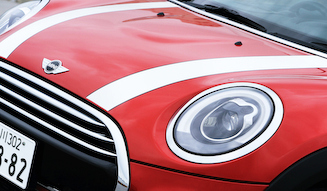
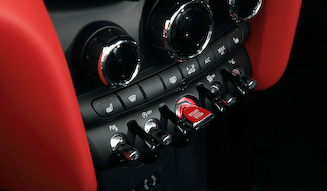
Another notable change is the body size. While the overall length remains compact at 3,835 mm (3,860 mm for the MINI Cooper S), the width has increased to 1,725 mm, making it a "3-number" size vehicle. The wheelbase has also been extended by 30 mm, reportedly contributing to increased interior space.
Indeed, the three models clearly possess distinct characters. Driving them back-to-back reveals precisely what the driver seeks. With a price difference of ¥400,000 between the MINI ONE and MINI Cooper, and another ¥520,000 between the latter and the MINI Cooper S, careful comparison is crucial for anyone interested in the MINI series.
MINI ONE
MINI Cooper
MINI Cooper S
A Buyer's Guide to the Richly Charactered MINI
Test Drive the New MINI 3 Models (2)
Sporty Yet Restrained Overall: The "ONE"
The MINI ONE is the most basic grade, introduced in Japan slightly later than the Cooper and Cooper S. A common feature across the series is the hexagonal grille, which the brand states is inspired by the original Mini. From another perspective, aside from the front mask and the notch on the rear hatch, the styling concept shows no dramatic changes.
When driven, the 1,198cc 3-cylinder engine, with its maximum torque of 180 Nm available from 1,800 rpm, is easy to handle in city driving. The test car was equipped with a 6-speed automatic transmission, so for punchier acceleration, it's best to downshift manually. Around 2,500 rpm, the torque effectively kicks in, providing reasonably strong performance.
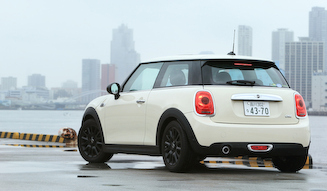
MINI ONE
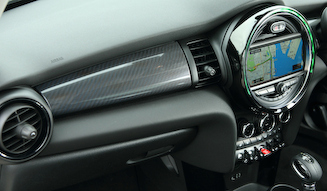
MINI ONE
The suspension is surprisingly firm. The test car featured the optional Dynamic Damper Control, allowing selection between "Normal" and "Sport" damper settings. True to its "go-kart feeling" slogan, even in "Normal" mode, body roll is minimal, strongly suggesting a focus on sporty character.
Despite this, the overall impression is one of restraint. With fuel economy approaching 20 km/liter (JC08 mode) even with the automatic transmission, the MINI ONE's excellent fuel efficiency is a major selling point. If you desire a sportier engine, you might be better off choosing the Cooper or Cooper S. This model seems suited for those who love the MINI aesthetic.
The availability of numerous options is appealing, but even adding only the essentials—such as the alloy wheels (¥220,000), the ETC in-mirror system (¥69,000), the Comfort Access for keyless entry (¥45,000), the Driving Assistant package including active cruise control and collision mitigation (¥114,000), and the navigation package (¥178,000)—can significantly increase the price.
MINI ONE
MINI Cooper
MINI Cooper S
A Buyer's Guide to the Richly Charactered MINI
Test Drive the New MINI 3 Models (3)
The "Cooper": Skillfully Balancing All Requirements
The MINI Cooper's character differs significantly from the MINI ONE. It also features a 3-cylinder engine with a turbocharger, but with an increased displacement of 1,498cc. Its maximum torque of 220 Nm, higher than the MINI ONE's, is available at a lower 1,250 rpm.
This difference is palpable beyond mere numbers, translating into smoother acceleration. There's no sense of sluggishness; the car picks up speed with satisfying ease. Driving the 6-speed automatic transmission model, even in "D" range, the acceleration was robust, allowing full enjoyment of MINI's sportiness both in city traffic and on the highway.
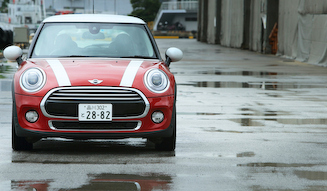
MINI Cooper
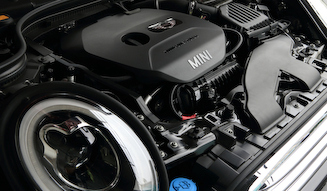
MINI Cooper
The MINI Cooper offers respectable efficiency, achieving over 19 km/liter (JC08 mode), and its actual driving performance is equally sporty. The all-around capability of the MINI Cooper is its key selling point. It strikes a perfect balance between driving dynamics, ride comfort, and fuel economy, adeptly meeting the demands placed on modern vehicles.
This makes the process of choosing from the wide array of interior and exterior customization kits an enjoyable one. As mentioned with the MINI ONE, many essential safety and comfort features are optional. Therefore, the starting price of ¥2.8 million (AT) should be considered a base figure. However, the MINI Cooper, with its high degree of personalization, is a product designed for enjoyment, and this sales approach is likely to be well-received by the market.
MINI ONE
MINI Cooper
MINI Cooper S
A Buyer's Guide to the Richly Charactered MINI
Test Drive the New MINI 3 Models (4)
The "Cooper S": Embodying the Go-Kart Feeling
While the other two models lean towards fuel efficiency, the MINI Cooper S presents a more distinct and focused character. Its newly developed 1,998cc 4-cylinder turbo engine, with increased displacement and approximately 20 ps more power than its predecessor, delivers performance that exceeds expectations based on its figures of 192 ps / 5,000 rpm and 280 Nm / 1,250 rpm. The thrill of driving is exhilarating.
Despite the turbocharger, the engine pulls strongly all the way to the redline, much like a naturally aspirated unit. The suspension and steering support this, providing a direct sense of control. This model truly embodies the "go-kart feeling."
While the MINI ONE prioritizes efficiency and the MINI Cooper offers balanced sportiness, the MINI Cooper S is crafted for those who actively seek driving pleasure.
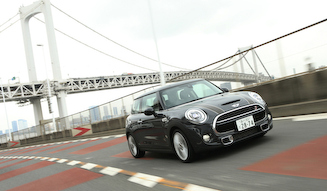
MINI Cooper S
Minimal body roll, relentless power delivery thanks to a broad torque band, finely tuned steering, and a sonorous exhaust note all contribute to the exhilarating driving experience.
While the automatic transmission is certainly capable, after test driving the 6-speed manual model (¥3.18 million), it became clear that choosing your own gears and fully exploiting the engine's characteristics would be a missed opportunity.
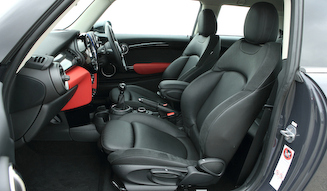
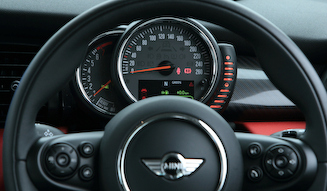
Even in its third generation, unlike the Volkswagen Golf, MINI retains its character, prioritizing emotional enjoyment over practicality. The interior space is minimal, and the luggage capacity is limited. The fact that the 4-door MINI Countryman accounts for 60% of sales in Japan could, cynically viewed, cast doubt on MINI's raison d'être.
However, if viewed as a 2+2 coupe, MINI is a highly commendable and distinctive model that can be enjoyed at a reasonable price. Its unique position, unchallenged by rivals in the fiercely competitive automotive market, is fascinating—a testament to the power of a strong character.
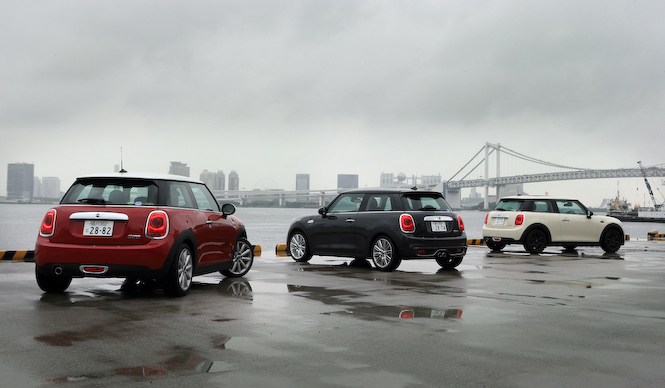
MINI ONE
Body Dimensions: Length 3,835 x Width 1,725 x Height 1,430 mm
Wheelbase: 2,495 mm
Tread Front/Rear: 1,500 / 1,500 mm
Weight: (MT) 1,170 kg (AT) 1,200 kg
Engine: 1,198cc Inline 3-cylinder DOHC MINI TwinPower Turbo
Bore x Stroke: 78.0 x 83.6 mm
Max Output: 75 kW (102 ps) / 4,000 rpm
Max Torque: 180 Nm / 1,400-3,900 rpm
Transmission: 6-speed MT / 6-speed AT
Drivetrain: FF
Tires: 175/65 R15
0-100 km/h Acceleration: (MT) 9.9 sec (AT) 10.2 sec
Trunk Capacity: 211 liters
Fuel Economy (JC08 mode): (MT) 20.2 km/ℓ (AT) 19.2 km/ℓ
Price: (MT) ¥2.26 million (AT) ¥2.40 million
MINI Cooper
Body Dimensions: Length 3,835 x Width 1,725 x Height 1,430 mm
Wheelbase: 2,495 mm
Tread Front/Rear: 1,500 / 1,500 mm
Weight: (MT) 1,170 kg (AT) 1,200 kg
Engine: 1,498cc Inline 3-cylinder DOHC MINI TwinPower Turbo
Bore x Stroke: 78.0 x 83.6 mm
Max Output: 100 kW (136 ps) / 4,400 rpm
Max Torque: 200 Nm / 1,250-4,300 rpm
Transmission: 6-speed MT / 6-speed AT
Drivetrain: FF
Tires: 175/65 R15
0-100 km/h Acceleration: (MT) 7.9 sec (AT) 7.8 sec
Trunk Capacity: 211 liters
Fuel Economy (JC08 mode): (MT) 19.2 km/ℓ (AT) 17.9 km/ℓ
Price: (MT) ¥2.66 million (AT) ¥2.80 million
MINI Cooper S
Body Dimensions: Length 3,835 x Width 1,725 x Height 1,430 mm
Wheelbase: 2,495 mm
Tread Front/Rear: 1,485 / 1,485 mm
Weight: (MT) 1,240 kg (AT) 1,270 kg
Engine: 1,998cc Inline 4-cylinder DOHC MINI TwinPower Turbo
Bore x Stroke: 78.0 x 83.6 mm
Max Output: 141 kW (192 ps) / 5,000 rpm
Max Torque: 280 Nm / 1,250-4,600 rpm
Transmission: 6-speed MT / 6-speed AT
Drivetrain: FF
Tires: 195/55 R16
0-100 km/h Acceleration: (6MT) 6.8 sec (6AT) 6.7 sec
Trunk Capacity: 211 liters
Fuel Economy (JC08 mode): (MT) 15.8 km/ℓ (AT) 17.6 km/ℓ
Price: (MT) ¥3.18 million (AT) ¥3.32 million
MINI Customer Interaction Center
0120-3298-14 (Reception Hours: 9:00-20:00 / Open Year-Round)