Circuit Test Drive: BMW M3 Sedan & M4 Coupe | BMW
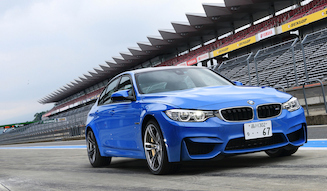
BMW M3 Sedan
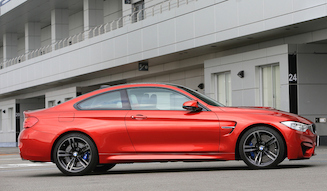
BMW M4 Coupe
Circuit Test Drive: BMW M3 Sedan & M4 Coupe
We test drove the latest models in BMW's high-performance "M" series: the M3 Sedan and M4 Coupe. Toshifumi Watanabe tested the capabilities of the M4 Coupe, a new model derived from the "4 Series Coupe" and succeeding the previous M3 Coupe, alongside the M3 Sedan, now in its fifth generation.
Text by WATANABE ToshifumiPhotographs by ARAKAWA Masayuki
The Philosophy and Engineering of "M"
For BMW, "M" is a code that guarantees the ultimate fulfillment of their corporate motto, "The Ultimate Driving Machine." This experience begins with catalog grades equipped with aero parts and lowered suspension, but among them, the purest pursuit of driving, where everything from the engine to the suspension system is custom-designed, is embodied by those bearing the "M" badge, namely the "M3," M5," M6", and "X5 M," "X6 M" in the lineup.
The greatest reason for this world that, while connected to the M Sport versions found in the mainstream, presents such a vastly different identity, is likely the complete redesign of the base car and engine.
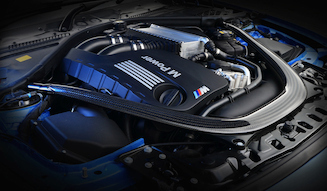
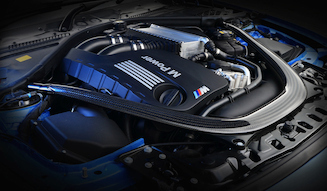
For example, the latest "4 Series" which, following its introduction, began to be named the "M4 Coupe," like the regular line, features a 3-liter inline-6 turbo engine. However, this engine, with its completely redesigned head and block, is a direct-injection twin-turbo (regular line uses a single turbo), and it is imbued with the philosophy and engineering of "M" without reservation."M3 / M4" also features a 3-liter inline-6 turbo engine. However, this engine, with its completely redesigned head and block, is a direct-injection twin-turbo (regular line uses a single turbo), and it is imbued with the philosophy and engineering of "M" without reservation.
With its closed-deck cylinder design and forged crankshaft, the new M3/M4 engine, featuring a significantly shorter bore/stroke ratio, uses IHI turbines to generate boost pressure close to 1 bar. It's engineered as a high-revving unit, producing 431ps—more than the previous model—at 7,500 rpm. Simultaneously, it delivers 550Nm of torque, nearly 40% more than the previous model, from just 1,850 rpm. The aim is to deliver greater power and torque across a wider rev range compared to the previous 4-liter V8 unit.
BMW M3 Sedan
BMW M4 Coupe
Circuit Test Drive: BMW M3 Sedan & M4 Coupe (2)
Undeniably the Fastest in its History
Given the powerful advancements in its internals, the exterior and interior haven't undergone changes as significant as to be particularly noteworthy compared to the base model, especially the M Sport grade. The shape of the bumper grille, clearly designed with airflow in mind, and the rear section, constructed from resin for weight reduction—including the trunk lid and frame—might not immediately suggest "M" work to the uninitiated.
However, the widened fenders, also serving to increase the tread width, likely convey an unusual, potent aura to those who know. It's worth remembering that "concealment" has been a consistent ethos for "M."
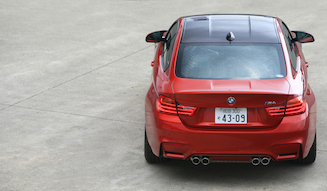
The exhaust note, which most strongly communicates the difference, is tuned to be generally lower when heard from the side. This is a common characteristic of modern direct-injection turbo engines. However, the mechanical sound of the straight-six, revving crisply and in perfect sync, is sure to stir the driver's emotions from the moment of the first blip of the throttle.
Upon starting to drive, the first thing that impresses is the sheer torque of the turbo engine. Due to the dual-clutch transmission lacking a torque converter, there's an undeniable weakness in power around 1,000 rpm when the turbo spools up, such as when just starting to move. However, once the revs reach 1,500 rpm, the driven wheels respond vigorously to accelerator inputs, with virtually no noticeable drop in acceleration during upshifts.
In situations like highway cruising where you might suddenly floor the accelerator from low revs without downshifting, some turbo lag can be felt. However, considering it produces over 430ps from a 3-liter displacement, the overall ease of use is commendable.
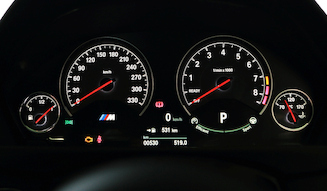
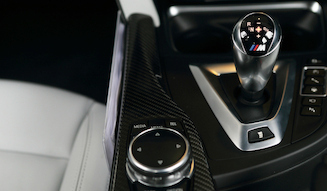
The test drive also took place on the main course at Fuji Speedway. During a brief full-throttle acceleration run on the straight from the exit of the final corner to before the entry of the first corner, the car reached speeds exceeding 260 km/h.
This figure, GT-R, is inferior to the, but surpasses the 911 Carrera.—Perhaps this gives you an idea of its power performance. In any case, it is undoubtedly the fastest in its history. Nevertheless, due to its tendency to build speed rapidly in the initial phase, leveraging its thick torque, the overall acceleration can feel somewhat flat, which is a slight disappointment. This is the challenge with turbo units.
BMW M3 Sedan
BMW M4 Coupe
Circuit Test Drive: BMW M3 Sedan & M4 Coupe (3)
M-like Flexibility
However, what compensates for this and leaves a lasting impression is the handling, which offers the flexibility to change lines at will with steering and throttle inputs. The initial gain in steering response, characteristic of "M" models, is pronounced, but the roll speed and amount are well-tuned, providing a high sense of control due to the absence of abrupt attitude changes.
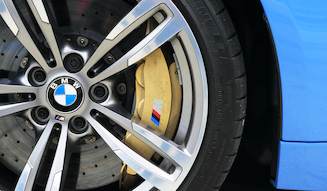
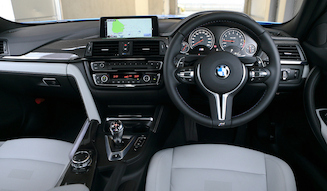
As you push the car harder, the effect of the electronically controlled differential, which optimizes drive distribution to the left and right rear wheels, becomes apparent. It precisely guides the vehicle to the inside of the turn, almost as if anticipating the turning intention from the steering angle. The cornering agility is so remarkable that even lower-tier FR models would be astonished. Even through a series of tight turns like 30R or chicanes, it responds effortlessly to corrective steering inputs that further tighten the turn, astonishingly demonstrating its driving freedom.
On the other hand, there are no issues with stability. Even at speeds exceeding 250 km/h, full braking can be applied with confidence, as the suspension's contact with the road under heavy load is managed to minimize changes.
To support over 430ps in an FR layout, it's natural to assume that high-rate springs and stabilizers are used. While the car reacts honestly to large undulations and significant bumps, the damping is effective even at very low speeds, so the shocks are not bothersome.
Whether equipped with standard steel brakes or optional carbon-ceramic brakes, the brake feel remains consistent even with extreme temperature changes, allowing for precise speed control. Although the test drive was brief and did not allow for testing in various scenarios, the comfort level appears more than sufficient given the performance.
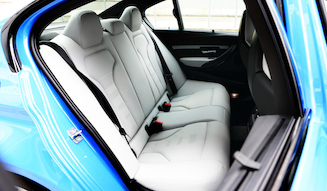
In essence, while you can fully enjoy its performance on the circuit on weekends, it also functions as a serene family sedan on weekdays. Including its spatial utility, the M-like flexibility is firmly present in the latest M3/M4.
BMW M3 Sedan
Body Size: Length 4,685 × Width 1,875 × Height 1,430 mm
Wheelbase: 2,810 mm
Tread Front/Rear: 1,579 / 1,603 mm *
Minimum Ground Clearance: 120 mm *
Weight: 1,640 kg
Engine: 2,979cc Inline-6 Direct Injection DOHC Twin-Turbo
Bore × Stroke: 84.0 × 89.6 mm
Compression Ratio: 10.2
Maximum Output: 317 kW (431ps) / 5,500-7,300 rpm
Maximum Torque: 550 Nm / 1,850-5,500 rpm
Transmission: 7-speed M DCT
Drivetrain: FR
Front Suspension: Double-joint Spring Strut
Rear Suspension: 5-link
Tires Front/Rear: 255/40R18 / 275/40R18
Brakes Front/Rear: Ventilated Disc / Ventilated Disc
Minimum Turning Radius: 6.1 meters *
Trunk Capacity: 480 liters *
0-100km/h Acceleration: 4.1 seconds *
0-1000m: 21.9 seconds *
Maximum Speed: 250 km/h (limiter controlled) *
Fuel Economy (NEDC): 8.3 ℓ/100km (approx. 12.0km/ℓ) *
CO2 Emissions: 194 g/km *
Steering: Right
Price: 11,040,000 yen
* European specifications
BMW M4 Coupe
Body Size: Length 4,685 × Width 1,870 × Height 1,385 mm
Wheelbase: 2,810 mm
Tread Front/Rear: 1,579 / 1,603 mm *
Minimum Ground Clearance: 121 mm *
Weight: 1,610 kg
Engine: 2,979cc Inline-6 Direct Injection DOHC Twin-Turbo
Bore × Stroke: 84.0 × 89.6 mm
Compression Ratio: 10.2
Maximum Output: 317 kW (431ps) / 5,500-7,300 rpm
Maximum Torque: 550 Nm / 1,850-5,500 rpm
Transmission: 6-speed Manual / 7-speed M DCT
Drivetrain: FR
Front Suspension: Double-joint Spring Strut
Rear Suspension: 5-link
Tires Front/Rear: 255/40R18 / 275/40R18
Brakes Front/Rear: Ventilated Disc / Ventilated Disc
Minimum Turning Radius: 6.1 meters *
Trunk Capacity: 445 liters *
0-100km/h Acceleration: (6MT) 4.3 seconds (7M DCT) 4.1 seconds *
0-1000m: (6MT) 22.2 seconds (7M DCT) 21.9 seconds *
Maximum Speed: 250 km/h (limiter controlled) *
Fuel Economy (NEDC):
(6MT) 8.8 ℓ/100km (approx. 11.4km/ℓ) *
(7M DCT) 8.3 ℓ/100km (approx. 12.0km/ℓ) *
CO2 Emissions: (6MT) 204 g/km (7M DCT) 194 g/km *
Steering: (6MT) Right/Left (7M DCT) Right
Price: (6MT) 10,750,000 yen (7M DCT) 11,260,000 yen
* European specifications
BMW Customer Interaction Center
 0120-269-437 (9:00-20:00, open daily)