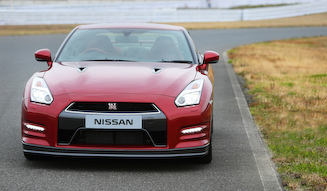
Test Drive: The 2014 Nissan GT-R, Reimagined for New Value | Nissan
Nissan GT-R 2014 Model | 2014 Nissan GT-R
Japanese Supercar Evolves Through Diversification
Test Drive: The 2014 Nissan GT-R, Reborn with New Value
Seven years have passed since the "GT-R" first shook the supercar world. Yet, the updated 2014 model has presented a finish that deviates from its predecessors, leaving existing owners and fans perplexed. Motor journalist Toshifumi Watanabe, who has followed the GT-R's development closely, shares his impressions of the latest model.—
Text by WATANABE ToshifumiPhotographs by ARAKAWA Masayuki
Did the GT-R Change the Supercar Landscape?
The Third-Generation Nissan GT-R DebutsIt was the winter of 2007. Seven years are about to pass, a period that would typically span more than one generation in the usual automotive model cycle. In today's market, where sports car segments evolve rapidly, rivals that were considered competitors back then—Porsche, Ferrari, and Lamborghini—have all undergone complete model changes.
Under these circumstances, maintaining a top-tier performance level is no small feat. It's akin to the world of elite athletes, who face relentless scrutiny and evaluation on the grandest stages every few years.
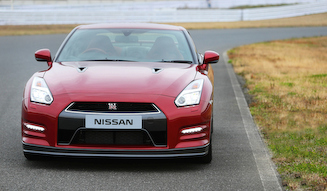
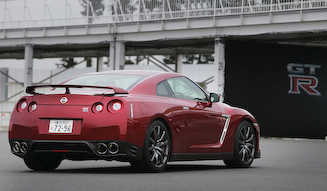
I had the opportunity to witness the GT-R's development environment on several occasions before its debut. It was a rigorous process, more akin to refining a racing car than a production vehicle. Every outcome was meticulously measured by numbers; anything falling short was unceremoniously rejected. It was in those moments, witnessing the birth of not just a "Mechanical Godzilla" but a "Digital Godzilla," that I found myself strangely convinced this was the only path to Nissan's ambition: offering the world's best performance at a three-digit million yen price.
On the other hand, I also harbored a concern that perhaps Nissan, without fully grasping the implications, had opened Pandora's Box by aggressively entering the supercar world, a realm traditionally valuing history and tradition above all else.
So, did the paradigm of the supercar change as a result?
The answer is neither yes nor no. It is undeniable that the benchmark for dynamic performance in the category was significantly raised, and in that regard, the GT-R has had a profound impact.
However, it is premature to believe that the comprehensive value associated with the GT-R name, once an "Oriental mystery," has reached parity with its rivals. Even if its existence became known overnight due to its overwhelming speed, it cannot instantly match the reputation built over time by others. The supercar market, despite its radical appearance, is fundamentally conservative.
Nissan GT-R 2014 Model | 2014 Nissan GT-R
Japanese Supercar Evolves Through Diversification
Test Drive: The 2014 Nissan GT-R, Reborn with New Value (2)
Changes in Its Seventh Year
What the GT-R must do now is entrust its ultimate raison d'être—record-breaking performance—to its extreme models, while simultaneously offering new value to users without a connection to the Nürburgring through its standard model. This dual approach aims to enhance satisfaction among existing fans and attract new customers.
Insisting on Uniform Performance Across the BoardKazutoshi MizunoAfter his departure, the new chief engineer likely adopted this philosophy. Considering the current trend where rivals are increasingly incorporating the comfort of sports sedans, this is a natural progression.
For ordinary people driving in ordinary conditions, the most significant improvement in the GT-R's evolution would be in comfort. However, this was largely a secondary benefit derived from improvements in component quality and assembly precision.
One could argue that the enhanced sense of quality, stemming from stiffer yet more controlled damping and reduced friction in moving parts, was perceived as an improvement in refinement.
The 2014 GT-Rmarks the first time in its model history that the suspension has been tuned for ride comfort.
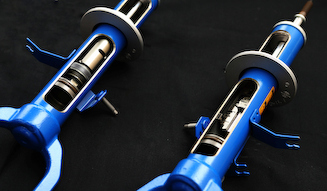
Specifically, the spring rates have been lowered, and the damping has been adjusted to be more effective even in the micro-displacement range. Consequently, body roll has increased, and the absolute speed at which the car breaks traction has decreased. The 2014 GT-R would undoubtedly be slightly slower on the Nürburgring than the 2013 model. The development team acknowledges this, stating they do not intend to measure lap times for the standard model.
Nevertheless, these are changes in behavior occurring in ultra-high-dimensional realms that are difficult for us to reach, not only in daily driving but even on the circuit. The dramatic improvement in ride comfort gained by compromising in these areas can be described as remarkable.
Nissan GT-R 2014 Model | 2014 Nissan GT-R
Japanese Supercar Evolves Through Diversification
Test Drive: The 2014 Nissan GT-R, Reborn with New Value (3)
Many Gains from the Changes
Perhaps the most significant change is its increased tolerance for varying road conditions. While the jarring impacts and reactions to ruts had been gradually refined in previous GT-Rs, the constant shaking of the chassis and steering during daily driving, amidst the rapid advancements of rivals, undeniably contributed to a perception of lower quality. The 2014 model has largely eliminated this sensitive kickback, resulting in a smoother ride where the car tracks straight even when left to its own devices.
Furthermore, in most situations we encountered, there were no uncomfortable jolts. The suspension's impression has softened, allowing the car to roll more smoothly and track straight.
On expressways and toll roads with heavy traffic, such as the Shuto Expressway, where changes in road surface are easily felt—including ruts, expansion joints, slippery white lines, and adverse cambers——the car now handles these challenging conditions with grace, allowing the driver to feel the changes in posture and road feedback while maintaining a comfortable pace.
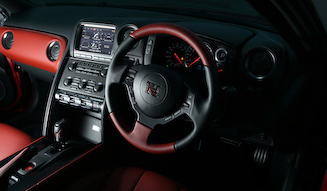
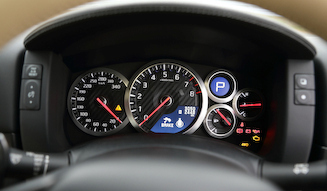
The impression is that the GT's capabilities have been significantly enhanced while maximizing the GT-R's extraordinary fundamental performance. Knowing that the suspension settings were finalized in just three to four months, based on a blend of past test data and the development team's experience, one can't help but feel a slight regret that this breakthrough might have come sooner.
The improved road tracking at normal speeds—meaning a flatter upper body movement and easier handling—may also positively impact fuel efficiency. During our test drive on the Shuto Expressway, with speed limits between 60-80 km/h, we occasionally deliberately tested responsiveness and grip, without excessive concern for throttle inputs. Yet, the onboard computer indicated figures around 12-13 km/l.
While the GT-R has always had respectable fuel economy relative to its performance, the calmer body movements seem to have reduced unnecessary acceleration, leading to better efficiency.
Nissan GT-R 2014 Model | 2014 Nissan GT-R
Japanese Supercar Evolves Through Diversification
Test Drive: The 2014 Nissan GT-R, Reborn with New Value (4)
Another Evolution: The GT-R NISMO
While the standard model has dramatically enhanced its appeal for daily use, reaching parity with its rivals in terms of average performance, the "GT-R NISMO" has been newly established as the model responsible for numerical performance benchmarks.
This model is central to Nissan's strategy of elevating NISMO, Nissan's motorsport division, into a global brand. Consequently, it features circuit-spec suspension settings, aerodynamic parts, and tires, with additional performance-enhancing components.Achieving a Nürburgring lap time of 7 minutes and 8 secondsIt possesses the potential for this unprecedented feat.
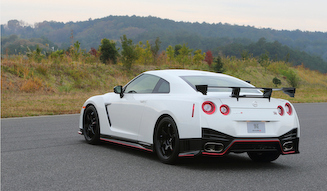
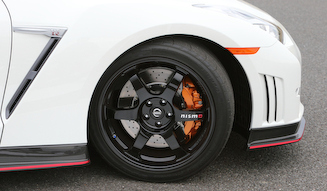
Furthermore, positioned above this is a model based on FIA GT3 regulations for circuit-exclusive use. With this lineup, the GT-R now comprehensively covers motorsport applications, from high-amateur to professional use. This model strategy, broadening the appeal of the core standard model while offering depth according to skill level, can be seen as analogous to Porsche's approach with the "911."
However, this is still a road-legal model. While the GT-R NISMO's public road driving is not an ordeal of constant hardship, for many who are not focused on shaving off tenths of a second, it can feel like an underutilized asset.
Conversely, freed from the constraint of chasing every last tenth of a second by the existence of the NISMO, the standard model clearly demonstrates the GT-R's road usability, something previously less apparent. In any case, this healthier approach is undoubtedly welcome news for us users.

Nissan GT-R 2014 Model | 2014 Nissan GT-R
Body | Length 4,670 × Width 1,895 × Height 1,370 mm
Wheelbase | 2,780 mm
Tread Front/Rear | 1,590 / 1,600 mm
Vehicle Weight | 1,740 kg
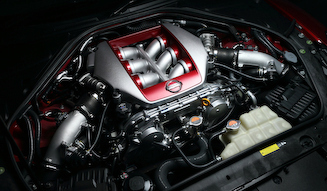
Engine | 3,799cc V6 Twin-Turbo
Bore x Stroke | 95.5 x 88.4 mm
Max Output | 404 kW (550 ps) / 6,400 rpm
Max Torque | 632 Nm (64.5 kgm) / 3,200-5,800 rpm
Transmission | 6-speed Dual Clutch Transmission
Drivetrain | 4WD
Suspension Front/Rear | Independent Double Wishbone / Independent Multi-link
Tires Front | 255/40ZR20
Tires Rear | 265/35ZR20
Brakes Front | Ventilated Disc φ390mm
Brakes Rear | Ventilated Disc φ380mm
Fuel Economy | 8.7 km/l
Price (incl. tax) |
(Pure Edition) ¥9,309,600
(Black Edition) ¥10,216,800
(Premium Edition) ¥10,400,400