Test Drive: The 2014 Lotus Evora | Lotus
Lotus Evora S Sports Racer IPS
Lotus Evora S Sports Racer IPS
A Luxury Lotus Matures
Test Drive: The 2014 Lotus Evora
Lotus is a brand often associated with Spartan, lightweight sports cars like the Elise. However, the Evora, introduced in 2009, was designed with everyday usability in mind, offering a more comfortable ride and amenities. It also featured a 2+2 configuration with small rear seats, making it more practical. The addition of an automatic transmission (AT) in 2011 with the "Evora IPS" further enhanced its accessibility. Five years on, Tatsuya Otani test drives the 2014 "Evora Sports Racer IPS," a model that has benefited from years of refinement.
Text by Tatsuya OtaniPhotographs by Masayuki Arakawa
Creating a Usable Sports Car That Retains Lotus DNA
The new generation of Lotus, born in the 1990s, is perhaps best known for its mid-engined, open-top sports cars like the "Elise", which featured a chassis built from extruded aluminum and combined with a compact, extremely lightweight body. The "Exige" was its performance-oriented, closed-coupe evolution.
Both cars prioritized sporty handling above all else, stripping away comfort features to achieve a lightweight and compact design. This philosophy echoed the approach of founder Colin Chapman, who in the 1950s and 1960s created the original Lotus "Elise," the first "Elan," and the "Europa," all pursuing ideal handling through simple design.
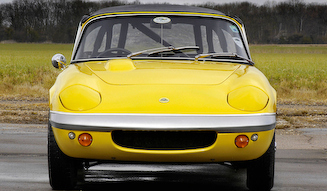
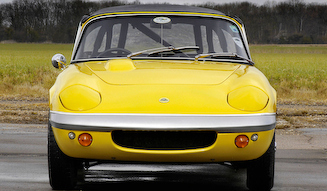
Lotus Elan
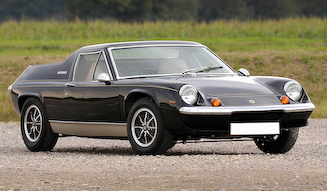
Lotus Europa
However, for modern drivers accustomed to the abundant amenities and refined comfort of today's sports cars, the current Elise and Exige might feel a bit too spartan.
Or perhaps, one might assume they are too small or simply built, only to discover on the road that they offer a surprisingly comfortable ride, low noise levels, and are easy enough to use for everyday errands.
Still, it seems reasonable to imagine a sports car based on the Elise or Exige, but with a slightly more luxurious interior. It might gain a little weight and lose some of the Elise's or Exige's agility, but if it were quieter, more comfortable, more spacious, and perhaps even included compact rear seats as a +2 option, it could surely become a practical sports car that retains the essence of Lotus...
It's entirely natural that Lotus's current management would consider such a direction, and it's likely there was a significant demand for it.
Lotus Evora S Sports Racer IPS
Lotus Evora S Sports Racer IPS
A Luxury Lotus Matures
Test Drive: The 2014 Lotus Evora (2)
The 2014 Model: Shedding Early Flaws, True to Concept
The Evora, developed with this concept, debuted in 2008. Its elegantly curved exterior design retained a sense of visual lightness, and the mid-mounted, supercharged 3.5-liter Toyota V6 engine provided ample power, living up to the Lotus name.
However, the suspension, perhaps prioritizing comfort too much, lacked the crispness characteristic of Lotus. The engine's response wasn't particularly sharp, and the nearly 1,400kg body (the Evora S Sports Racer IPS weighs 1,460kg) felt heavier than its actual weight.
Looking at the Evora again with a sense of mild disappointment, the body, designed for interior spaciousness, seemed somewhat too tall, and the interior's quality was far from impressive.
In essence, the pursuit of a little more comfort seemed to have come at the cost of diminishing Lotus's inherent strengths. Furthermore, it couldn't quite compete with modern sports cars in terms of refinement and technological sophistication. The result was a car with a somewhat unclear positioning.
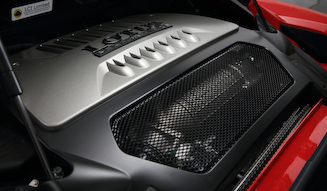
Based on these reflections, Lotus embarked on improving the Evora. These efforts spanned the powertrain, suspension, and interior, though Lotus did not specifically label it a minor model change.
Yet, the 2014 Evora Sports Racer S IPS not only regained the direct driving feel reminiscent of its Elise and Exige siblings but also saw a significant improvement in interior quality. The exterior, which had seemed a bit stout, was transformed into a much sharper appearance with subtle cosmetic updates. In other words, the initial weaknesses of the Evora were eliminated, resulting in a sports car that faithfully embodies its original concept.
Lotus Evora S Sports Racer IPS
Lotus Evora S Sports Racer IPS
A Luxury Lotus Matures
Test Drive: The 2014 Lotus Evora (3)
This is the Car Lotus Wanted to Build
The first thing that strikes you during the actual test drive is the effortless revving of the V6 engine. Its sharp response is reminiscent of a racing engine, built with lightweight moving parts like pistons and crankshafts, and it reacts beautifully to the slightest movement of your right foot. The "IPS" gearbox, based on a 6-speed torque converter automatic, also achieves a level of responsiveness and directness that rivals dual-clutch transmissions.
Unlike the early model, where the suspension's movement had a certain "vagueness" due to an overemphasis on comfort, the current suspension effectively utilizes its limited travel while skillfully filtering out harshness, achieving sharp handling. In this regard, it might feel similar to the McLaren "MP4-12C."
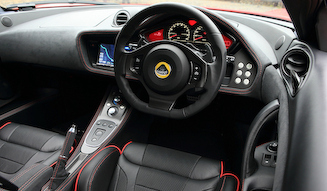
Similarly,MP4-12C, its excellent visibility is noteworthy. The horizontal view is expansive, like a panoramic photograph, and the vertical visibility is also ample, allowing you to see traffic lights directly overhead and easily check the road surface just ahead of the car. Even the rearward visibility is quite good for a mid-engined sports car of this type.
Upon closer inspection, the interior, meticulously covered in Alcantara, is truly appealing. The control system, utilizing many touch-sensitive switches, is not only innovative but also user-friendly. The seats are designed to be thin to avoid encroaching on interior space, but their shape is optimal, providing excellent support during spirited driving, and the leather quality is high. The overall modern aesthetic is also very pleasing.
"Ah, this is the car Lotus wanted to build."
The new, or rather, the 2014 model Evora, is a new generation of sports car that gives us precisely that impression.

Lotus Evora S Sports Racer IPS
Body Dimensions: Length 4,380 x Width 1,850 x Height 1,230 mm
Wheelbase: 2,575 mm
Tread Front/Rear: 1,560 / 1,555 mm
Weight (EU spec): 1,460 kg
Engine: 3,456cc V6 Supercharged
Max Output: 257.5 kW (350 ps) / 7,000 rpm
Max Torque: 400 Nm (40.8 kgm) / 4,500 rpm
Transmission: 6-speed Automatic (IPS)
Drivetrain: MR
Suspension Front: Double Wishbone
Suspension Rear: Double Wishbone
Tires Front/Rear: 235/35R19 / 275/30R20
Brakes Front/Rear: φ350mm Ventilated Disc / φ332mm Ventilated Disc
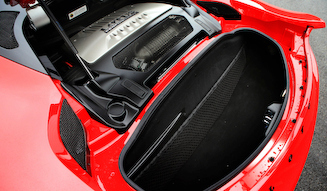
Trunk Capacity: 160 Liters
Top Speed: 266 km/h
Price (incl. 8% consumption tax): ¥11,314,200