Experiencing the electric up! e-up! | Volkswagen
Volkswagen e-up! | Volkswagen e-up!
An EV That Doesn't Announce Itself as an EV
Experiencing the e-up!, the Electric Version of the up!
As announced at last year's Tokyo Motor Show, the "e-up!", an electric vehicle based on Volkswagen's smallest model, the "up!", is soon to arrive in Japan. At a test drive event held in conjunction with the "Volkswagen Fest", a fan meeting held for the first time in six years,Volkswagen FestFumio Ogawa took the wheel of the brand's first-ever EV for an impression.
Text by OGAWA FumioPhotographs by HANAMURA Hidenori
The Key Is a Familiar Driving Experience
The electric vehicle market is becoming increasingly active. In Japan, where practical applications like the Nissan "Leaf" and Mitsubishi "i-MiEV" were introduced relatively early, a steady stream of attractive models from overseas is now beginning to arrive. The "e-up!"Leaf", and the Mitsubishi "i-MiEV", among others, were introduced relatively early for practical use. Now, a continuous stream of attractive models from overseas is also beginning to arrive. The "e-up!"e-up!", scheduled for release in Japan in the latter half of this year, is one such noteworthy vehicle.
The e-up! is a pure electric vehicle that combines a lithium-ion battery with an electric motor driving the front wheels. Its most compelling feature is its familiar, everyday driving feel. In line with Volkswagen's philosophy that "the era of EVs being treated as special is over, and they will become so commonplace that switching from a gasoline engine will be seamless," its operation and performance are designed for anyone to drive without feeling out of place, which is a significant appeal.
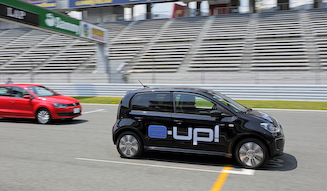
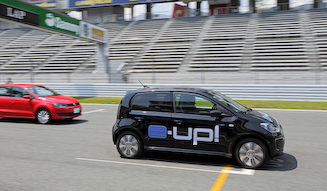
The e-up! was unveiled in its home market in November 2013 and is already on sale in Germany. Indeed, the driving experience is one that should be widely accepted.
Starting the car is just like a conventional vehicle: insert the key and turn it. The drive mode selector also has the familiar design of a transmission; selecting 'D' and driving off is exactly the same as with a traditional car.
The driving feel is also exceptionally smooth. While it doesn't offer the astonishing acceleration of the BMW "i3",i3", it accelerates briskly, reaching 60 km/h from a standstill in 4.9 seconds and 100 km/h in 12.4 seconds. The absence of any shifting shock makes the acceleration feel as pleasant as that of a luxury car with a large-displacement engine.
The suspension system is tuned towards the softer side, with springs that feel relatively yielding. However, pitching is carefully controlled, and the ride comfort is pleasant across nearly all speed ranges, from moderate speeds in urban areas to high-speed driving above 100 km/h. Wind noise does not become dramatically louder, and road noise, including tire noise, is not intrusive.
Volkswagen e-up! | Volkswagen e-up!
An EV That Doesn't Announce Itself as an EV
Experiencing the e-up!, the Electric Version of the up! (2)
Understated Exterior, Refined Drivability
The e-up! is a compact hatchback measuring just 3.5 meters in length, yet its comfort rivals that of a luxury car.
The advantages of electric vehicles, particularly their quietness and cleanliness, are often favored by women. The e-up! offers these benefits in a way that is accessible to everyone, without unnecessary fanfare. While many automakers tend to pursue novelty to emphasize the presence of their EVs, many will likely appreciate Volkswagen's concept of keeping the exterior largely the same while boldly changing only the essential internal components.
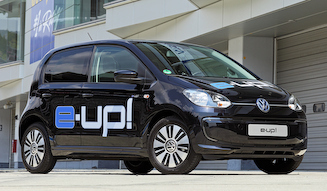
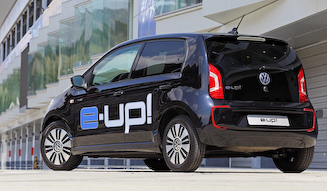
The handling has been refined with a focus on drivability, including a 50:50 front-to-rear weight distribution. As a result, it offers a driving feel that will be familiar to traditional car enthusiasts.
However, perhaps due to the soft setting of the front springs, if you delay your turn-in timing when cornering at high speeds, the line can become unstable. While enjoyable cornering is possible once you get used to it, some drivers might initially feel a disconnect, given the prevalence of cars that emphasize sporty handling today.
Regarding cornering, the e-up! has another distinctive feature: in addition to the 'D' range, there are positions that utilize the regenerative braking system.
Pushing the selector left from 'D' selects 'D1', and pulling it down further selects 'D2' and 'D3'. These modes correspond to varying levels of regenerative braking intensity. For example, when approaching a corner, you can select 'D' to 'D1' and then 'D2' to achieve deceleration, much like downshifting in a manual transmission car. For stronger deceleration, select 'B' below 'D'.
That said, the e-up! does not utilize regenerative braking for deceleration as aggressively as the i3. The deceleration effect during regenerative braking is quite mild. While the i3's system allows for a "lazy" drive where strong braking occurs simply by lifting off the accelerator, the e-up! requires more frequent use of the brake pedal.
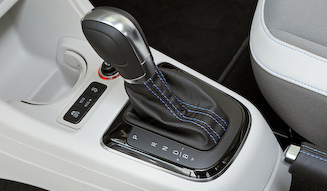
The i3's system has the advantage of allowing for a lazy driving style once accustomed to it, eliminating the need for the brake pedal. The e-up!'s benefit, however, lies in its similarity to conventional gasoline or diesel engine cars.
Volkswagen e-up! | Volkswagen e-up!
An EV That Doesn't Announce Itself as an EV
Experiencing the e-up!, the Electric Version of the up! (3)
If Circumstances Allow, It's a Car Worth Considering for Purchase
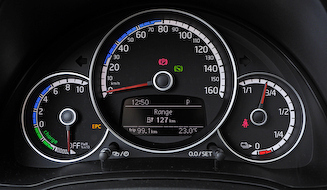
Volkswagen states that the cruising range on a full charge is 160 km according to EU tests. Indeed, even when driving at a brisk pace with the air conditioning running at full blast, the needle on the battery level indicator moves quite slowly.
Furthermore, there are ECO and ECO+ modes that reduce acceleration, limit output, and turn off the air conditioning to minimize power consumption. However, the standard mode is recommended for an enjoyable drive.
The appeal of the e-up! lies in its ability to make you want to drive it every day after just one experience. It's akin to mineral water – unlikely to become tiresome and doesn't impose itself on the driver.
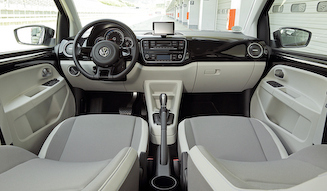
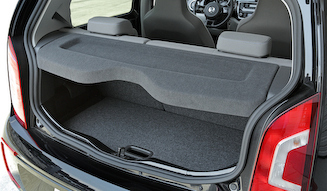
In its home market, information about the e-up! and certain commands can be controlled via a smartphone. This may also be the case in Japan. One significant benefit (in my personal opinion) is the ability to remotely operate the air conditioning system via a smartphone app. This ensures the cabin is already at a comfortable temperature when you get in during hot summers or cold winters. It also reduces the load on the battery during driving by using external power for the air conditioning while charging, a unique advantage of electric vehicles.
The price in Japan has not yet been determined, but a spokesperson for Volkswagen Group Japan indicated that the European price of 27,000 euros (approximately 3.75 million yen) would be a reference point.
With subsidies from local governments, it might be possible to purchase it for under 3 million yen. Pure electric vehicles require dedicated charging facilities at home or the workplace. However, if you have the environment to install a charger, it becomes a car worth seriously considering for purchase.

Volkswagen e-up! | Volkswagen e-up!
Body Dimensions | Length 3,540 x Width 1,645 x Height 1,477 mm
Wheelbase | 2,420 mm
Engine | Electric Motor
Maximum Output | 60 kW (82 ps)
Maximum Torque | 210 Nm
Battery Weight | 230 kg
Battery Capacity | 18.7 kWh
Transmission | 1-speed
0-80 km/h Acceleration | 9.1 seconds
0-100 km/h Acceleration | 12.4 seconds
Maximum Speed | 130 km/h
Range (NEDC) | 160 km
Tires | 165/65R15
Volkswagen Customer Centre
 0120-993-199