A New York Taxi in Tokyo | Nissan
Nissan NV200 New York TAXI | Nissan NV200 New York City Taxi
Riding a New York Taxi in Tokyo
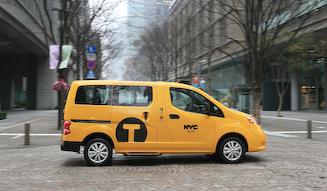
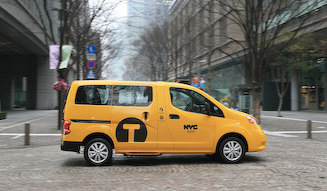
We reported in April 2012 that the New York City taxi, the yellow cab, would be made by Nissan.April 2012Two years later, I had the opportunity to test drive the very same New York taxi on the streets of Tokyo. Although some equipment was omitted to comply with Japanese regulations, the vehicle was the real deal. Fumio Ogawa shares his thoughts on this rather unusual test drive, which differs from his usual impressions of production models.—
Text by OGAWA FumioPhotographs by ARAKAWA Masayuki
The Unsung Heroes of the City
Some people may like taxis for their convenience, while others may dislike them for their rough driving. However, few have the opportunity to consider a taxi as a car.
In 1976, the Museum of Modern Art in New York held an exhibition called "The Taxi Project," curated by Italian architect Emilio Ambasz. Five companies, including Volkswagen, Alfa Romeo, and Volvo, exhibited original taxi prototypes, which garnered considerable attention.
Thinking about taxis is actually quite an exciting endeavor. This is because taxis have a clear purpose, allowing for the enjoyment of deciphering the process to reach a solution. When I test-drove a London taxi for "ENGINE" magazine some time ago, I quoted a line from Ambasz's preface for "The Taxi Project" exhibition: "The taxi is an unsung hero."
"Unsung hero" is a term used to honor soldiers who receive little recognition despite their military achievements. Ambasz once wrote that taxis play such a crucial role in the city, yet no one truly acknowledges their existence.
Nissan Motor Corporation's involvement in New York City taxis, starting in the fall of 2014, has given me, after a long time, an opportunity to focus on the existence of taxis.
Nissan NV200 New York TAXI | Nissan NV200 New York City Taxi
Riding a New York Taxi in Tokyo (2)
Different from the Japanese Specification
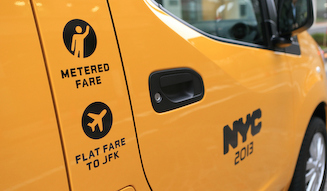
The vehicle provided by the OPENERS editorial department was one that had been temporarily prepared as a press car for publicity. A New York City Taxi Driver's license, whether a dummy or real, was also fitted into the partition between the front and rear seats. It's modern to have a USB port. While some equipment is (presumably) omitted, it's a Prospec, which is strangely uplifting.
Furthermore, Nissan is currently advancing taxi projects for cities around the world, starting with this New York taxi. One is the "NV200 Vanette Taxi" for Japan. They also recently announced a London taxi with the same specifications as the Hackney Carriage (the so-called London taxi), and a Barcelona model is planned next.
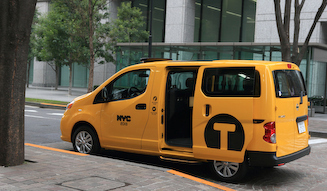
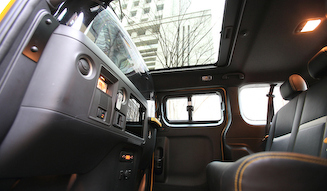
The New York taxi is equipped with a 2-liter 4-cylinder engine combined with a continuously variable transmission. While the base is the "NV200," compared to the Japanese "NV200 Vanette Taxi," the body dimensions are 186.3 inches (4,732 cm) in length, which is considerably longer than the 4,400 cm Vanette Taxi. Even the Vanette Taxi has more than enough interior space, but the spaciousness of the New York taxi is remarkable. Large luggage can be placed at your feet, making it seem quite user-friendly.
When driven, the 131 ps maximum output and 139 Nm maximum torque for a 1,645 kg vehicle give a "neither here nor there" impression. There's no remarkable acceleration, nor is there any noticeable lack of power. Since the maximum torque is at a high 4,800 rpm, a more active drive can be achieved by revving the engine as much as possible. However, as it's a taxi, there's almost no opportunity to drive like that. In Japan, the NV200 Vanette Taxi has a hybrid-like specification that can use both LPG and gasoline, and fuel efficiency is likely a more important factor in the world of commercial vehicles.
Nissan NV200 New York TAXI | Nissan NV200 New York City Taxi
Riding a New York Taxi in Tokyo (3)
Spacious Rear Seats
What concerns us more than the driver's seat is the rear seat with its thick black vinyl-covered seats. It's functional and not uncomfortable to sit in, with ample legroom and headroom, making the packaging impressive. However, the ride comfort is firm, possibly due to the suspension arm length, with significant jolts from road imperfections, making it not the most comfortable ride.
Toyota Motor Corporation also exhibited the "JPN Taxi Concept" at the 2013 Tokyo Motor Show, a proposal for a new taxi based on the Comfort. This New York taxi from Nissan Motor Corporation is more stylish. It is characterized by its practical and simple design, like a pair of jeans.
If Tokyo taxis are to emerge in earnest from now on, what will be needed are short overhangs, easy boarding and alighting for the elderly, quietness, and a reasonable fare structure.—Various things come to mind.
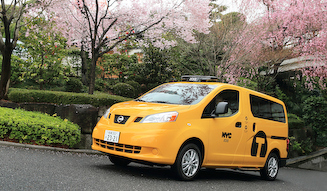
Taxis are part of the urban landscape, so style is, of course, important. Cities with well-designed public transportation are intelligent and attractive. That's why I remain endlessly interested in taxis. I've come to realize that anew.