Ford EcoSport: A First Drive Abroad
Ford EcoSport
A New Compact SUV for Global Strategy
Test Drive of the Ford EcoSport Overseas
While Ford releases American-flavored models like the "Mustang" and "Explorer," under the banner of "One Ford," they are also actively developing global strategic vehicles such as the "Focus," "Kuga," and "Fiesta" for universal production and sales worldwide. The "EcoSport," a compact SUV, is the fourth of these global cars to be introduced in Japan. Similar to how the Kuga is an SUV version of the Focus, the EcoSport is a crossover SUV based on the Fiesta.Domestic Launch on April 24Prior to this, Hirohisa Kaneko test drove it in Thailand, where the factory is located.
Text by KANEKO Hirohisa
A New Contender Enters the Fiercely Competitive Compact SUV Market
This year promises to be a strong one for compact SUVs.
Already announced are the Honda "Vezel" and the Peugeot "2008",Captur",Mercedes-Benz" whose Japanese specifications are scheduled for announcement this summer, and the Ford "EcoSport," slated for introduction in May.GLA-Class", and the Ford "EcoSport" to be introduced in May.
While they are SUVs, they are not off-road types; rather, they are based on passenger cars (the Vezel on the "Fit," the GLA on the "A-Class") and are driven by either the front wheels or all four wheels.
Their intended use is primarily for city driving. However, they feature slightly increased ground clearance compared to their base passenger cars to handle uneven roads and snow, and surprisingly, models like the GLA can even handle quite rough off-road conditions thanks to a button that allows electronic control of the throttle, transmission, and brakes to be set for off-road use.
And this time, we got behind the wheel of one of them, the Ford EcoSport, in Hua Hin, Thailand. It belongs to the SUV category of B-segment size and is what Ford itself calls a "Smart Urban SUV."
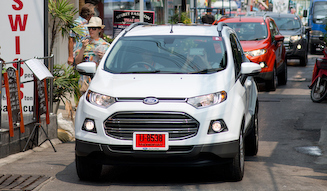
The EcoSport is powered by a 1.5-liter four-cylinder engine driving the front wheels. Although it's an SUV, the four-wheel-drive option is only available for the Brazilian market.
Incidentally, the EcoSport is manufactured in four Ford plants: Brazil, China, Thailand, and India. Development was primarily led by Ford Brazil. Although it was not imported to Japan, the EcoSport is actually in its second generation; since the first generation was released in 2003, it was a hit in Brazil, selling 700,000 units. This second generation expands its sales reach to over 100 countries worldwide from three production bases outside Brazil.
"The B-segment market is growing, especially for SUVs, in rapidly expanding markets like ASEAN, India, Brazil, and Europe," explained Graham Pearson, Vehicle Line Director for Ford Asia Pacific.
Ford EcoSport
A New Compact SUV for Global Strategy
Test Drive of the Ford EcoSport Overseas (2)
Leveraging the Spare Tire Mount
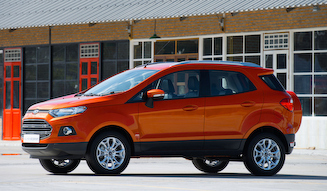
The first thing that caught my eye when facing the EcoSport was the spare tire mounted on the tailgate. It's become rare these days to see a spare tire mounted externally like this. Most cars store it under the trunk floor. Often, that tire is a temporary "space saver" type. Some vehicles even omit the spare tire altogether, providing only a puncture repair kit. In many of those cases, they are equipped with run-flat tires, which allow you to drive for tens to nearly a hundred kilometers even after a puncture.
This reflects a shift in the times, where punctures from nails or sharp metal debris on the road are less common, and run-flat tires have been developed to allow you to reach a tire shop or repair facility even if you do get a flat.
However, these convenient operations are still limited to developed countries. This is not the case in developing or emerging economies. In such regions, if you don't have a full-size spare tire, you might have to abandon your vehicle by the roadside.
While punctures may seem like a thing of the past when living in Japan, the world is a vast place.
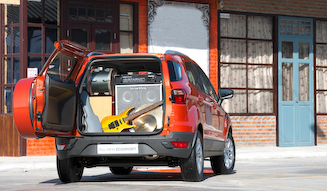
Ford's development team likely turned this to their advantage. By mounting a full-size spare tire on the EcoSport, they aim to maximize the benefit of a larger trunk space.
The tailgate opens sideways, and the floor has been lowered to create a cargo area that is nearly rectangular. The capacity is 362 liters, which can be expanded to 705 liters by folding down the rear seats. As a demonstration, they easily showed that a cardboard box simulating a washing machine package could be stored.
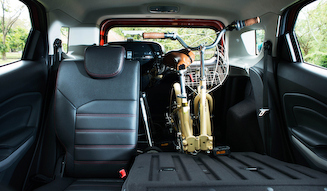
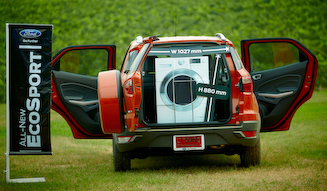
Incidentally, while the image shows the spare tire with a body-colored cover, the Japanese specification will not include a cover. This is to create a rugged atmosphere with the exposed tire, rather than the visual smoothness of a body-colored cover. I agree that this would make the EcoSport look more appealing.
Ford EcoSport
A New Compact SUV for Global Strategy
Test Drive of the Ford EcoSport Overseas (3)
Not Flimsy
The EcoSport does not feature Ford's "EcoBoost" engine, which the company has been focusing on recently. While the EcoBoost engine, which balances fuel efficiency and performance, is found in models like the "Explorer",Focus",Fiesta", and others, the EcoSport is equipped with a conventional 1.5-liter four-cylinder engine.
It also lacks features like automatic emergency braking and idling stop. It's quite simple. While such features are highly demanded in developed markets like Japan, Europe, and North America, the EcoSport is designed for the global market. Although it will be sold in developed countries, the requirements of non-developed countries are prioritized in its design.
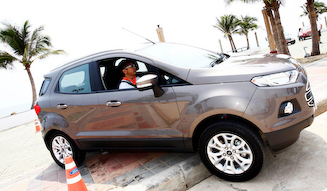
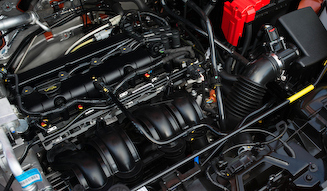
Having actually driven the EcoSport, I found it to be quite well-executed.
Firstly, despite being an SUV, the seating position is not too high, and the driving posture is natural, characteristic of Ford, making it easy to drive. With 110 horsepower paired with a 6-speed automatic transmission, it has sufficient power. Even when cruising around 100 km/h, the cabin remained quiet.
It doesn't feel flimsy, which can be common in cars with smaller engines, suggesting it can be used robustly for various purposes. The numerous storage compartments throughout the cabin are also very practical and helpful.
Ford EcoSport
A New Compact SUV for Global Strategy
Test Drive of the Ford EcoSport Overseas (4)
A B-Segment SUV Embodying Ford's Values
However, one aspect I couldn't quite understand was the position of the tailgate hinges. Thailand, like Japan, drives on the left, and the EcoSport is right-hand drive. The tailgate hinges are on the left side, meaning the right side opens wide.
Isn't that the wrong way around?
Shouldn't the hinges be on the right side for the left side to open in Thailand and Japan? When you park on the left side of the road, you'd want to load and unload luggage from the left, and having the right side open poses a safety risk with passing cars and motorcycles.
When I asked about this, Pearson replied, "No, because the driver gets out and opens the gate, having it open on the right side is closer and more convenient."
Is that really the case? I strongly believe that having the right hinge and the left side opening makes much more sense.
The 20cm ground clearance and 55cm wading depth are also reassuring; it was able to clear a high concrete step. It's designed for users who might have to drive over uneven unpaved roads, streams, or puddles, so in that regard, it could be called a UV (Utility Vehicle) rather than an SUV (Sport Utility Vehicle).
Ford's "ONE FORD" strategy isn't just about sending out one type of car globally; it's about responding precisely to regional needs, meeting diverse demands with multiple models, and ultimately providing the same level of satisfaction to people in any region, regardless of their background. Like the Focus, Fiesta, and Explorer, the EcoSport embodies Ford's value of "high practicality and excellent driving performance" as a B-segment SUV.

Ford ECOSPORT TITANIUM (Japanese Specification)
Body Size | Length 4,195 x Width 1,765 x Height 1,655 mm
Wheelbase | 2,520 mm
Tread Front/Rear | 1,520 / 1,525 mm
Minimum Turning Radius | 5.5 m
Ground Clearance | 180 mm
Weight | 1,270 kg
Engine | 1,497cc Inline 4-cylinder DOHC
Maximum Output | 82 kW (111 ps) / 6,300 rpm
Maximum Torque | 140 Nm (14.3 kgm) / 4,400 rpm
Transmission | 6-speed AT (PowerShift)
Drivetrain | FF
Suspension Front/Rear | MacPherson Strut / Twist Beam Trailing Arm
Brakes Front/Rear | Ventilated Disc / Drum
Tires | 205/60R16
Fuel Economy (JC08 Mode) | 14.5 km/ℓ
Steering | Right
Price | 2,460,000 yen
Ford Customer Service
 0120-125-175