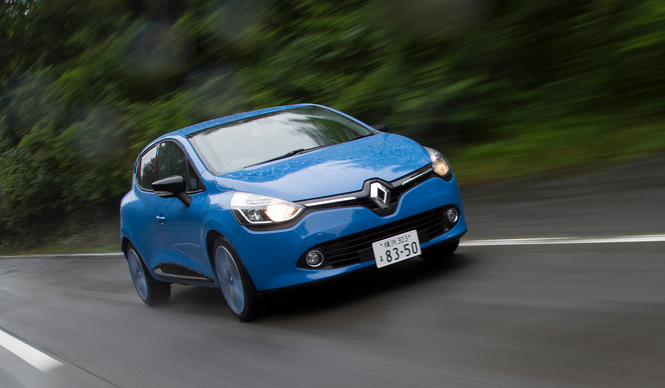
Test Drive: Renault Lutecia in Japan | Renault
Renault Lutecia | Renault Lutecia
The Vanguard of New Design
Test Drive: Renault Lutecia
Beginning with the concept car "DeZir" unveiled in 2010, Renault's new design strategy, "Cycle of Life," commenced. As the first production model in this strategy, it appeared at the 2012Paris Motor Showin Paris. The new model,Lutecia (Clio in its home market)" has now arrived in Japan.Finally Arrives in JapanThe sporty version, theR.S. test drive, was test-driven in France by Tatsuya Otani. Now, he takes the standard model for a spin on Japanese roads.
Text by OTANI TatsuyaPhotographs by MOCHIZUKI Hirohiko
Design and Quality Fused at a High Level
It's a design you could gaze at endlessly without tiring.
Compact cars, where space efficiency is paramount, typically use relatively flat body panels to maximize interior space within minimal exterior dimensions. However, the new Lutecia is different. The front and rear fenders feature pronounced curves that create distinct shadows, and the rear cabin tapers dramatically, emphasizing the swell of the rear fenders.
The lower edges of the front and rear doors are adorned with similarly sculpted resin panels, and the door panels themselves are treated with a three-dimensional finish that harmonizes with these elements. Gazing at the interplay of light and shadow reflected on these surfaces, and the patterns woven by the clouds and trees in the sky, one can truly lose track of time. The skill of Laurens van den Acker, who joined Renault as Senior Vice President of Design in 2009 and conceived the design concept for the new Lutecia, is truly remarkable.
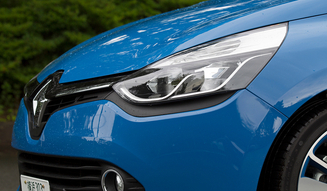
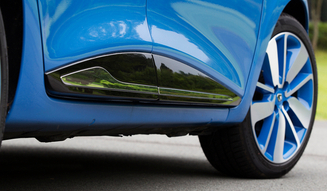
Complementing this exterior design from the side is the high-quality body finish. All body panels exhibit excellent surface precision, accurately reproducing the contours intended by the designers.
The gaps between panels, or shut lines, are also meticulously aligned. Furthermore, the design of the front grille, headlights, the Renault logo at the center of the grille, the rear door handles cleverly integrated into the window graphic, and the rear combination lights are unique, yet they all contribute to a cohesive overall proportion.
The test car is equipped with the Pack Couleur, which matches the aluminum wheels to the body color, further enhancing the sense of design unity. The exterior design is undoubtedly a highlight of the new Lutecia.
Renault Lutecia | Renault Lutecia
The Vanguard of New Design
Test Drive: Renault Lutecia (Part 2)
A Bright and Cheerful Interior
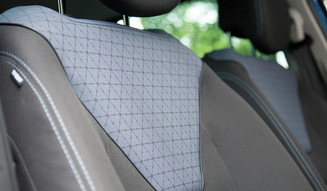
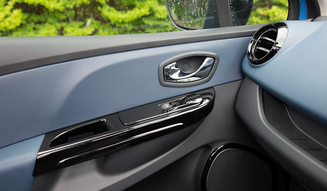
The interior design is also bright and cheerful. Notably, the test car, equipped with the aforementioned Pack Couleur, features the same blue accent color on the dashboard and seats as the body color.
I personally dislike compact cars with entirely black interiors and am invariably drawn to designs with such bright color schemes. Some compact cars in this class attempt to inject cheerfulness by painting only a portion of the dashboard a bright color, but these often suffer from an unbalanced design between the painted parts and the black sections, giving them a distinctly "afterthought" feel.
However, with the Lutecia, such concerns are unfounded. The colored parts, with their soft curves, are sure to bring a bright and relaxing atmosphere to the cabin.
The dashboard, composed of piano black, flat panels, features a large 7-inch touchscreen, as is common in modern cars. However, currently, this display cannot show navigation information (though the French specification model can, of course).
Renault Japan is reportedly considering the integration of a Japanese navigation system that utilizes the audio controls on this unit. Historically, Japanese versions of French cars have been slow to localize infotainment systems due to limited production volumes, but it appears they are finally catching up to their rivals in this area.
Renault Lutecia | Renault Lutecia
The Vanguard of New Design
Test Drive: Renault Lutecia (Part 3)
A Pervasive Sense of Lightness
Speaking of catching up to rivals, the powertrain is a prime example. The basic Lutecia grade announced this time (with the sporty Renault Sport model expected to be added within the year) is equipped with a 1.2-liter direct-injection turbocharged four-cylinder engine adopting a downsizing concept, paired with a 6-speed EDC (dual-clutch automatic transmission).
While the official fuel economy figures for Japan have not yet been released as certification is ongoing, the specifications are comparable to those of rival German manufacturers, suggesting promising fuel efficiency.
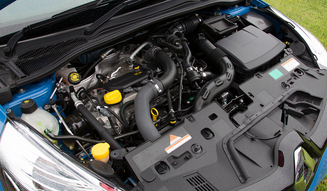
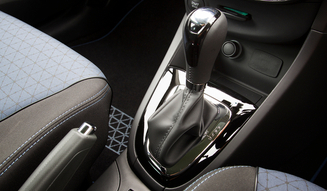
Regarding the impression of this powertrain, the engine, with a maximum output of 120ps at 4,900rpm, is rated to produce its peak torque of 190Nm at 2,000rpm. However, the actual feeling of power becomes apparent only after exceeding 3,000rpm.
In this regard, the tuning differs significantly from engines from manufacturers like Volkswagen, where stepping on the throttle immediately unleashes substantial torque even at lower revs.
The gearbox also seems to understand this engine characteristic well. Rather than shifting up rapidly to keep the engine at low RPMs during acceleration, it tends to hold the engine at higher revs. Conversely, during deceleration, it actively downshifts, a characteristic setting reminiscent of classic French cars.
The electric power steering is set to be light. Road feedback is well isolated, which might appeal to more delicate drivers, but the limited road feel makes it less suitable for aggressive driving at the limit.
Similar to the steering, the ride quality conveys a certain sense of agility. Unlike traditional Renaults that feel planted even on rough roads, this car gives the impression of a light, buoyant ride.
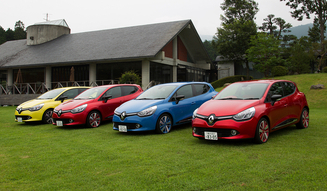
This might also be influenced by the Michelin Primacy 3 tires (size 205/45R17), which are designed to reduce rolling resistance. In any case, unlike previous Renaults, the overall feel is one of pervasive lightness.
Renault has made a significant shift in its design direction and has also thoroughly revised its powertrains, adopting a different tuning approach for the suspension.
Perhaps Renault is on the verge of a major transformation.

Renault Lutecia | Renault Lutecia
Body Dimensions | Length 4,095 x Width 1,750 x Height 1,445 mm
Wheelbase | 2,600 mm
Tread Front/Rear | 1,505 / 1,505 mm
Weight |
(Intense) 1,210 kg
(Zen, Actif) 1,190 kg
Engine | 1,197cc Inline 4-cylinder Direct Injection DOHC Turbo
Max Output | 88kW (120ps) / 4,900 rpm
Max Torque | 190Nm (19.4kgm) / 2,000 rpm
Transmission | 6-speed Dual Clutch (EDC)
Drivetrain | FF
Suspension Front/Rear | MacPherson Strut / Trailing Arm
Tires |
(Intense) 205/45R17
(Zen, Actif) 195/55R16
Price |
(Intense) ¥2,380,000
(Zen) ¥2,150,000
(Actif) ¥1,998,000