April 7, 2015
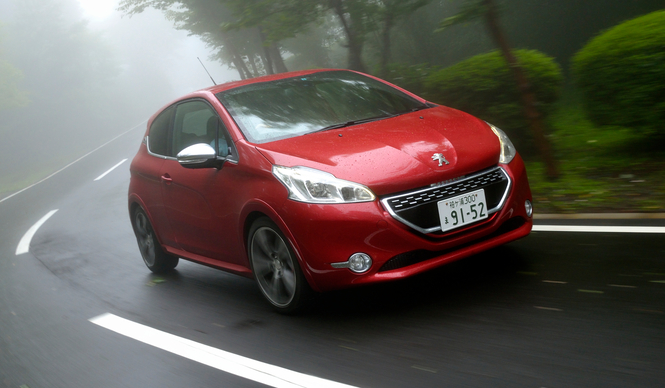
Test Drive: Peugeot 208 GTi
Peugeot 208 GTi | プジョー 208 GTi
The Fastest Sport Version in the Series
Test Drive of the Peugeot 208 GTi in Japan
The hot version of Peugeot's compact hatchback, thePeugeot 208, is thePeugeot 208 GTi. While OPENERS recently published an overseas test drive report by Toshi fumi Watanabe, OPENERS has now had the opportunity to test drive it in Japan. At the wheel is Tatsuya Otani.
Text by OTANI TatsuyaPhotographs by ABE Masaya
The 208 Inherits the Glorious "GTI" Badge
Peugeot, once renowned for its excellent practicality and durability, was able to project a bright, agile, and sporty image thanks to the 205, which debuted in 1983. The following year, 1984, saw the debut of the "205 GTI" equipped with a powerful engine.
In the same year, Peugeot began participating in the World Rally Championship (WRC) with the "205T16," based on the 205 (though only its exterior resembled the 205, its internals employed cutting-edge technology like a mid-ship layout and full-time 4WD), and achieved overwhelming victories, winning the titles in 1985 and 1986.
As you know, Peugeot's sales grew thereafter as it introduced a succession of models that incorporated the sportiness and advanced technology common to the 205.
This grade, which holds special significance for Peugeot, has now been applied to the 208. This is the Peugeot "208 GTi" introduced here.
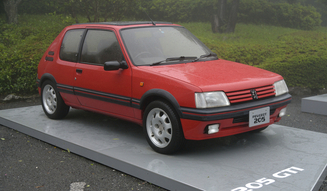
Peugeot 205 GTI | プジョー 205 GTI
Peugeot 208 GTi | プジョー 208 GTi
The Fastest Sport Version in the Series
Test Drive of the Peugeot 208 GTi in Japan (2)
The 208 is a Model Packed with Peugeot's Full Commitment
In fact, even without the GTi designation, the 208 itself can be considered a model packed with Peugeot's full commitment. According to the materials they released, the aforementioned "205" recorded sales of 5 million units worldwide, and the subsequent "206" approached 6 million units. However, the sales figures for the following "207" are not specified.207" are not specified.
This is purely speculation, but perhaps the 207 was not as successful as the 205 or 206. Otherwise, there is no explanation for why the 207's sales figures were not listed alongside those of the 205 and 206.
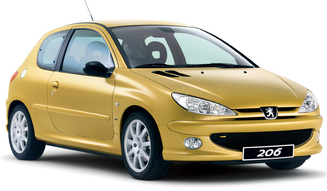
Peugeot 206 | プジョー 206
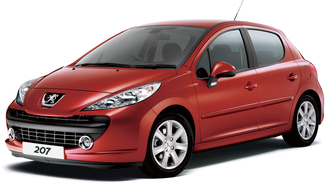
Peugeot 207 | プジョー 207
The 207 was not a bad car in itself. It drove well and had a comfortable ride. Therefore, if its sales were sluggish, the only conceivable reason is that its body size, which was more than 20 cm longer than its predecessor, was not well-received.
Nevertheless, Peugeot humbly accepted the message from the market and crafted the 208 into a new model with a particularly rich substance.
This is evident not only in its more compact size but also in the significantly improved overall quality of the car, the adoption of innovative designs that break away from conventional notions, and the meticulous tuning of the latest technologies.
The extent of this evolutionary leap is clearly reflected in the precisely finished body panels, where the car's quality seems to emanate even into its styling.
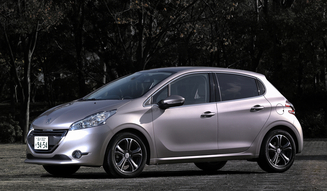
It goes without saying that the 208 GTi, which joins this ambitious 208 series, is a special model. Furthermore, while maximizing its available technology to enhance performance, Peugeot has not only created a spirited hot hatch but also imbued it with a level of sophistication suitable for adult drivers.
This sense of style, or perhaps planning ability, might be the most crucial aspect of the 208 GTi.
Peugeot 208 GTi | プジョー 208 GTi
The Fastest Sport Version in the Series
Test Drive of the Peugeot 208 GTi in Japan (3) Title
Tough Yet Refined
The 208 GTi is powered by a 1.6-liter direct-injection inline-4 gasoline engine with a twin-scroll turbocharger, delivering a series-topping 200ps.
Given that the lightweight 208 body, which performs well even with the 1.2-liter engine producing 82ps, is now equipped with a powerful 200ps engine, it's only natural that the 208 GTi sprints with such verve. However, the engine's remarkably easy-to-handle nature, despite its output of 125ps per liter, is another feature that cannot be overlooked.
Indeed, on the day of the test drive, the weather was unfavorable, with typhoon-like strong winds and heavy rain due to the passage of a low-pressure system. Yet, even in these adverse conditions, the 208 GTi navigated the winding Hakone roads without being overwhelmed by its 200ps output.
This is likely due to not only the flat torque curve that generates strong torque from low RPMs but also the high traction that allows for reliable power delivery to the wheels, even on wet surfaces.
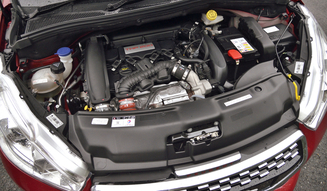
In fact, even when pressing the accelerator pedal deeper when exiting tight corners, the car accelerated smoothly without the traction control intervening.
This performance is likely a result of the appropriate front-rear weight distribution, meticulously designed suspension geometry, and clever engine mount configuration. Additionally, the suspension setting, which allows for relatively soft initial travel, also contributes. The tires consistently gripped the road, even over uneven surfaces, providing effective traction, likely due to this setup.
Another benefit of this suspension setting is the comfortable ride, without transmitting harsh shocks. In fact, the 208 GTi offers a smoother and surprisingly composed ride for this type of hot hatch. It's a tuning that suits a discerning adult more than a boisterous youngster.
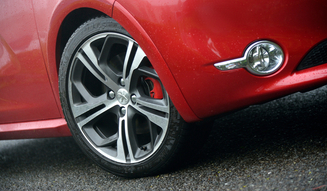
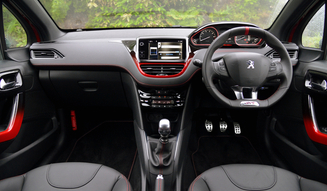
Of course, if the handling were sluggish, it would just be a family car. However, the 208 GTi is by no means sluggish; it navigates winding roads with a pleasing agility and ample stability. The fact that it achieves this level of responsiveness while maintaining solid rear grip demonstrates that Peugeot's renowned chassis tuning expertise is still very much alive.
The gearbox is a 6-speed manual only, and its operation is excellent. The clutch is not unduly heavy, so it should be perfectly usable for daily driving.
Furthermore, while the interior and exterior feature GTi-specific embellishments, it's commendable that they create a sporty atmosphere without resorting to a "childish" aesthetic. Much like the 205 GTI, it seems to effectively express a worldview that is both "tough and refined."
Finally, let us share one particularly appealing point about the 208 GTi. Despite its 200ps engine and comprehensive equipment, the price is a mere 2.99 million yen, just 1 million yen more than the basic grade.
For those who admired the 205 GTI but found it out of reach, this can truly be called a bargain price.

Peugeot 208 GTi | プジョー 208 GTi
Body Size | Length 3,960 x Width 1,740 x Height 1,470 mm
Wheelbase | 2,540 mm
Tread Front/Rear | 1,480 / 1,490 mm
Minimum Ground Clearance | 120 mm
Minimum Turning Radius | 5.4 meters
Weight | 1,200 kg
Engine | 1,598cc Inline-4 DOHC Turbo
Compression Ratio | 10.5 : 1
Bore x Stroke | 77 x 85.8 mm
Maximum Output | 147kW (200ps) / 6,000 rpm
Maximum Torque | 275Nm / 1,700 rpm
Transmission | 6-speed Manual
Gear Ratio | 1st 3.538
2nd 2.041
3rd 1.433
4th 1.102
5th 0.880
6th 0.744
Final Drive Ratio | 3.562
Drivetrain | FF
Front Suspension | MacPherson Strut
Rear Suspension | Torsion Beam
Tires | 205/45R17
Brakes Front/Rear | Ventilated Disc / Disc
Fuel Economy (JC08 Mode) | 13.8 km/ℓ
Fuel Tank Capacity | 50 ℓ
Price | 2.99 million yen