January 23, 2015
Test Drive of the Fiat Panda
Fiat Panda Easy
Test Drive: Fiat Panda in Japan
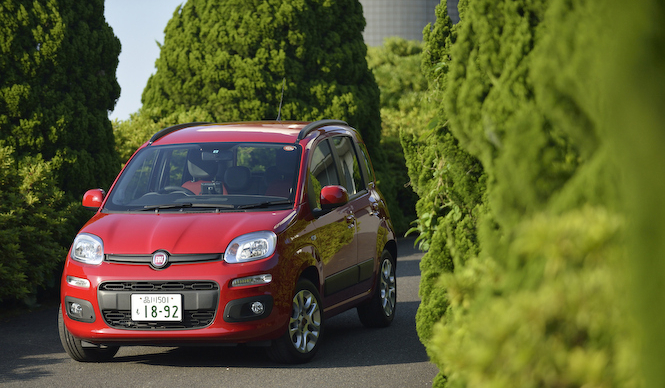
The Fiat Panda, an icon of compact cars. Its third generation, inheriting the name, was released on June 1st.Released in JapanThe third-generation Fiat Panda shares its fundamentals with the Fiat 500 (Cinquecento), but boasts a cheerful design distinct from the 500 and impressive practicality as a 4-door, 5-seater. OPENERS, along with Satoshi Shiomi, test drove this new Panda.
Text by SHIOMI SatoshiPhotographs by ABE Masaya
The Panda Has a Storied Ancestry
When you search for most car models on the internet, their descriptions appear at the top. However, for the Volkswagen Golfis overshadowed by the sport of golf, and the Fiat Panda is ranked below the giant panda.
Both the Golf and the Panda are quite famous among passenger cars and are important models in automotive history. However, because their names are such common, major words, they don't appear at the top of search results. "So what if they don't appear at the top?" you might ask, and that's certainly not what I want to discuss here.
The first-generation Panda was simply too great.
The design was handled by Giorgetto Giugiaro, who visited Japan recently for the launch of the 7th-generation Golf.Giorgetto GiugiaroThis was a work from his time at the carrozzeria Italdesign.
Fiat's requirement was for it to be producible at low cost. Therefore, the first-generation Panda used only flat glass and body panels. Yet, Giugiaro managed to design it stylishly with an excellent package, solidifying his reputation as one of the world's top car designers.
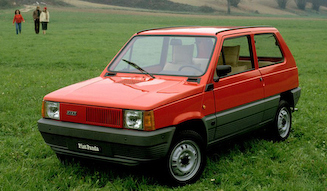
The first-generation Panda was loved for a long time in Italy and across Europe, produced for 19 years from 1980 to 1999. Outside of Italy, it was commonly seen in Spain, likely because Seat, which was part of the Fiat Group at the time, also manufactured it.
The Second and Third Generations
The second generation appeared a few years later, but its appearance was quite different, giving it a weak impression as a direct successor.
Initially, there were plans to give the successor model a new name. However, it was reportedly threatened with a lawsuit for resembling a competitor's model. Thus, the name Panda was given, and it came to be counted as the second generation.
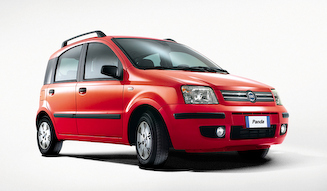
Second-generation Fiat Panda (2003 model)
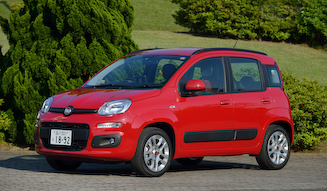
Third-generation Fiat Panda
The third generation has now been released in Japan.
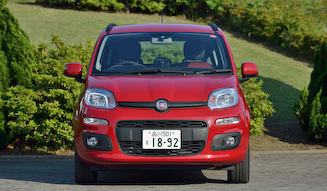
The third generation clearly follows the lineage of the second. It's a 2-box compact car with a short overall length, narrow width, and tall height, maximizing interior space vertically. The standard roof rails suggest it's positioned more as a very compact wagon than a hatchback.
Fiat Panda Easy
Test Drive: Fiat Panda in Japan (2)
Squircle and TwinAir
Both the exterior and interior feature a motif called "Squircle," a coined term combining "square" and "circle" to mean a "rounded square."
The Japanese model comes in a single grade and is equipped with the TwinAir engine, already used in the Fiat 500 (Cinquecento).
This 875cc inline 2-cylinder engine, however, produces a stronger 85ps at 5,500 rpm and 145 Nm (14.8 kgm) of torque at 1,900 rpm, surpassing the 4-cylinder engine of the second generation. While a 2-cylinder might suggest a basic engine, the TwinAir is a high-tech, intercooled turbo engine with sophisticated valve actuation, boasting high efficiency. Fuel economy is rated at 18.4 km/ℓ under the JC08 mode.
The reason for adopting a 2-cylinder engine is to improve efficiency by reducing the engine's weight, decreasing the number of parts, and minimizing mechanical resistance.
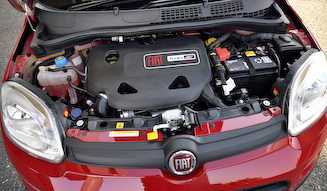
However, because it's a 360-degree crank phase 2-cylinder type where the pistons move together, vibrations are clearly transmitted to the occupants, despite all possible measures being taken. Especially at low RPMs, you can feel the entire car vibrating.
If you find these vibrations unpleasant, your assessment of the Panda will likely be low.
Fiat Panda Easy
Test Drive: Fiat Panda in Japan (3)
Isn't It Okay Not to Be Luxurious?
However, many people may realize for the first time, when driving the Panda or Cinquecento with the TwinAir engine, that the mere presence of vibration isn't necessarily unpleasant.
I am one of them. The rumbling sound and vibration are linked to the driver's "Let's go!" intention during acceleration, so they are surprisingly unobtrusive. In fact, they become an endearing characteristic, making the drive even more enjoyable given the decent acceleration.
Of course, I don't deny the general principle that less vibration is better for mechanical components like engines, and it's not luxurious. It's unlikely to be to everyone's taste.
However, if you try the combination with the robotized manual transmission – which is also not luxurious but is light, inexpensive, and efficient – and find it acceptable, or even like it, then you're in for a treat. You should be able to enjoy driving even without speeding.
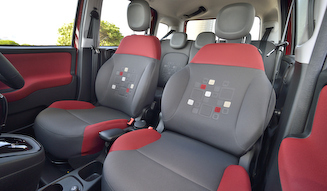
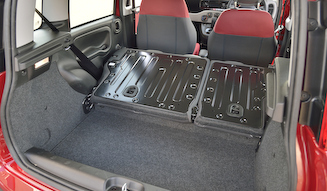
The tradition from the first generation of high utility for its size is inherited. It comfortably accommodates four adults (with a capacity of five) and offers a luggage space of 225 liters with the rear seats up, expanding to 870 liters when folded.
While it exhibits more body roll than the Cinquecento due to its higher stance, the movement is natural and reassuring. The supportive seats are comfortable even on long journeys, and the ride quality was quite satisfactory.
Driving the Panda or Cinquecento makes one ponder: is it only acceptable if it's luxurious?
I genuinely believe Japanese Kei cars are exceptionally well-made, but their efforts to appear more luxurious than necessary can sometimes feel rather melancholic.
Perhaps it's too biased of me to say, but the Panda conveys an honesty that says, "For 2.08 million yen, this is what you get!"

Fiat Panda Easy
Body Dimensions: Length 3,655 x Width 1,645 x Height 1,550 mm
Wheelbase: 2,300 mm
Tread Front/Rear: 1,410 / 1,405 mm
Trunk Capacity: 225-870 liters
Weight: 1,070 kg
Engine: 875cc Inline 2-cylinder Turbo
Max Output: 63kW (85ps) / 5,500 rpm [57kW (77ps) / 5,500 rpm]
Max Torque: 145Nm (14.8kgm) / 1,900 rpm [100Nm (10.2kgm) / 2,000 rpm]
Transmission: 5-speed Automatic (Dualogic)
Drivetrain: FF
Tires: 185/55R15
Fuel Economy (JC08 Mode): 18.4 km/ℓ
CO2 Emissions: 126 g/km
Price: 2,080,000 yen
*Values in brackets are for when the ECO switch is ON.