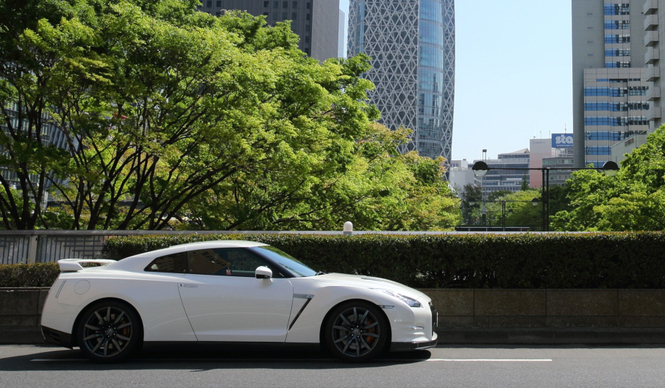
Driving the GT-R Once More | NISSAN
Nissan GT-R | NISSAN GT-R
The Sixth Spring Since Its Debut
Driving the GT-R Again
Since its debut in 2007,GT-Rthe Nissan GT-R has been Japan's flagship supercar. Continuously evolving, we took the 2013 model, now in its sixth year, out onto public roads.
Text by OGAWA Fumio
Photographs by ARAKAWA Masayuki
“It’s Still 90% Complete”
The Nissan GT-R is one of the few Japanese cars featured in OPENERS.
Its unique combination of a 550-horsepower 3.8-liter V6 engine driving all four wheels and a boxy coupe body has garnered attention from car enthusiasts worldwide. Another exceptional aspect of the GT-R as a Japanese car is the strong personal project element driven by Kazutoshi Mizuno, who oversaw its development.
In its Skyline era, the GT-R, which was rarely exported and not offered in left-hand drive, was hailed as a cult car in the UK and other countries, becoming the object of desire for those with a taste for slightly different sports cars. It also garnered fervent support from fans of movies like "The Fast and the Furious," alongside cars like the Subaru Impreza and Mitsubishi Lancer Evolution.
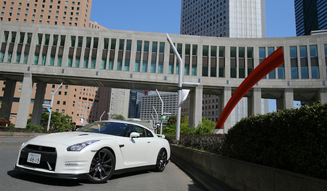
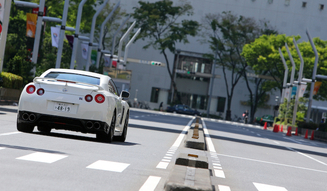
This unique existence, the GT-R, marks its sixth anniversary since its announcement in 2013. During this time,
Kazutoshi Mizunohas offered fascinating insights into the car's improvements, explaining how he addressed specific issues each year.
The 2013 model features minimal numerical changes, including power output. However, Kazutoshi Mizuno stated, “It’s still 90% complete. That’s why we’ve evolved it with each annual model” (FRIDAY, April 26, 2013 issue).
True to his words, refinements have been made to finer details, aiming to enhance both power and controllability. Indeed, driving it, one is impressed by its increased refinement and all-around capability.
Nissan GT-R | NISSAN GT-R
The Sixth Spring Since Its Debut
Driving the GT-R Again (2)
A Superb Sense of Unity
For those accustomed to imported cars, the GT-R's exterior and interior might feel mismatched. The body style lacks elegance, and the interior is surprisingly luxurious, perhaps not fitting for a car that touts a racing image.
It doesn't fully adhere to the TPO (Time, Place, Occasion) principles of fashion. The coordination is off. The controls are complex, the dashboard materials feel cheap, and one can't help but question what the designers were thinking.
However, the mechanical coordination is superb.
Though not apparent from its appearance, its charm becomes evident the moment you start the engine, engage a gear, and press the accelerator.
Despite its relatively large dimensions—4,670mm long and 1,895mm wide—it possesses a remarkable sense of unity. Furthermore, the steering wheel, accelerator pedal, and highly effective brakes provide a direct connection, allowing the driver to feel as one with the car.
To be more specific, the 2013 model features a lowered front roll center, a stiffer stabilizer, revised dampers and springs, larger fuel injectors, and an orifice in the turbocharger's wastegate to enhance power in the higher rev range.
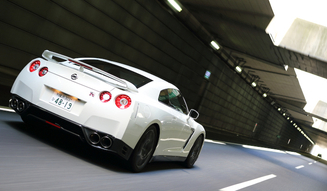
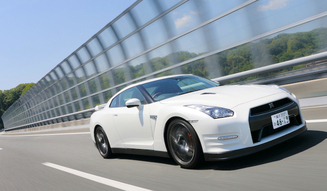
As a result, it feels more comfortable even at the same speed. Torque surges from below 2,000 rpm, and its acceleration and deceleration are on a different level from ordinary cars.
Meanwhile, the suspension has become more supple. Even in Normal mode, let alone Comfort mode, there's no unpleasant harshness, whether on the highway or in the city.
The tires are 255/40ZR20 at the front and 285/35ZR20 at the rear, and they are run-flat types, yet they don't negatively impact ride comfort. The tuning is masterful.
Nissan GT-R | NISSAN GT-R
The Sixth Spring Since Its Debut
Driving the GT-R Again (3)
An Almost Unfathomable Potential
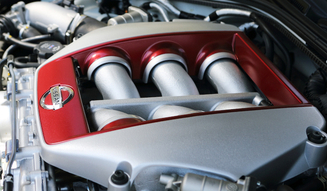
One of the GT-R's greatest attractions is its V6 twin-turbocharged engine. Its revving characteristics are superb—quick to rise and fall, and sporty. The engine is even inscribed with the names of the "Takumi" craftsmen at the Nissan factory who assembled each one, much like swordsmiths.
Although the displacement is large, the engine is compact front-to-back, positioned behind the front axle—a front-midship layout—aiming for sharp turn-in. And, of course, this objective has been achieved. Agility is the keyword here.
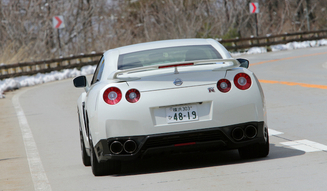
An engine with a light flywheel can be thrilling with manual shifting, but the GT-R's dual-clutch transmission handles the gear changes automatically. While the noise of gear shifts can be noticeable due to sound insulation issues, it's a clear indication of how frequently the six gears are being utilized.
The latest GT-R's maximum torque, now increased to 632 Nm, is available across a wide range from 3,200 to 5,800 rpm, allowing for ample driving flexibility even at lower engine speeds. However, the frequent upshifts and downshifts to maintain the "optimal torque band" mean it's always ready for immediate acceleration.
Indeed, a light touch of the accelerator is enough to propel the car, despite its weight exceeding 1.7 tons, into rapid motion.
The dashboard features a setup switch labeled "R," which, when selected, sharpens the shift timing and the damping force of the Bilstein electronically controlled dampers for a sportier feel.
This combination makes the acceleration feel even more intense.
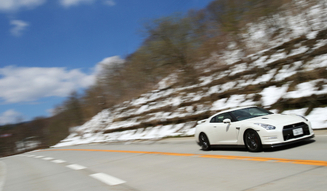
The steering response is incredibly quick; with the slightest input—a slight turn of the wheel to the left or right—the nose instantly changes direction. On public roads, even on tight winding sections, it feels almost too sporty.
This immense potential is arguably the GT-R's greatest allure.
Nissan GT-R | NISSAN GT-R
The Sixth Spring Since Its Debut
Driving the GT-R Again (4)
A Design That Would Normally Be Rejected by Automakers
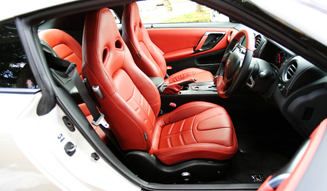
The model tested was the "Premium Edition" (9.786 million yen), which comes standard with the BOSE sound system and an anti-theft system. An optional "Fashionable Interior" with semi-aniline leather is also available (equipped on the test car).
While it's an exceptionally high price for a Japanese car, even at 7 million yen, it would likely not significantly impact sales figures. Comparing it to European sports cars,Porsche 911the most basic model (375ps) costs 11.45 million yen,Mercedes-Benz C63 AMG Coupe(457ps) is 10.85 million yen,BMW M3(420ps) is 10.18 million yen—models with significantly less power are priced higher.
The GT-R holds a significant advantage with its maximum output of 550ps/6,400 rpm and maximum torque of 632 Nm/3,200-5,800 rpm, coupled with its potential for circuit driving in R mode.
Moreover, it's greeted with smiles wherever it goes. It's a model that commands a certain respect from its owner. This, too, is a major draw for owners.
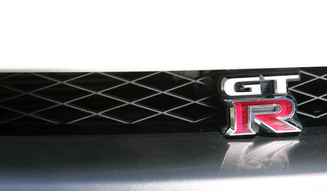
Admittedly, as mentioned earlier, the GT-R falls short in terms of design sophistication, which European manufacturers prioritize. Even the driving position feels more sedan-like; a Jaguar, for instance, offers a much racier atmosphere with its forward-leaning legroom.
But—“I understand that pursuing performance alone leads to this kind of design. This stark design would normally be rejected by automakers. That’s precisely why it’s so intriguing.” A former European automaker’s development chief once told me this. Such paradoxical praise exists.
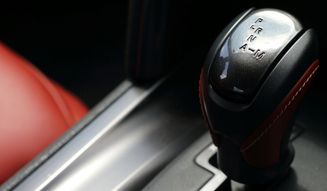
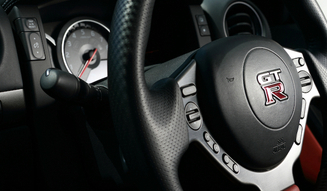
And another thing: the GT-R's human touch is, in fact, its greatest charm. Holding the thick steering wheel, you feel as if you're conversing with Kazutoshi Mizuno.
You find yourself wondering, "Mizuno-san says it's 90% complete, but what constitutes that remaining 10%? Perhaps he wants to make the engine's rev characteristics even sharper?" This self-reflection is precisely what makes a car engaging, and it's a process not limited to automotive journalists—it's enjoyable for anyone.
Recent news has been about the departure of Kazutoshi Mizuno, often called "Mr. GT-R," from Nissan. Just as Dr. Ulrich Bez, who left Porsche engineering to revive Aston Martin with funding from wealthy individuals in the Middle East, there's the possibility that he might not join a Korean automaker as rumored, but instead continue to nurture the GT-R as a Japanese brand. Couldn't we send out such a heartfelt plea?
This was my reunion with the GT-R after a long time, prompting such thoughts.

NISSAN GT-R Premium edition
Body size | Length 4,670 × Width 1,895 × Height 1,370 mm
Wheelbase | 2,780 mm
Tread Front/Rear | 1,590 / 1,600 mm
Minimum ground clearance | 110 mm
Minimum turning radius | 5.7 meters
Weight | 1,740 kg
Engine | 3,799cc V6 DOHC Twin-Turbo
Compression ratio | 9.0 : 1
Bore x Stroke | 95.5 × 88.4 mm
Maximum output | 404kW (550ps) / 6,400 rpm
Maximum torque | 632Nm (64.5kgm) / 3,200-5,800 rpm
Transmission | 6-speed automatic
Gear ratio | 1st 4.056
2nd 2.301
3rd 1.595
4th 1.248
5th 1.001
6th 0.796
Reduction ratio | 3.700
Drive system | 4WD
Suspension Front | Independent double wishbone
Suspension Rear | Independent multi-link
Tires Front/Rear | 255/40ZRF20 (97Y) / 285/35ZRF20 (100Y)
Brakes | Ventilated discs
0-100km/h acceleration | 2.8 seconds
Fuel economy (JC08 mode) | 8.7 km/ℓ
CO2 emissions | 267 g/km
Fuel tank capacity | 74 ℓ
Price | 9,786,000 yen