April 19, 2019
Test drive the new Toyota RAV4.
TOYOTA RAV4 | The Toyota RAV4
Test drive the new Toyota RAV4.
Its specialty is off-road.
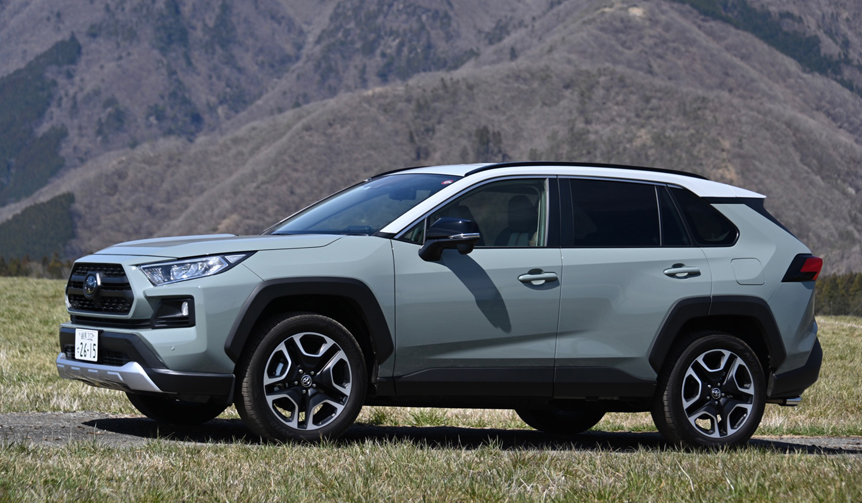
Debuting in 1994, the Toyota RAV4 became a huge hit as a pioneer of passenger car-like crossover SUVs, a segment now handled by most manufacturers both in Japan and abroad. After disappearing from the Japanese market for a time as an overseas-exclusive model, the latest fifth generation has been introduced to Japan, with sales commencing on April 10th. Amidst the global SUV boom, what kind of model has the reborn RAV4 become? We took it for a test drive.
Text & Photographs by HARA Akira
The fifth generation aimed for an SUV-like model with enhanced off-road capability.
Toyota's mid-size SUV, the RAV4, has undergone a full model change to its fifth generation, with sales beginning in Japan on April 10th.
The first generation debuted 25 years ago in 1994, with "Recreational Active Vehicle 4 Wheel Drive" as its name. It pioneered a new genre as a compact, specialty crossover SUV that was suitable for both the outdoors and the city, and was fun to look at and drive.
The RAV4 continued with its second generation in 2000 and third in 2005, growing into a flagship model for Toyota's global lineup, exported to over 170 countries. The fourth generation in 2013 became a more car-like SUV, shedding its iconic rear-mounted spare tire, and continued production as an overseas-exclusive model.
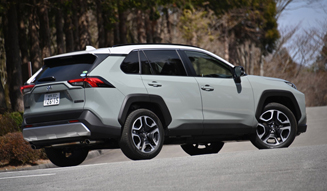
Amidst a global SUV boom that has seen diverse models launched by manufacturers both domestic and foreign, the fifth-generation RAV4 was not designed to pursue the passenger car-like feel or on-road performance trending in current SUVs. Instead, it aimed to be an SUV-like model with enhanced adventure and off-road capabilities.
The car's name has also changed to the acronym for "Robust, Accurate Vehicle with 4Wheel Drive." To assess the capabilities of the new RAV4, which has returned to Japan as a 4WD vehicle combining a powerful, SUV-like design with reliable driving performance and meticulous attention to usability, we participated in a test drive event held at the foot of Mt. Fuji.
TOYOTA RAV4 | The Toyota RAV4
Test drive the new Toyota RAV4.
Its specialty is off-road (2)
Two powertrain options and three 4WD systems
When thinking of Toyota SUVs, urban crossover models like the Harrier and C-HR often come to mind. The new RAV4 measures 4,600mm in length, 1,855mm in width, and 1,685mm in height, making it slightly smaller than the Harrier and larger than the C-HR – a perfectly balanced size.
The wheelbase, however, is a long 2,690mm. While the Harrier's 2,660mm wheelbase can appear somewhat tall, the RAV4 achieves a stable stance with large-diameter tires positioned at the four corners, along with a spacious interior.
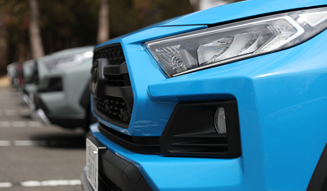
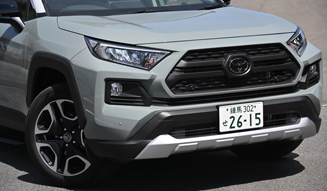
The distinctive front face, unlike the 'keen look' adopted by many domestic Toyota models, features a combination of a large Octagon-shaped grille and sharp-eyed headlights, sharing commonality with the Tacoma and Tundra pickup trucks popular in the North American market, the RAV4's primary target.
The "Adventure" grade, which symbolically represents the off-road image, is also available, featuring a dedicated front grille and bumper with a more powerful presence than the standard model, along with fog lamp bezels.
The powertrain options include the E-Four hybrid, which combines a 2.5-liter inline-4 gasoline engine with a motor to produce a system output of 163kW (222ps), with the engine alone delivering 131kW (178ps) at 5,700rpm and 221Nm of torque at 3,600-5,200rpm. The other option is a 2.0-liter inline-4 gasoline engine producing 126kW (171ps) at 6,600rpm and 207Nm of torque at 4,800rpm.
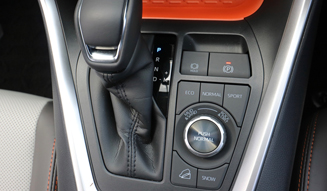
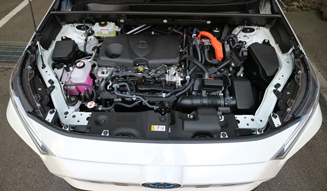
The hybrid uses an electronically controlled continuously variable transmission with a 6-speed sequential shiftmatic, while the gasoline model employs a continuously variable transmission with a launch gear and a 10-speed sequential shiftmatic.
For the gasoline models, there are two 4WD systems: the "Dynamic Torque Vectoring AWD," a world-first system with couplings on both rear wheels that allows torque distribution ratios of up to 50:50 front-to-rear and 0:100-100:0 left-to-right; and the "Dynamic Torque Control 4WD," which has a single coupling before the rear differential and distributes torque 50:50 front-to-rear and left-to-right.
The hybrid utilizes an electric "E-Four" 4WD system that drives the rear wheels with a motor, distributing torque up to 20:80 front-to-rear and 50:50 left-to-right. In total, three distinct 4WD systems are offered.
TOYOTA RAV4 | The Toyota RAV4
Test drive the new Toyota RAV4.
Its specialty is off-road (3)
Testing three 4WD systems off-road
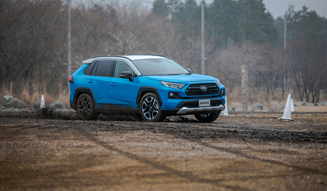
First, we compared the three 4WD systems on a circular dirt course. The procedure involved entering the approximately 300-meter circuit at around 40 km/h, accelerating, and observing the vehicle's behavior.
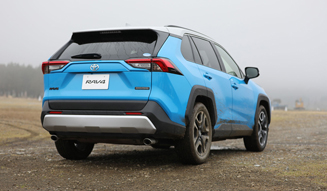
We started with the blue "Adventure" model equipped with "Dynamic Torque Vectoring AWD." As soon as the steering was turned, the nose pointed inward, and the vehicle accelerated through the corner towards the exit. The multi-information display showed how torque was being effectively distributed between the left and right rear wheels.
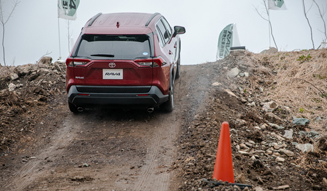
Next, we tried the white "X" grade with "Dynamic Torque Control 4WD." This model exhibited the typical understeer of a conventional 4WD system as it entered the corner, but it allowed for natural cornering through throttle control, making it a viable option in its own right.
Finally, we tested the silver "Hybrid G" equipped with "E-Four." Due to its weight being 60kg more than the gasoline models, the vehicle's movements, both vertically and laterally, were more pronounced, giving a different sense of its behavior.
During cornering, the rear wheels received significant torque, resulting in rear-wheel-drive-like behavior. Accelerating out of the corner tended to induce oversteer, causing the car to tuck inward. However, once accustomed to this behavior, it felt like the car could be drifted at will, making this the most enjoyable option in terms of driving fun.
Next, we experienced a mogul course with large bumps and a steep incline and decline using the two gasoline 4WD models. On the mogul section, one wheel lifted completely off the ground, but the "Dynamic Torque Vectoring AWD" quickly distributed torque to the remaining tires, allowing for easy traversal.
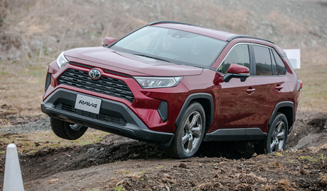
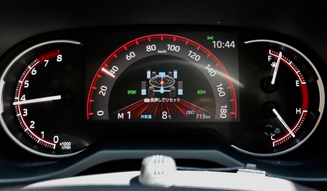
The "Dynamic Torque Control 4WD" could also navigate the course, but there was a noticeable delay in power distribution, resulting in longer wheelspin. The display showed the lifted tire being braked in orange, while the driven wheels were indicated in blue along with their torque distribution.
Furthermore, the former is equipped with "Downhill Assist Control" as standard, which allowed for a stable descent on steep slopes simply by focusing on steering.
For off-road driving, all models allow mode selection via controls such as the Multi-Terrain Select near the shift lever. However, the Adventure uses a rotary dial, the X uses a button push, and the Hybrid G uses a TRAIL mode switch above the dial, each with a different operating method.
TOYOTA RAV4 | The Toyota RAV4
Test drive the new Toyota RAV4.
Its specialty is off-road (4)
Testing gasoline and hybrid models on-road
On the on-road courses around Mt. Fuji, we tested the gasoline "Adventure" model and the hybrid. The "Adventure," with its distinctive front face, serves as the new model's image leader. Its two-tone color scheme of Urban Khaki and Ash Gray Metallic on the roof is particularly striking and suits the vehicle well.
The low instrument panel, wipers hidden from the driver's view, and door mirrors mounted on the doors provide excellent forward visibility. The inclusion of a digital rearview mirror is a welcome feature for a model often used for carrying cargo. The Orchid Brown interior with orange accents also looks appealing.
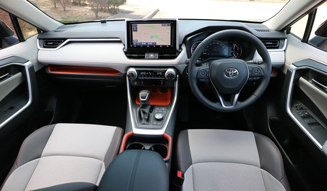
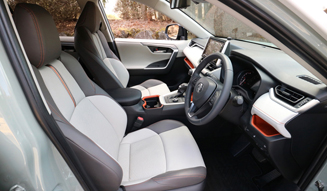
The drive is brisk thanks to the direct-shift CVT with a launch gear. Aside from the characteristic "rubber band" feel that can occur at full throttle with CVTs, there are no complaints.
When cruising without the need for 4WD, the "disconnect mechanism" disengages the drivetrain to the rear wheels, contributing to excellent fuel economy (WLTC mode: 15.2 km/ℓ).
Meanwhile, the hybrid model with its white metallic body conveys a sense of its heavier weight compared to the gasoline version during cornering. However, the 2.5-liter hybrid system is very powerful, and the way it thrusts the vehicle forward like a rear-wheel-drive car is quite impressive.
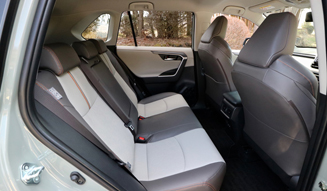
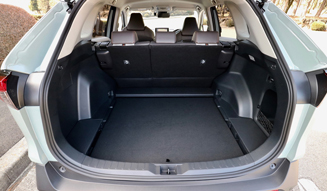
Speaking with Mr. Akira Matsumoto, the chief engineer responsible for the RAV4's product planning, after the test drive, he noted, "In North America and Europe, where sales began earlier, the high performance has been highly praised, with 80-90% of sales being hybrid models. In Japan, however, due to the price difference of 500,000 to 600,000 yen for the engine and motor that are 0.5 liters larger than the gasoline version, we anticipate hybrid sales to be around 30%."
The gasoline 4WD models start at 2,835,000 yen, with the Adventure priced at 3,177,400 yen. The hybrid 4WD models are priced at 3,450,600 yen for the X and 3,817,800 yen for the G (all prices include tax).
Inquiries
TOYOTA Customer Service Center
0800-700-7700 (9:00-18:00)