March 28, 2019
Test Drive of the Fully Redesigned BMW 3 Series | BMW
BMW 330i M Sport | BMW 330i M Sport
Test Drive of the Fully Redesigned BMW 3 Series
The BMW "3 Series," the undisputed benchmark for sports sedans worldwide, has evolved into its seventh generation (G20 model) with a full model change. Under the banner of "Pride of 3," the new model boasts refined design, unparalleled sports performance, and innovative technology. We test-drove the Japanese specification, announced in January 2019 and released on March 9th, to assess its capabilities.
Text & Photographs by HARA Akira
First, the 330i and 320i
Debuting in 1975 as the successor to the "02 Series," the BMW "3 Series" compact sedan established its position as a sports sedan with its easy-to-handle body and high-revving engine. The first-generation E21 model was followed by the E30, which became a popular model in Japan due to the expansion of sales networks coinciding with Japan's bubble economy, famously (or infamously) dubbed "Roppongi's Corolla."
Over successive generations—E36, E46, E90, and F30—the 3 Series has sold a cumulative 15 million units globally. While 500,000 units in Japan, representing 3 percent of the total, might seem modest, it's significant. The German headquarters considers Japan one of the six major global markets, and BMW Japan, the importer, holds considerable influence in determining the concept, specifications, and performance of new models.
"Development of the seventh-generation 3 Series began five years ago," explained Yasunari Mitate, Product Manager for the BMW Brand Management Division.
Specific requests from the Japanese market incorporated into the G20's development include enhancing its premium feel and quality, given that the 3 Series is a aspirational brand for Japanese users, including those transitioning from domestic brands. Furthermore, to deliver the high-performance driving dynamics of the 3 Series to a wider audience, a dedicated engine was developed for the 320i, a variant not offered globally. Japan also leads the world in sensitivity to advanced safety technologies, necessitating the standardization of world-class systems.
Regarding safety, Mitate shared an anecdote: when they informed the German headquarters that even minicars in Japan come standard with automatic emergency braking, the staff were so astonished they nearly fell off their chairs.
Initially introduced to Japan were the high-output "330i" with a 2.0-liter inline four-cylinder turbo engine, and the "320i," a Japan-exclusive specification. As the 320i had not yet arrived, the only available grade for test driving was the 330i M Sport.
BMW 330i M Sport | BMW 330i M Sport
Test Drive of the Fully Redesigned BMW 3 Series (2)
The "3" Has Grown Significantly
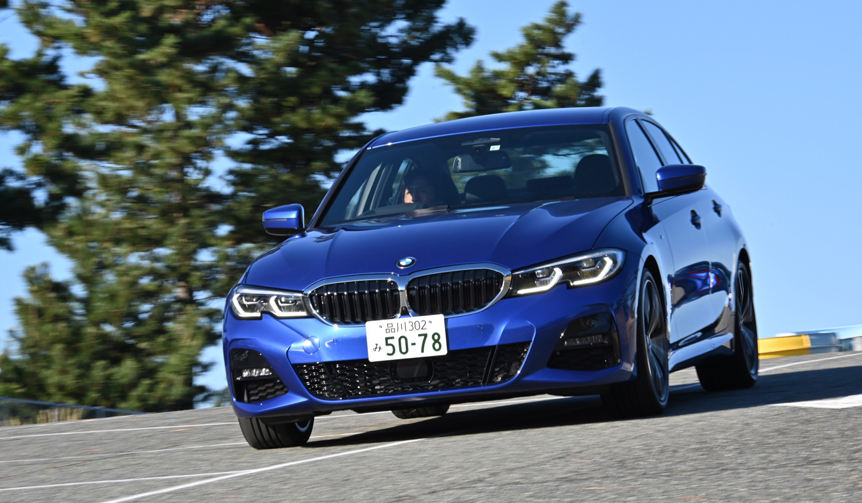
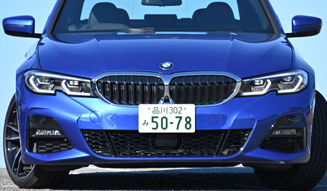
In the hotel parking lot serving as the test drive venue, rows of 330i M Sports in the exclusive Portimao Blue color were lined up. The front featured a kidney grille, redesigned from the previous two-part structure to a single frame, equipped with active grille shutters, and distinctive four-eyed headlights with sharp notches on the lower outer edges.
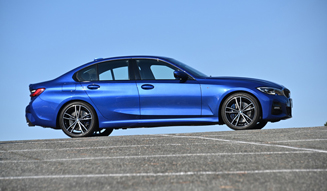
The side panels, eschewing character lines for a sculpted form that evokes sportiness through light and shadow, showcased fresh design elements. Yet, gazing at the long hood characteristic of FR sedans and the BMW's traditional Hofmeister kink with its perfectly balanced roofline and C-pillar, one realizes it is unmistakably still a BMW 3 Series.
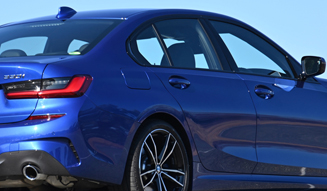
The new model's dimensions are 4,715mm long, 1,825mm wide, and 1,430mm high. Compared to its predecessor, it's 70mm longer and 25mm wider, giving a straightforward impression of "it's gotten bigger" when standing next to it. Once the most compact among premium D-segment rivals, it has now surpassed the Mercedes-Benz C-Class and approaches the size of the largest, the Audi A4.
I once owned an E34 "5 Series," and this new model surpasses it both perceptually and in actual dimensions (the E34 measured 4,720×1,751×1,392mm). The extended wheelbase (2,850mm, 40mm longer than before) and wider track (front +43mm, rear +21mm) likely enhance straight-line stability, handling, and interior space, but concerns about usability on narrow Japanese roads and in parking spaces arise. However, technological advancements have provided solutions.
BMW 330i M Sport | BMW 330i M Sport
Test Drive of the Fully Redesigned BMW 3 Series (3)
Packed with New Equipment and Features
Upon entering the 330i M Sport test car, the first thing that catches the eye is the unique 12.3-inch full digital instrument cluster, standard on the Japanese specification. It displays navigation information in the space between the speedometer and tachometer, which rotate clockwise and counter-clockwise respectively, challenging the conventional notion that round dual dials are inherently BMW (though analog and digital dual-dial options are available in the home market).
The 10.25-inch LCD panel on the center console is touch-enabled and positioned low and forward for easy driver access. This placement was chosen because a significant downward glance would be required to view the navigation screen, deemed too distracting. Information is also projected onto the optional head-up display on the windshield, allowing the driver to concentrate on driving.
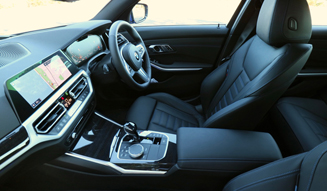
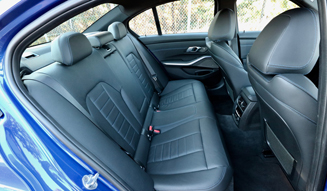
The "Intelligent Personal Assistant," BMW's first AI-powered voice control system, also contributes to minimizing eye movement. While similar systems are appearing in rival cars, BMW's system stands out by allowing users to choose their activation phrase beyond the standard "OK, BMW," such as "San-san-maru" or "M-spo."
Initially, it may not always comply, as in the example: "It's hot, lower the temperature." "What temperature?" "Set it to 21 degrees." "Okay, setting to 28 degrees." It can also be difficult to recognize commands that deviate from standard patterns. To mitigate user frustration in such cases, the system can connect to a human operator. The system is expected to learn driver habits over about a year of use and adapt to regional dialects, potentially even Kansai-ben, as it's used more widely across Japan.
Another feature, standard on the new 3 Series partly in response to its increased width, is the "Reversing Assistant." When unable to proceed forward due to narrow roads or oncoming traffic, engaging reverse gear and checking the Reversing Assistant button on the monitor allows the car to retrace its exact path in reverse without the driver needing to steer.
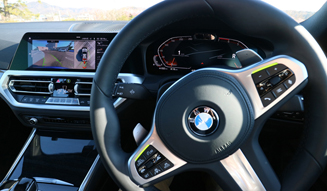
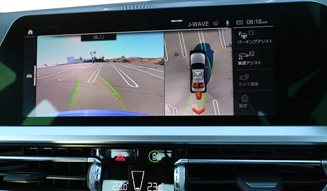
The clever aspect of this system is that it continuously records the car's trajectory for the last 50 meters when moving forward below 35 km/h, rather than requiring explicit activation. In a practical test within a large parking lot, after slowly navigating an '8' pattern, the system accurately retraced the path back to the starting point, displaying the projected trajectory and remaining distance on the monitor. While mastering it requires practice and careful control of acceleration and braking, the experience confirmed its potential usefulness in daily driving.
Furthermore, the standard "Driving Assistant Professional" system, combining three cameras and radar detecting long (300m), medium (120m), and short (20m) distances with Mobileye's EyeQ4 processor—capable of 2.5 trillion operations per second—is touted as the world's best.
Activation is a single press of a button on the left side of the steering wheel, and the system indicates its engagement within the speedometer's frame. It smoothly maintains its position in the lane through corners, without jerky, polygonal movements or ping-ponging between lane markers, demonstrating impressive performance. BMW reports that extensive testing on Japanese roads has enabled the system to maintain lane keeping with minimal deviation on routes like the Tokyo-Osaka stretch.
BMW 330i M Sport | BMW 330i M Sport
Test Drive of the Fully Redesigned BMW 3 Series (4)
The New Model as a Sports Sedan
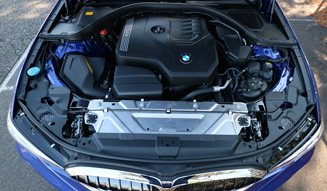
The 330i is equipped with a 2.0-liter B48B20B inline four-cylinder twin-scroll turbo engine, producing a maximum output of 258ps (190kW) at 5,000 rpm and peak torque of 400Nm between 1,550 and 4,400 rpm. This represents an increase of 6ps (5kW) and 50Nm across the usable rev range compared to the previous generation. In standard driving mode, it shifts up efficiently around 2,000 rpm, while in sport mode with paddle shifters, it eagerly revs past 6,000 rpm. The Bavarian four-cylinder engine is undeniably superb.
The test car featured M Sport exclusive equipment such as variable sport steering, suspension lowered by 10mm, an innovation package including laser headlights, the "Adaptive M Suspension" with electronically controlled variable dampers, an M Sport differential for stable high-speed cornering, and a "Fast Track Package" combining these with 19-inch large-diameter wheels, resulting in a razor-sharp sports sedan.
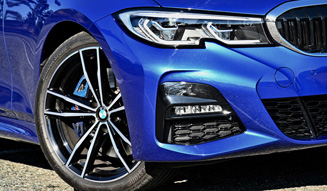
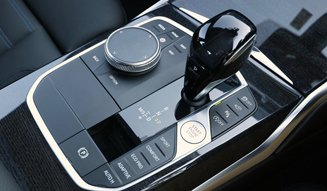
The chassis becomes more stable with increasing speed, the steering, with its thicker grip, precisely navigates S-curves in a single motion, and the brakes are easily controlled. Subjectively, it offers performance comparable to the previous generation's 340i. If the four-cylinder's sound at high revs doesn't bother you, it's a car you could order immediately with confidence.
However, despite the existence of such high-performance models, 90 percent of users in Japan opt for the 320i. Producing such a car is indeed key to the 3 Series' success in Japan. The engine tuned specifically for the 320i delivers 184ps (135kW) at 5,000 rpm and 300Nm of torque between 1,350 and 4,000 rpm, prioritizing performance in the practical driving range. Pricing is ¥6.32 million for the 330i M Sport and ¥4.52 million to ¥5.83 million for the 320i.
BMW has declared this year the "Year of the 3 Series," with plans to introduce diesel models (320d), plug-in hybrids (330e), and an inline-six M Performance model (M340i).
Inquiries
BMW Customer Interaction Center
0120-269-437