April 10, 2019
First Drive: The New Porsche 911 with Tatsuya Otani | Porsche
Porsche 911 Carrera S Coupe
Porsche 911 Carrera 4S Coupe
New Porsche 911 Test Drive Report: Tatsuya Otani
The Latest Porsche Was Indeed the Best
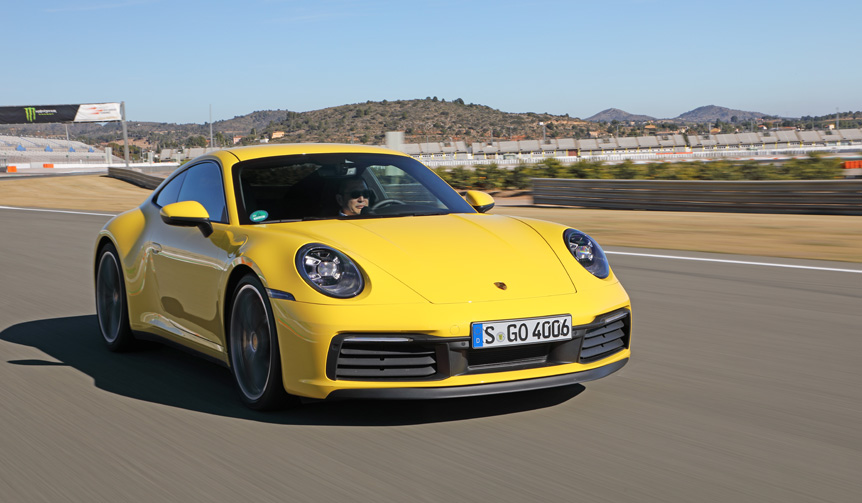
The debut of the eighth-generation Porsche 911 in November 2018 is still fresh in our memory. Motor journalist Tatsuya Otani test-drove the model, which evolved from the Type 991 to the 992, in Valencia, Spain.
Text by OTANI TatsuyaPhotographs by Porsche
Newly Developed Body Utilizes Extensive Aluminum
The Porsche 911 has evolved into its eighth generation after a model change for the first time in seven years. The latest 911 is known as the Type 992 (the seventh generation was the Type 991).
Since the debut of the first generation in 1963, the history of the 911 can be said to be a history of evolution. The original 911, born over half a century ago with a 2.0-liter flat-six engine, had a maximum output of 130 ps and a 0-100 km/h acceleration of 9.0 seconds. By the time of the late Type 991 II Carrera S Coupe (equipped with a 3.0-liter turbo engine), it produced a maximum output of 420 ps. The PDK model achieved 0-100 km/h acceleration in 3.9 seconds (in Sport+ mode). This is why it is said that 'the latest Porsche is the best.'
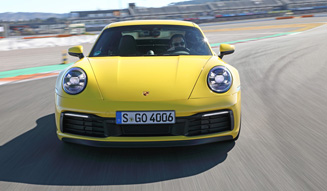
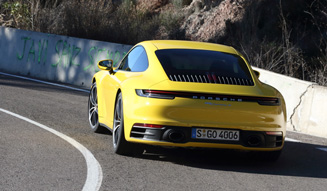
So, what kind of evolution has the eighth generation undergone? This time, we test-drove the 'Carrera S Coupe' and its 4WD variant, the 'Carrera 4S Coupe.' While the basic 3.0-liter twin-turbo flat-six engine remains the same, increased boost pressure and revised combustion have boosted the maximum output to 450 ps. Acceleration from 0-100 km/h has 'evolved' to 3.5 seconds (for the Carrera S in Sport+). For now, only the automatic PDK transmission is available, but its 'evolution' from the previous 7-speed to an 8-speed is also noteworthy.
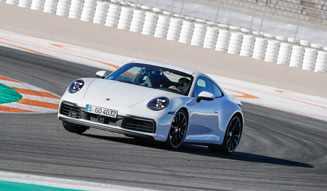
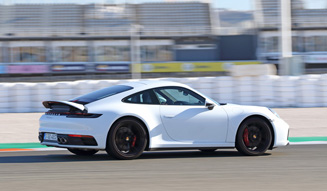
Even more significant is the 'evolution' in the chassis and body. The body structure is newly developed, utilizing extensive aluminum, reducing the body-in-white weight from 252 kg for the 991 to 240 kg for the 992. The new body architecture is called MMB (Modular Mid-engine Platform) and is said to be widely used within the Volkswagen Group going forward. However, contrary to its name, the 992 retains the rear-engine layout, so Porsche fans can rest assured.
Porsche 911 Carrera S Coupe
Porsche 911 Carrera 4S Coupe
New Porsche 911 Test Drive Report: Tatsuya Otani
The Latest Porsche Was Indeed the Best (2)
Ride Comfort Remains Excellent Regardless of Speed
The new body brings with it a review of chassis specifications. As previously reported by OPENERS, while the RWD Carrera S and 4WD Carrera 4S traditionally differed by about 40mm in rear track and overall width (the Carrera 4S being wider), the Type 992 adopts the same wide body for the Carrera S as the Carrera 4S. The overall width is 1852mm and the rear track is 1557mm, both common. Furthermore, the front track, which was 1543mm for both the Carrera S and Carrera 4S, has been expanded to 1589mm. The front tires remain 245/35ZR20, but the rear tires have been increased by one inch from the previous 305/30ZR20 to 305/30ZR21.
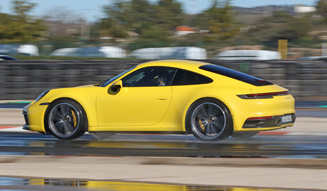
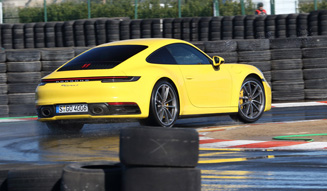
What can be inferred from this is Porsche's effort to increase tire grip. How has this changed the 911's driving dynamics? Below is a report from the international test drive event held in Valencia, Spain. This time, the test focused primarily on the Carrera S, with only a brief test of the Carrera 4S. Therefore, unless otherwise noted, please consider this article to reflect the impressions of the Carrera S.
Sitting in the driver's seat, you notice that the hip point is subtly lower than before. However, the view from the driver's seat is unmistakably 911. The front and side windows are angled relatively vertically for a sports car, providing excellent visibility. The cabin size is also just right, being snugly proportioned to make it easy to gauge the car's dimensions.
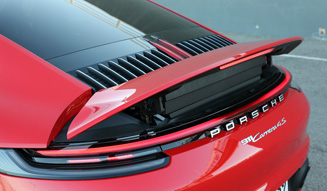
During this test drive, we accidentally took a wrong turn and ended up in a narrow alley. Despite the steep incline and poor visibility, we managed to escape this predicament safely. This suggests that the current 911 can be maneuvered without difficulty, much like the current model, even in congested urban areas or narrow residential streets.
The ride comfort is also excellent. The 911 has always offered a remarkably comfortable ride for a sports car, and this characteristic is carried over to the 992, with road imperfections impressively isolated. Furthermore, the new model incorporates a new theory in its damper control system, designed to keep the body as flat as possible even when one or two wheels encounter a bump. As a result, a comfortable ride is now enjoyable regardless of vehicle speed.
Porsche 911 Carrera S Coupe
Porsche 911 Carrera 4S Coupe
New Porsche 911 Test Drive Report: Tatsuya Otani
The Latest Porsche Was Indeed the Best (3)
Control at the Limit of Driving Has Also Improved
Looking at the performance curve of the more powerful engine, the torque in the low-rev range below 2,000 rpm appears to be less than in the previous model. Indeed, during the test drive, while the low-end torque wasn't as immense as the 991 II, it didn't feel lacking or difficult to handle. Rather, the torque seemed to build up smoothly as the revs increased, which, for a sports car, felt more natural and perhaps even preferable.
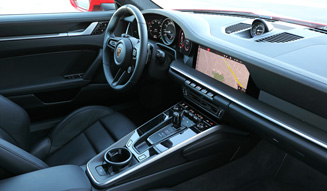
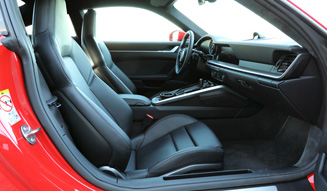
As might be expected from its comfortable ride, on winding roads, the suspension firmly grips the surface even when it's uneven, providing a strong sense of security by extracting stable grip from the tires. This sense of stability rivals that of the 4WD Carrera 4S. In fact, even after driving the same course in the Carrera 4S, no significant difference was observed, likely due to the dry road conditions.
The tendency to provide stable grip remained unchanged even during circuit driving. Moreover, in the medium-to-high-speed corners of the Ricardo Tormo Circuit, the gentle rear-end breakaway at the limit of cornering was easy to perceive and control with counter-steer.
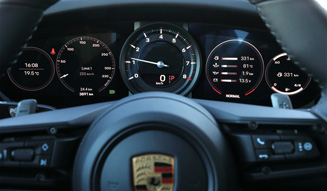
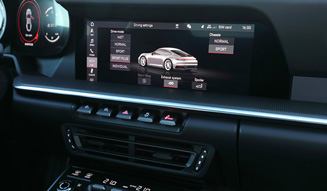
In other words, the new 992 offers a comfortable ride and even greater stability during cornering. If one were to graph its chassis performance, it would show a consistent level of stable grip under all conditions, rather than excelling at a single point. Indeed, the expanded tread and larger tire sizes were used to raise the overall grip level, not just the peak performance. Consequently, their effects are more noticeable in everyday use and on rainy highways, and the handling has become more predictable and easier to manage even during extreme driving.
The latest Porsche is indeed the best. This tradition seems to have been firmly upheld with this model change.
Inquiries
Porsche Customer Care Center
0120-846-911