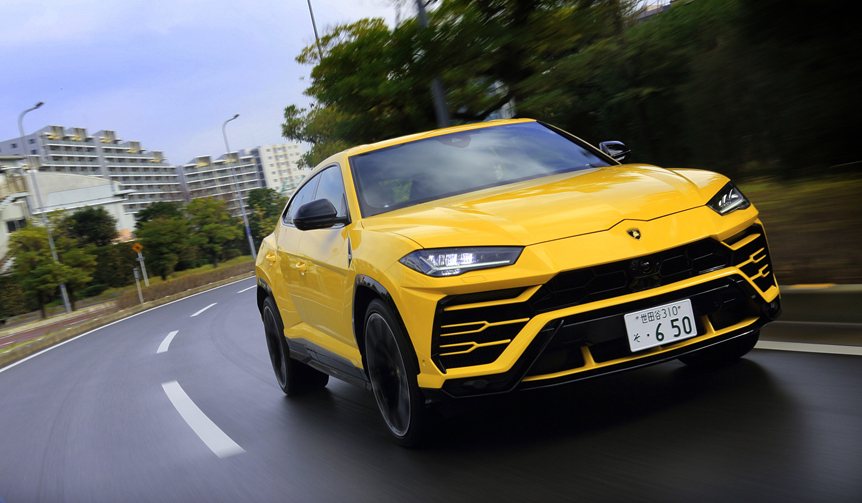
Test drive of Lamborghini's super SUV, the Urus | Lamborghini
Lamborghini Urus
Test drive of Lamborghini's super SUV, the Urus
The "Urus," a super SUV, made its long-awaited debut in December 2017 as Lamborghini's third model after the "Aventador" and "Huracán." Deliveries to Japan began this year. In an era where many premium brands are releasing SUVs, this model stands out. Automotive journalist Tatsuya Otani takes it for a spin.
Text by OTANI TatsuyaPhotographs by ARAKAWA Masayuki
Achieves 0-100 km/h in 3.6 seconds and a top speed of 305 km/h
"The Urus is the first SUV in Lamborghini's history."
If I wrote that, I'd likely receive many complaints from Lamborghini fans. They'd say, "Lamborghini made SUVs before the Urus..."
The story begins in the late 1970s when Lamborghini started developing a high-performance off-roader for military use. Although this model, named "Cheetah," never reached mass production, Lamborghini developed its evolution, the "LM001," in 1981. The "LM002," a civilian version of this, was produced from 1986 to 1992, with a total of 300 units manufactured. Therefore, the Urus is the "second Lamborghini SUV," following the LM002.
However, there is almost no technical connection between the LM002 and the Urus, separated by nearly 30 years. All that remains is the Lamborghini name and the concept of a high-performance car capable of off-road driving.
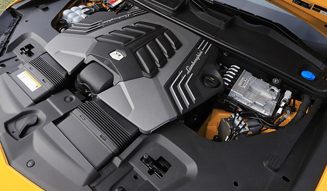
The Urus, a super SUV reborn for modern times, is equipped with a 4.0-liter V8 twin-turbo engine producing 650 ps and 860 Nm, mounted at the front. It drives all four wheels via an 8-speed automatic transmission and a Torsen center differential. The front and rear suspension is based on a multi-link system with air suspension, combined with active stabilizers and four-wheel steering to achieve ideal traction and handling characteristics on various surfaces.
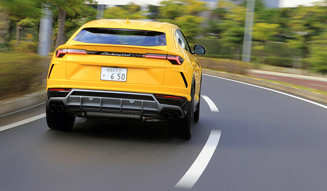
The Urus did not compromise on on-road performance either. With its aerodynamic design and lightweight body utilizing ample aluminum, it achieves 0-100 km/h acceleration in 3.6 seconds and a top speed of 305 km/h. It has attained performance befitting a super SUV, or rather, a true super sports car.
Page 2.The minimal body roll is the first surprise
Lamborghini Urus
Test drive of Lamborghini's super SUV, the Urus (2)
The minimal body roll is the first surprise
The Urus has a distinctly Lamborghini appearance, but there's no need to be intimidated when driving it calmly through the city. Selecting "Strada," the mode for public roads, on the "Tamburo" (Italian for drum) drive selector softens the air suspension and dampers to a comfortable level, preventing unpleasant jolts even on rough surfaces. While the suspension is fundamentally firm, the robust body effectively absorbs input from the tires, suppressing unnecessary vibrations, which is the primary reason it doesn't feel uncomfortable.
Even Lamborghini's first turbo engine has a subdued exhaust note, never becoming overly loud. Furthermore, it delivers ample torque from low to mid-range speeds with excellent responsiveness, making city driving with frequent acceleration and deceleration feel effortless. In fact, thanks to its agile handling and taut suspension, it drives with a lightness that belies its 5.1-meter length and 2.0-meter width. Its agility is so remarkable that it brings to mind the phrase "urban guerrilla" once used to describe a certain Japanese family car.
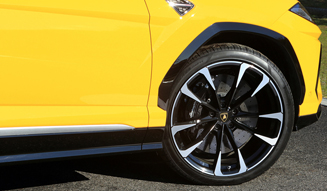
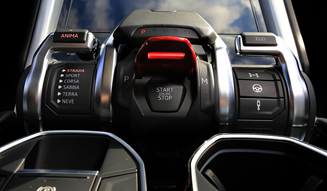
However, the Urus truly comes alive when you select "Sport" on the drive selector on a winding road with less traffic. What's immediately surprising in such conditions is the minimal body roll. No matter how fast you push it, the body barely tilts, maintaining a stable stance as if sinking deeply while remaining almost level. Consequently, even with the high seating position of an SUV, there's no sense of fear; instead, you can enjoy cornering while engaging closely with the tires. Moreover, the steering response is almost perfectly neutral, unlike the understeer common in SUVs, and if the weight transfer and throttle control are just right, it even feels like it could induce slight oversteer.
Furthermore, the engine's response in these situations is superb. As mentioned, the turbo engine provides ample low-to-mid-range torque, but it offers a feeling closer to a naturally aspirated engine, with torque increasing as the revs climb, rather than a perfectly flat torque curve. There are no sudden surges of torque, making it easy to control. These characteristics also serve as a powerful asset when enjoying hard cornering.
Page 3.A super SUV worthy of Lamborghini
Lamborghini Urus
Test drive of Lamborghini's super SUV, the Urus (3)
A super SUV worthy of Lamborghini
Even after hearing all this, die-hard fans might argue, "A V8 turbo can't possibly produce authentic 'Lambo music'!" And indeed, that point must be conceded.
While the "Aventador" with its V12 engine and the "Huracán" with its V10 engine produce highly precise mechanical noises and crisp exhaust notes characteristic of naturally aspirated multi-cylinder engines, the Urus's sound is more elegant.
What's particularly striking is the flowing tone when revved to the top end. Unlike the Aventador and Huracán, which deliver sharp exhaust notes where each explosion within the cylinders is discernible, the Urus emits a smoother, continuous sound. Yet, it still conveys the refined impression of a multi-cylinder engine. While it may differ from the traditional Lamborghini sound, it is a superb auditory experience in its own right.
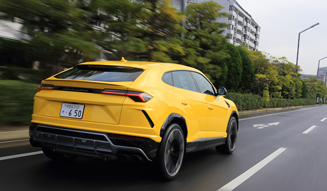
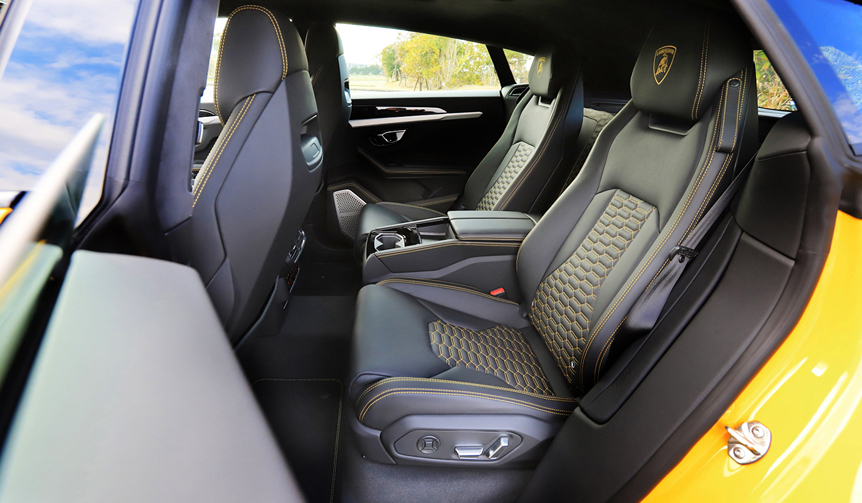
The exterior is a captivating interpretation of Lamborghini's one-volume design, originating from the Countach, adapted for an SUV. The interior shares a design language with the Huracán. The rear seat is a standard bench type; the separate type in the test car was an option. Incidentally, while the rear headroom offered only about 3 cm of clearance, there was nearly 30 cm of legroom (when a 172 cm tall person sat in front of another). Including the comfort of the separate seats, the cabin offers comfort suitable for long drives.
With the spacious visibility and interior of an SUV, combined with the performance that is the prerogative of a super sports car, the Urus is truly a super SUV worthy of Lamborghini.
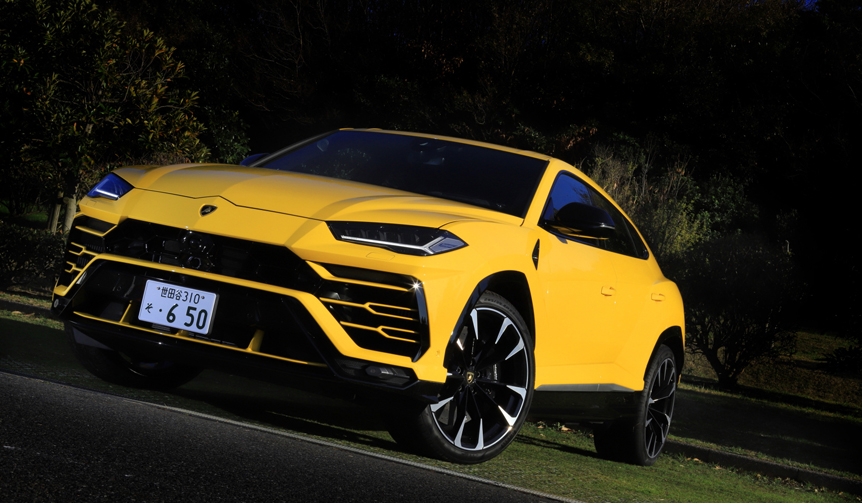

Lamborghini Urus
Body | Length 5,112 x Width 2,016 x Height 1,638 mm
Wheelbase | 3,003 mm
Tread Front/Rear | 1,695 / 1,710 mm
Vehicle Weight | 2,200 kg
Engine | 3,996cc V8 Twin-Scroll Twin-Turbo
Max Output | 478 kW (650 ps) / 6,000 rpm
Max Torque | 850 Nm / 6,800 rpm
Transmission | 8-speed AT
Drivetrain | 4WD
Suspension Front/Rear | Multi-link (Adaptive Air)
Tires Front | 285/45R21
Tires Rear | 315/40R21
Brakes Front | Carbon Ceramic Disc φ440 x 40 mm
Brakes Rear | Carbon Ceramic Disc φ370 x 30 mm
Top Speed | 305 km/h
0-100 km/h Acceleration | 3.6 seconds
0-200 km/h Acceleration | 12.8 seconds
100-0 km/h Braking | 33.7 meters
Fuel Economy (EC) | 12.7 L/100 km (approx. 7.9 km/L)
CO2 Emissions | 290 g/km
Ground Clearance | 150 - 248 mm
Minimum Turning Radius | 5.9 meters
Trunk Capacity | 616 - 1,596 liters
Price (incl. tax) | ¥27,799,200
Lamborghini
Official Website
https://www.lamborghini.com/jp-en
Official Facebook
https://www.facebook.com/LamborghiniJapan/