January 23, 2015
Golf 7 Overseas Test Drive Report - Yasuhisa Shimashita Edition | Volkswagen
Volkswagen Golf
The Future of Cars Is Bright
Experiencing the Evolution of the 7th Generation Golf
Audi,Bentley,Lamborghini,Bugatti… The Golf is the flagship car of the vast Volkswagen Group, which owns numerous prestigious automotive brands. It is no exaggeration to say that the Golf is the benchmark for modern cars and the pinnacle of its era. OPENERS presents evaluations from two experts, both experiencing the car for the first time. Following the familiar Yasuhisa Shimashita,Yasuhiko Kawamurawe now present the impressions of the equally familiar Yasuhisa Shimashita. Mr. Shimashita, who was thrilled by the evolution from the Golf 6 to the Golf 7, shares his reasons in detail!
Click here for Fumio Ogawa's domestic test drive review of the new Golf
Text by SHIMASHITA Yasuhisa
Looks Similar at First Glance...
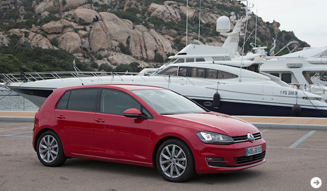
The international press launch for the new, seventh-generation Golf was held on the island of Sardinia, Italy. Upon exiting the airport, dozens of Golfs, ready for departure, were lined up in the parking lot before us.
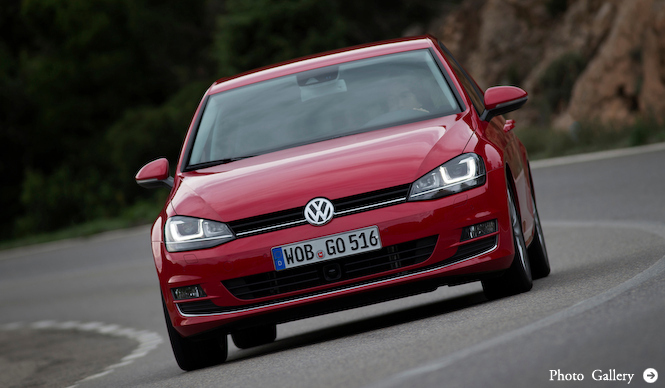
The styling, unmistakably Golf to anyone's eyes, has been retained. Those not particularly interested might not even realize it's a new model. However, those familiar with the Golf will notice at first glance, and the more they look, the more they'll realize it's quite different from the current model.
The body size, always a topic of discussion, has grown slightly again. With a length increase of 56mm and a width increase of 13mm, while the height decreased by 28mm, the dimensions are now 4,255×1,790×1,452mm. The wheelbase has extended by 59mm to 2,637mm. Interestingly, the front wheels are positioned 43mm further forward relative to the driver, shortening the overhangs. This creates a longer nose and a more set-back cabin, giving it what VW's 32-year-old exterior designer, Philipp Röhmers, calls "proportions like a premium car."
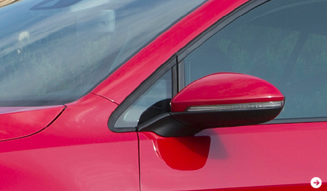
The design is meticulously refined down to the smallest details. The mounting of the door mirrors has been changed, and small triangular windows have been added to the side windows. This, too, contributes to the sense of premium quality. Once pointed out, you can certainly see it.
The horizontal line that runs through the radiator grille and headlamp units, when observed closely, shows a conscious continuity with the character line on the body side and even the line that crosses the tailgate from the taillamps, giving the impression of a lower center of gravity.
Interestingly, the thick, "く"-shaped C-pillar, a distinctive feature of the Golf, has no character line, creating a flat surface.
According to Mr. Röhmers, this "quotes the image of the simple and powerful 'Golf 2' and 'Golf 4'."
Indeed, the volume of this section leading to the rear wheel arch is further emphasized, making the view from the rear three-quarter angle strikingly different than one might imagine.
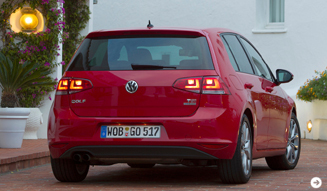
While it may look similar at first glance, it is undeniably a different car. Moreover, as you look at it, it grows on you, and the next time you see the current model, you'll find it looks dated. It's truly a masterful design.
Volkswagen Golf
The Future of Cars Is Bright
Experiencing the Evolution of the 7th Generation Golf (2)
Golf-esque Interior Evolution
Furthermore, while increasing in size, the new Golf has undergone significant weight reduction.
By increasing the use of high-tensile steel plates, employing high-strength hot-formed steel, and using tailor-rolled blanks whose thickness can be varied by section, the white body has been reduced by 23kg. Additionally, by reviewing the engine, chassis, and electrical systems, a substantial weight reduction of up to 100kg has been achieved, depending on the grade. Setting aside usability for a moment, one might not have much to complain about even with the increased size.
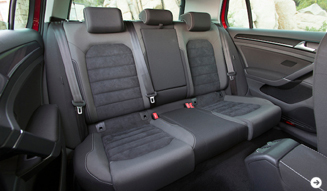
The interior changes are a bit more apparent. For the first time in Golf history, the center console is angled towards the driver. The quality, as usual, is exceptionally high. Although the overall height has decreased, the seating position has also been lowered, and the cabin feels wider, eliminating any sense of confinement. The rear seats are similar. Legroom has increased by 15mm, offering a bit more space.
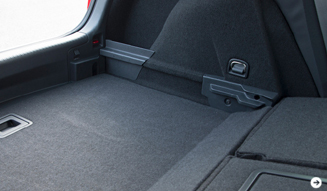
The luggage space has increased by 30 liters to 380 liters. The floorboard can be adjusted to two height levels; raised, it creates a flat surface and storage space underneath, while lowered, it makes loading bulky items easier. The maximum capacity with the rear seats folded is 1,270 liters. The significantly lower height of the opening to the ground is also welcome news for ease of loading and unloading.
Volkswagen Golf
The Future of Cars Is Bright
Experiencing the Evolution of the 7th Generation Golf (3)
A Leap Forward in Driving Performance
While every aspect of the new Golf has undoubtedly progressed, the most significant leap forward has undoubtedly been in its driving performance.
To be honest, given the exceptional completeness of the Golf 6, I hadn't expected something that would surpass it from the outset. However, my expectations were dashed in the best possible way, and quite spectacularly.
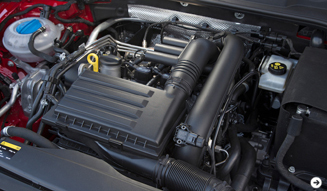
The test drive was of the 1.4TSI with a 7-speed DSG, producing a maximum output of 140ps. What impressed me first was the high level of quietness. The rigidity of the chassis also seemed extraordinary.
The road surfaces in Sardinia are not always smooth, but regardless of the road condition, the robust floor and precisely mounted suspension effortlessly absorbed impacts, transmitting almost no vibration or noise. While sound insulation and vibration damping must be thorough, the foundation of the structure itself appears overwhelmingly solid.
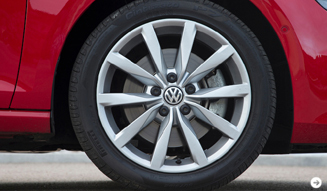
The ride comfort is also impeccable. The test car was equipped with the "DCC" adaptive damping system, so its effect was certainly present, but even so, the sense of premium quality, which felt even superior to the Passat, was remarkable. The combination of a robust body and a suspension that strokes smoothly and stays planted on the road undoubtedly provides a level of comfort that surpasses the class standard, even without DCC.
The handling is also excellent. The weight reduction, combined with a wider track, a variable-ratio steering gear, and the standard inclusion of "XDS," an electronic differential lock function using the brakes, results in immediate grip upon steering input and agile cornering with light agility. Perhaps due to the electric power steering control, the steering feel is a bit muted, but the sense of road contact is maintained even at deep steering angles, and there is no anxiety even when the rear slides, demonstrating a considerable depth of capability.
Volkswagen Golf
The Future of Cars Is Bright
Experiencing the Evolution of the 7th Generation Golf (4)
Class-Leading Environmental Performance and Safety
While the engine is newly developed, it doesn't offer a particularly novel experience during normal driving. However, the ample torque, light revving, and skillful combination with the DSG, along with the lighter body, contribute to a exhilarating acceleration.
In fact, this powertrain incorporates new innovations. The "ACT (Active Cylinder Management)" system, which deactivates two cylinders under light load, contributes to improved efficiency without any noticeable discomfort during operation.
Additionally, when the "Driving Performance Selector" is set to "ECONOMY," the coasting function engages, disengaging the clutch during deceleration to allow for free-wheeling. These features also significantly contribute to the low fuel consumption of 4.7L/100km (approximately 21.2km/L).
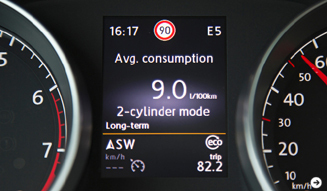
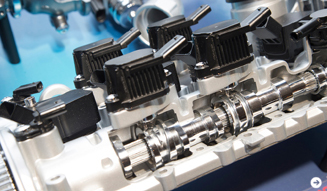
New innovations are also abundant in terms of safety. Beyond the City Emergency Brake, first introduced on the "up!", the car features several VW firsts or segment firsts, such as the Multi Collision Brake, which automatically applies the brakes after an accident to prevent secondary collisions, and the Proactive Occupant Protection system, which tightens seatbelts and closes windows and the sunroof upon detecting a potential accident. These features achieve class-leading safety standards.
The Future of Cars Is Bright
It is undeniably a Golf in both appearance and substance. However, every aspect has been significantly evolved, resulting in a car that feels one or two classes upgraded overall. This is the initial impression upon meeting the new Golf. It doesn't excel in one particular area; rather, all domains have been elevated to a higher level.
Even the current Golf 6 is a superb car that leaves its rivals far behind. To think that Volkswagen has refined it to this extent, seemingly without any significant competition pushing them, is truly awe-inspiring.
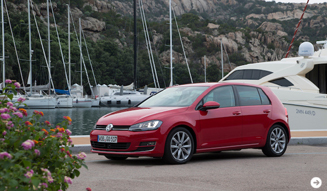
Although the weather in Sardinia was not ideal, I felt as though I could sense the bright future of automobiles while driving the new Golf, and my spirits soared. This truly astonishing new Golf is slated for release in Japan in mid-2013.

Volkswagen Golf 1.4 TSI 103kW (140 PS)
Body Dimensions | Length 4,255 x Width 1,790 x Height 1,452 mm
Wheelbase | 2,637 mm
Tread Front/Rear | 1,549/1,520 mm
Trunk Capacity (VDA) | 380-1,270 Liters
Weight | 1,288 kg
Engine | 1,395 cc Inline-4 Turbo
Max Output | 103 kW (140 ps) / 4,500-6,000 rpm
Max Torque | 250 Nm / 1,500-3,500 rpm
Transmission | 7-speed DSG
Drivetrain | FF
Top Speed | 212 km/h
0-100 km/h Acceleration | 8.4 seconds
Fuel Consumption (NEDC Combined Cycle) | 4.7 L/100 km
CO2 Emissions | 109 g/km
Price | 22,525 Euros