Test Drive of the All-New, Redesigned Citroën C3
Citroen C3 | CITROËN C3
Test Drive of the All-New, Redesigned Citroën C3
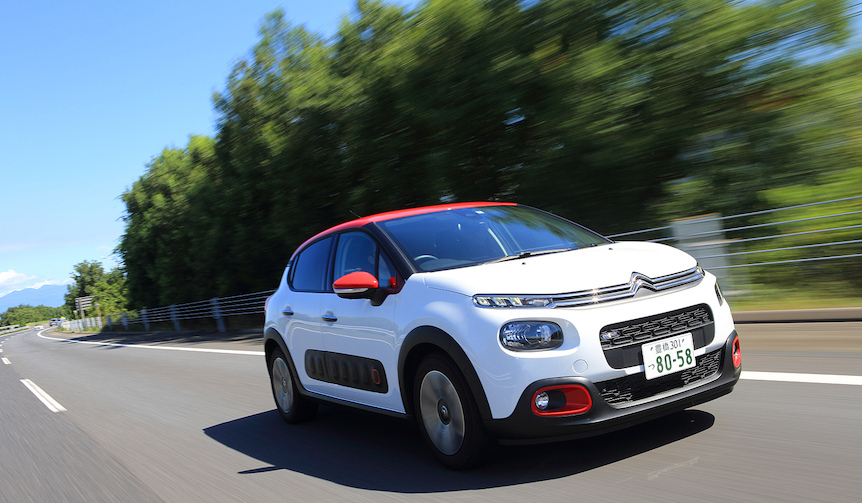
The Citroën C3, a compact model from CITROËN, has undergone a full model change and went on sale in Japan this year. Fumio Ogawa test drove the new C3, which has abandoned its predecessor's rounded styling for a distinctive SUV-like appearance.
Photographs by ARAKAWA MasayukiText by OGAWA Fumio
A Crossover Interpreted in the Citroën Style
French patissier Pierre Hermé used the word "kawaii" for a collection in 2003. By that time, this uniquely Japanese aesthetic had already been accepted there.
I couldn't help but wonder if "kawaii" (as the French pronounce it) was indeed the basic concept behind Citroën's new "C3".
At least, this is the impression anyone living in Japan would have upon seeing this car.
The C3 received a full model change in 2017. The previous generation also had a roofline that suggested an arc, and it was, in a way, a cute car.
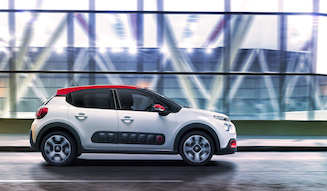
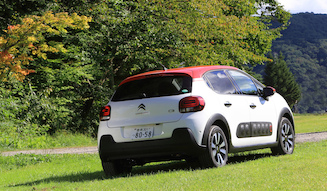
In contrast, the profile of the new model is more conventional. However, the details are meticulously crafted, including the paintwork.
The C3 appears to share a design language with the "C4 Cactus" which was previously released in Japan as a limited edition.
It's difficult for an outsider to interpret this precisely, but Citroën provides a description in its press release.
"It has a unique presence in terms of volume and proportions. That, in essence, is Citroën design. The high-set front end gives a powerful impression while continuing into a horizontal waistline."
In other words, is the new C3 a modern, and distinctly Citroën, interpretation of a crossover between an SUV and a hatchback?
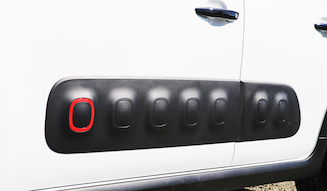
Furthermore, as individuality was a requirement, the designer adopted "Airbumps" as one means to achieve this.
Airbumps are air-filled soft material elements on the car's sides. Six air-filled polyurethane capsules are attached to the metallic body. This is a technique that gained attention with the C4 Cactus mentioned earlier.
Additionally, the test car was a combination of white body color and red roof. The world of automotive design is serious, or rather, forms must have a reason.
Materials are similar. Therefore, using paint for individuality is not highly recommended (or so it should be), except for race cars.
Within this context, MINI and smart have adopted bold color schemes. For smart, the material of the two-tone sections might be closer to the traditional approach.
These cars have been well-received in the market, so the new C3 must have been launched with confidence. The vibrant colors are uplifting, like those of bicycles or sports gear, so let's be (more than!) understanding.
Another impressive aspect is the driving performance. This is not a car that relies solely on cuteness.
Citroen C3 | CITROËN C3
Test Drive of the All-New, Redesigned Citroën C3 (2)
Powerful Performance Beyond Engine Displacement
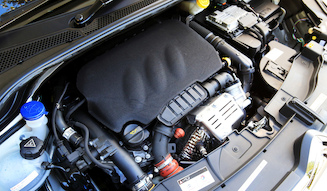
The new Citroën C3, introduced to the Japanese market in July 2017, is a front-wheel-drive model equipped with a 1.2-liter three-cylinder engine and a 6-speed automatic transmission.
It's a compact car with a length under 4 meters, characterized by its bulbous Airbumps rather than large air dams or spoilers.
It has a relaxed atmosphere, to use a phrase that was popular a while ago. However, the driving impression can be summarized as surprisingly powerful.
The maximum torque of 205 Nm at 1,500 rpm is not bad on paper, but the driving feel is genuinely strong.
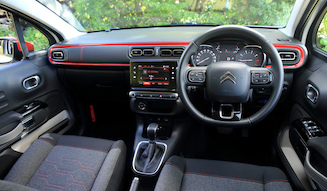
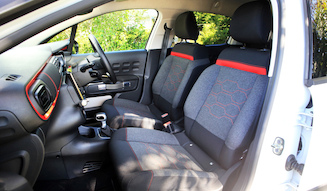
Some European compact cars required the engine to be revved high to achieve good performance.
In contrast, the new C3 drives normally. Moreover, it can easily overtake other cars cruising at a relaxed pace. One should not judge the 1.2-liter three-cylinder engine by old standards.
The 6-speed transmission likely keeps the engine in its optimal torque band. Acceleration is better than expected at any speed. It demonstrates lively acceleration on the highway.
There was no noticeable turbo lag when the engine speed increased. The benefits of the small turbocharger, designed for everyday usability, are fully realized.
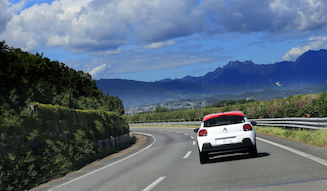
During the test drive, which spanned from central Tokyo to Karuizawa, I never felt a lack of power.
It climbed effortlessly in D mode, both on the uphill sections of the Chuo Expressway near Dangosaka and on the winding roads leading up to Karuizawa Prince Hotel.
France aims to cease the production of internal combustion engines by 2040 (within the country?), but setting aside the merits of that decision, this is a superb internal combustion engine.
Speaking of which, the Renault "Twingo" is also a good car. Compact cars are reaching a level of maturity. Yet, the trend is towards phasing out internal combustion engines. This strikes me as a paradox.
Citroen C3 | CITROËN C3
Test Drive of the All-New, Redesigned Citroën C3 (3)
A Well-Crafted Automobile
The suspension setup also makes for enjoyable driving on winding roads. It doesn't feel harsh, yet the car remains stable in corners.
It holds its composure from corner entry to exit. The handling is trustworthy.
While I haven't tested it at very high speeds, the steering characteristics are nearly neutral during normal driving. It's enjoyable to navigate curves while being aware of the car's slight body roll.
The French perspective on cars includes the notion of "cars as tools," and the C3 is indeed a well-made tool.
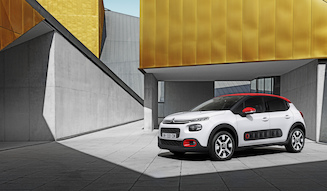
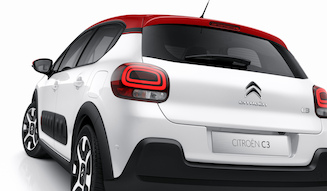
With its optimal compact size for urban environments, acceleration that keeps pace with traffic, good fuel economy, and comfortable seating for four adults, the C3 easily passes the test. Furthermore, it's enjoyable to drive.
Citroën's (and its sister company Peugeot's) product strategy has been bold for the past four years or so.
Starting around the 2013 "C4 Picasso",
the front fascia became such that it's hard to tell which are the headlights. As a result, it's instantly recognizable as a Citroën.
While they likely don't aim for distinctiveness just for its own sake, if German cars are intellectual, this is sensory design. The next design move cannot be logically deduced.
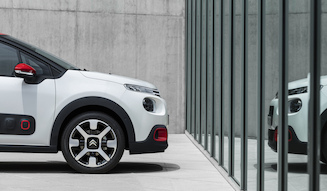
Citroën C3 front
Even with the advent of the electric vehicle era, car manufacturers are currently refining traditional car-making to produce good vehicles. I believe this is a prime example.
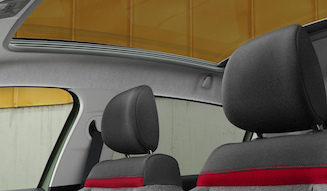
The previous C3 had a unique panoramic windshield that extended overhead. That sense of openness clearly felt like a design that moved "from the inside out."
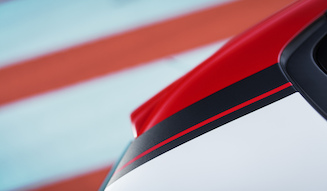
Citroën C3 front detail
The bumper that largely covers the front, the auxiliary lamps embedded within it, and the wheels, which Citroën boasts have the "largest diameter in their class," emphasize its presence.
The new C3 appears significantly more youthful with its model change. The points it emphasizes feel clearer.
Even if it's cute, a car is not a stuffed animal. It's not just about liking it because it feels good.

Citroën C3 Feel
Citroën C3 Shine
Body Dimensions: Length 3,995 x Width 1,750 x Height 1,495 mm
Wheelbase: 2,535 mm
Tread (Front/Rear): 1,480 / 1,480 mm
Weight: 1,160 kg
Engine: 1,199cc Inline 3-cylinder DOHC Turbo
Bore x Stroke: 75.0 x 90.5 mm
Max Output: 81 kW (110 ps) / 5,500 rpm
Max Torque: 205 Nm (20.1 kgm) / 1,500 rpm
Transmission: 6-speed AT (6EAT)
Drivetrain: FF
Suspension (Front/Rear): MacPherson Strut / Torsion Beam
Brakes (Front/Rear): Ventilated Disc / Disc
Tires: 205/55 R16
Fuel Economy (JC08 Mode): 18.7 km/ℓ
Minimum Turning Radius: 5.5 meters
Ground Clearance: 160 mm
Fuel Tank Capacity: 45 liters
Price: (Feel) ¥2,160,000 (Shine) ¥2,390,000
Citroën Call
0120-55-4106 (9:00-19:00, open daily)