Long-Distance Touring from Paris to Geneva in the Peugeot 3008 GT | Peugeot
Peugeot 3008 GT | The Peugeot 3008
Driving Over 1,000km in the Peugeot 3008 GT!
Does an SUV Deserve the "GT" Badge?
Announced in Europe in May 2016, the Peugeot 3008, Peugeot's latest SUV, has been available in Japan since March with a 1.6-liter gasoline engine. We had the opportunity to drive the 2-liter diesel version, the "3008 GT," which is slated for introduction in Japan, on a round trip of 1,200 km between Paris and Geneva. Here is a report from Kazuhiro Nanyo, who was behind the wheel.
Photographs by MOCHIZUKI HirohikoText by NANYO Kazuhiro
A Completely Different Machine from the 1.6-Liter Gasoline Model
Already a hit in Japan, with its initial "Debut Edition" lot selling out shortly after its March launch, the Peugeot "3008" has proven immensely popular. Currently, the lineup features the THP165, a 1.6-liter turbo gasoline model. However, the 2-liter diesel version, the BlueHDi 180, is set for a full rollout starting this summer. Dubbed the "3008 GT," it is positioned as a powerful, sporty grade, similar to the hatchback "3008"308 GTi by PEUGEOT SPORT" and the station wagon "308"308 SW."308 SWThe "GT" moniker, also applied to these models, signifies a powerful, sporty trim level.
In the past, "GT" was a designation far removed from SUVs, belonging instead to a category extending from sports cars. A GT was a car that boasted performance comparable to a sports car, yet offered enhanced weather resistance, ample luggage space for travel bags, and a comfortable ride with sufficient speed for long distances.
The 3008 with its lightweight gasoline engine already garners high praise on Japanese roads for its agile handling, which belies its SUV nature. However, the diesel engine, with its greater power and increased front axle weight, makes for a fundamentally different driving experience. Does it truly live up to the "GT" name?
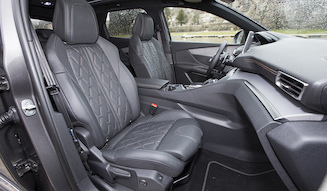
This time, I had the chance to test drive a left-hand drive, European-spec model on a true grand tour: a round trip of 1,200 km from Paris to Geneva, crossing the Jura Mountains and borders. The vehicle was largely in line with the Japanese specifications, featuring a combination interior of faux leather and Alcantara, a six-speed automatic transmission, and the optional panoramic sunroof.
Peugeot 3008 GT | The Peugeot 3008
Driving Over 1,000km in the Peugeot 3008 GT!
Does an SUV Deserve the "GT" Badge? (2)
A Two-Tone Copper and Black That Stands Out in Parisian Scenery
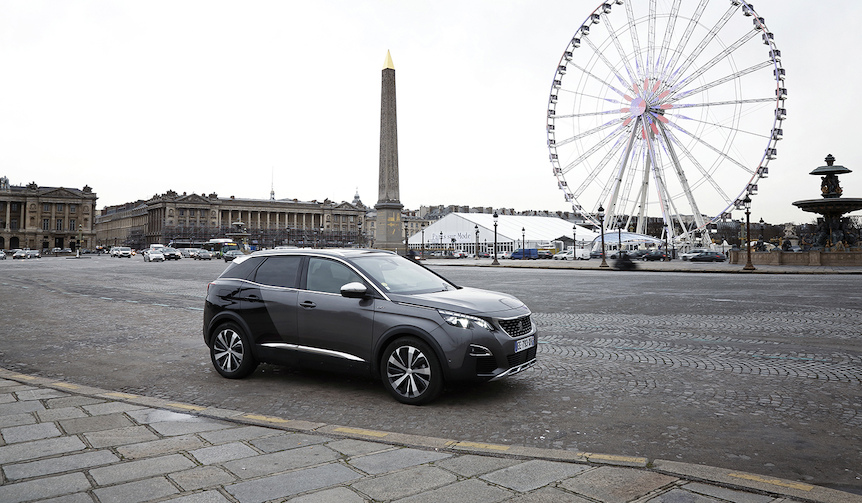
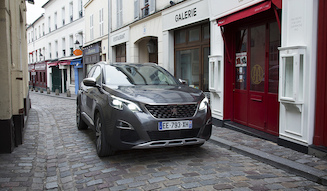
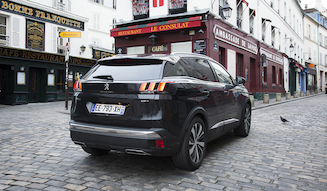
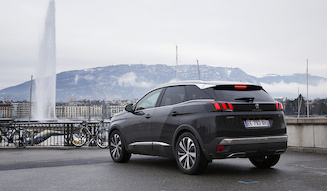
A distinctive feature of the 3008 GT's exterior is its two-tone color scheme, where the rear two-thirds of the body are sharply cut off diagonally. This design, named "coup franche" in French, meaning "clean cut," is a sporty touch also found on the 308's GTi and GT models. The test car, in metallic copper and black, struck a perfect balance between being neither too flashy nor too subdued.
This bold yet subtly expressed aesthetic, a kind of "just shy of excessive" beauty, surprisingly harmonizes well with the Parisian cityscape. Despite the rain, which called for umbrellas, the frequent glances from passersby were a testament to the 3008 GT's eye-catching appeal.
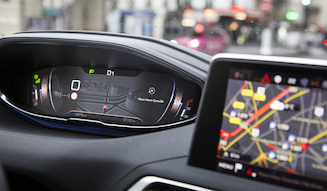
Departing from Peugeot's headquarters behind the Arc de Triomphe, we first navigated through Paris to reach the highway entrance. Driving in the city, the elevated driving position typical of SUVs offered excellent visibility, the refined ergonomics with minimal buttons to operate were a pleasure, and the 400 Nm of torque allowed for effortless acceleration past other cars at traffic lights. These factors effectively reduce the sense of confinement and stress often associated with urban driving. Although the 3008 GT's width of 1,860mm is slightly wider than the gasoline 3008's 1,840mm due to its fenders, it was not noticeably cumbersome.
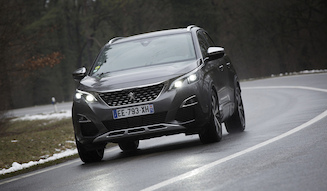
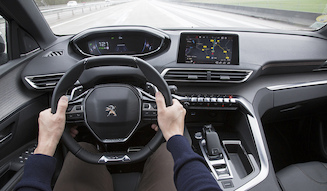
However, it wasn't until we merged onto the highway near Porte d'Orléans, still caught in traffic, and accelerated fully after the toll booth that the BlueHDi 180 truly revealed its potential. In a good way, this engine is remarkably un-diesel-like.
The BlueHDi 180 reaches its peak torque at 2,000 rpm, which is relatively high for a diesel engine. While it offers ample torque below this, it truly excels in its surge, punch, and responsiveness above 2,000 rpm. Cruising at the French legal speed limit of 130 km/h keeps the engine at just under 2,000 rpm in sixth gear, and at 110 km/h, it's around 1,700 rpm. It performs its supporting role so discreetly that conversations inside the cabin are easy and clear.
Furthermore, the ride comfort, noticeably more settled than the 1.6-liter version, and the solid straight-line stability are reassuring. The suspension quickly and smoothly absorbs bumps, and combined with the luxurious feel of the Alcantara-trimmed dashboard, it creates a refined cruising experience comparable to a sedan. While the driving position is that of an SUV, it possesses the long-legged speed expected of a GT, enabling effortless long-distance journeys.
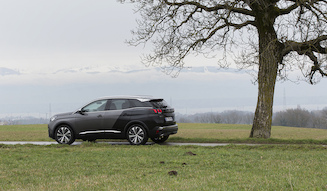
However, simply taking the highway to Geneva would be rather mundane. After passing through Burgundy, we decided to detour from the town of Dole and cross the Jura Mountains into Switzerland. The town of Montbéliard, where Peugeot was founded, is also located in a valley along the Jura range. We couldn't pass up the opportunity to drive through what is essentially Peugeot's home turf.
The 3008 GT, one of Peugeot's latest creations, performs admirably, effortlessly navigating the winding local roads as if singing. Although not as steep as the Alps, the numerous hills and valleys with continuous medium-to-high-speed corners demand not only precise steering and excellent tracking but also supple road holding to absorb occasional rough patches.
Peugeot 3008 GT | The Peugeot 3008
Driving Over 1,000km in the Peugeot 3008 GT!
Does an SUV Deserve the "GT" Badge? (3)
The Reason Peugeot Didn't Make the 3008 All-Wheel Drive
Still, I was impressed by the speed at which locals drove their older Peugeots through these roads. While this region experiences icy conditions in winter, if such spirited driving is the norm, then a heavy four-wheel-drive system would be a hindrance during the other three seasons. Peugeot's insistence on solutions like Advanced Grip Control, which electronically manages traction based on road conditions without adding weight, reflects their emphasis on agility and economy in daily use. Considering this, one truly appreciates the "terroir"—the soil and climate—that has nurtured Peugeot's handling prowess, including that of the 3008 GT. The tenacious road holding, which allows for precise control even in a practical vehicle, has been developed out of necessity rather than as a luxury.
At just over 1.6 tons, the 3008 GT's weight is standard for a C-segment SUV, but it's on the heavier side for a diesel-powered vehicle. Conversely, this highlights how light the 1.6-liter gasoline version of the 3008, weighing under 1.5 tons, truly is.
However, this translates into a distinctly sharper acceleration out of corners. Torque steer, a common trait in powerful front-wheel-drive cars, is barely perceptible, and the speed noticeably increases towards the next turn. While the car's size is apparent during braking and cornering transitions, once in the turn, the low center of gravity and supple suspension become enjoyable. In contrast to the agility of the 1.6-liter version, the 3008 GT with the 2-liter BlueHDi 180 offers a "robustness" as its key characteristic.
Beyond the mountains, the road surface noticeably improved, and the corners became gentler as we entered the Swiss canton of Vaud. Although not a member of the EU, the Swiss border, now part of the Schengen Area, retains customs checks but no passport control. The slopes at the foot of the mountains stretch down to Lake Geneva, with the peaks of the Alps peeking through the clouds. In the distance, the famous Jet d'Eau on the lake is slightly swayed by the wind. Geneva was now within reach.
In countries like Switzerland, where the price difference between gasoline and diesel is negligible, the economic benefits of diesel are less pronounced. The 3008 GT's 52-liter tank costs just under 5,000 yen to fill completely in Switzerland. On this round trip, despite some spirited driving on local roads including mountain passes, we achieved an average fuel economy of 15 km/liter. In Japan, with its generally lower speed limits, a single tank should provide a range of nearly 800 km.
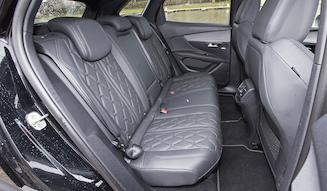
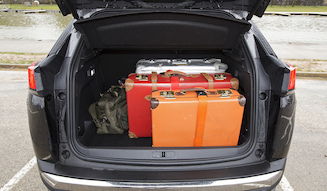
Overall, the 3008 GT's qualifications as a "GT" were satisfactory. However, considering that the hatchback 308 BlueHDi 120, a 1.6-liter diesel, offers around 20 km/liter in normal use and a range of approximately 1,000 km on a full tank, one can't help but wish for a 1.6-liter diesel model in the 3008 SUV lineup as well.
With models like the 308 and 3008, Peugeot's vehicles built on the EMP2 platform have steadily increased their premium feel, positioning them a step above other European mass manufacturers like Ford and Opel, and making them a credible challenger to German cars. Therefore, it is hoped that Peugeot will not only offer the top-tier 2-liter GT but also introduce the 1.6-liter diesel, a flagship of clean diesel technology, to the Japanese market.