First Drive: The New Discovery in Utah | Land Rover
Land Rover Discovery | The Land Rover Discovery
First Drive: The New Discovery in Utah
The Benchmark for Modern SUVs
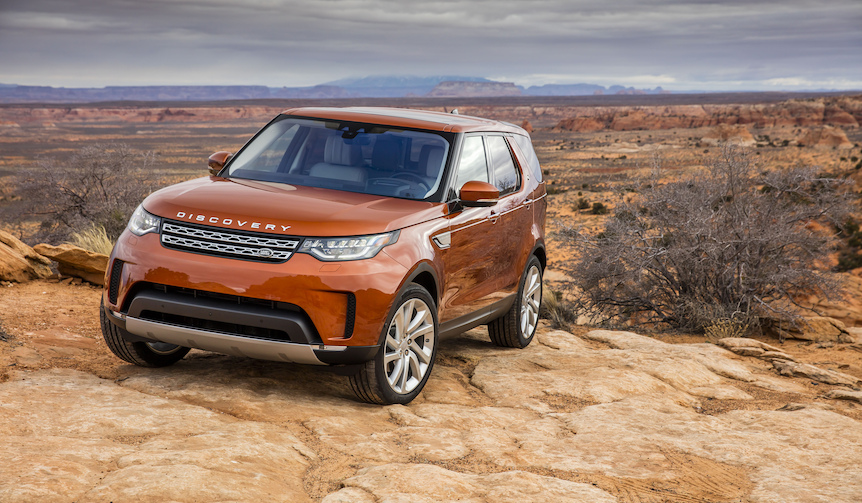
The new Land Rover "Discovery," which just went on sale in Japan on April 5th,Discoverywas test-driven by automotive journalist Hirohisa Kaneko in Utah, USA, prior to its introduction in Japan, where he experienced its evolution firsthand.
Text by KANEKO Hirohisa
A Robust and Expressive Design
The Land Rover Discovery has undergone a full model change. This is the fifth generation of the model. The Discovery is a core SUV for Land Rover, featuring a genuine off-road capability with height-adjustable air suspension and a two-speed transfer case.
Based purely on its chassis mechanics, it is identical to the company's top model, the "Range Rover". The significant difference is that the Discovery is equipped with a 3-row, 7-seat configuration.
I have previously driven the first through fourth generations of the Discovery on and off-road, both domestically and internationally, and have experienced their evolution firsthand.
There have been two major changes in its evolution. The first was the adoption of air suspension, and the second was the installation of the "Terrain Response" system, which is now standard on all Land Rovers, allowing drivers to select different modes based on road conditions.
These two advancements first improved on-road performance and off-road capability, and then enabled the two to be harmoniously balanced at a high level without contradiction.
Consequently, the difference between the first and fourth generations is as vast as night and day, which is astonishing. Of course, technological advancements have occurred in the interim, and most SUVs on the market have seen significant performance improvements. However, the Discovery has consistently led the way at every milestone.
So, how much has the fifth generation changed from the fourth? I went to a media test drive event in Utah, USA, to find out.
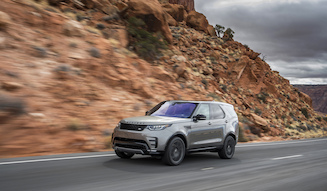
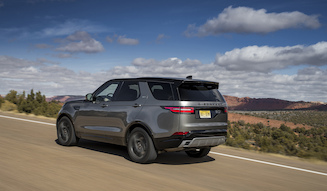
Based on the announcement images alone, I felt a similarity to the "Discovery Sport", but the actual vehicle is significantly different. The elder sibling is robust and expressive. While evolving the design of the previous Discovery, it has succeeded in establishing a new image.
Details such as the stepped roof and its windows that wrap around to the sides, and the asymmetrical cut of the tailgate, have been refined and carried over in a modern way.
However, more fundamental than these are the overall proportions, particularly the design of the rear of the body, which is cut off at a nearly vertical angle.
It rises almost vertically and then tilts slightly forward from just below the window line. While this upright stance is difficult to convey in photographs, it is the very identity of the successive Discoveries.
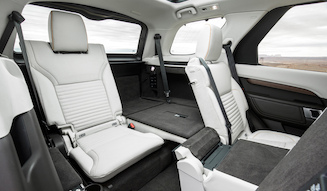
The vertical tailgate is designed to maximize cargo space during demanding outdoor activities. This simultaneously enhances versatility and contributes to the 7-seat, 3-row configuration.
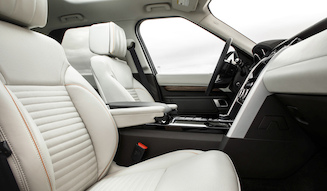
The cockpit design is an evolution of the previous "Discovery" and the current Range Rover, and "Range Rover Sport". The 10-inch screen at the top of the center console controls the infotainment system and is called "InControl Touch Pro."
In addition to touch control, voice control is also possible. In front of the shift lever is the rotary switch for Terrain Response 2, and next to it are switches for Hill Descent Control, ride height adjustment, and the ATPC switch, which will be discussed later. The materials, finish, and the quality and finish of the leather upholstery have also become as luxurious as the Range Rover, which is one of the significant changes.
What was surprising was that the speedometer and tachometer were conventional, with needles, rather than screen-based. While it has approached the Range Rover in terms of off-road capability and luxury, perhaps they deliberately kept these conservative.
Land Rover Discovery | The Land Rover Discovery
First Drive: The New Discovery in Utah
The Benchmark for Modern SUVs (2)
Exceptional Quietness and a Smooth Ride, Surpassing Even the Range Rover
Driving the "HSE Lux" (US specification) equipped with a 3-liter V6 diesel turbo engine, the first thing that surprised me was the high level of quietness and the smooth ride.
The road noise that should have been audible from the tires was almost imperceptible, and similarly, fine vibrations were not transmitted. They were not transmitted from the body or the steering wheel. This level of quietness and smoothness is not only first-class for an SUV but also ranks highly among all categories of vehicles, including sedans.
This remained unchanged even when merging onto the freeway from local roads and increasing speed. The exhaust noise and vibration from the "TdV6" diesel turbo were also impressively suppressed. While diesel-specific noise and vibration are noticeable at idle, they dissipate as soon as the engine speed increases even slightly.
The initial impression upon driving was this high level of quietness and smooth ride. Compared to the previous Discovery, this is a significant evolution, and I even felt it might surpass the flagship Range Rover.
This is likely due to the new aluminum monocoque and improved air suspension adopted by the new Discovery. In any case, the on-road cruising experience has become exceptionally refined.
The combination of the 3-liter V6 diesel turbo engine, producing a maximum output of 258ps and a maximum torque of 61.2kgm, and the 8-speed automatic transmission is flawless. Manual shifting can also be performed using the paddles behind the steering wheel, which is also excellent in this regard.
I also drove the "HSE" equipped with the 3-liter V6 "Si6" gasoline engine. The high level of comfort, such as quietness and ride quality, remained unchanged, and I was not particularly aware of the difference in engines.
Of course, there is a difference in that the diesel has higher maximum torque but lower maximum output than the gasoline engine, resulting in a slight difference in acceleration at high speeds, but there is no practical issue.
Personally, I felt the diesel, with its superior acceleration at low speeds and from a standstill, would be more suitable for situations where you are driving off-road or on snowy roads with a full load of passengers and luggage. The Japanese specifications will initially offer two engine options: these V6 gasoline and diesel engines, so it will be necessary to consider them along with the equipment.
Furthermore, it is good news that the range of operation for folding the characteristic 3-row, 7-seat configuration of the Discovery, using buttons located in the luggage compartment, has been expanded.
If I had to point out a weakness, it would perhaps be the forward downward visibility, which is obstructed by the large door mirrors.
If we broadly divide Land Rover's current SUV lineup into two groups, we have the Range Rover, Range Rover Sport, and Discovery, which have longitudinally mounted engines, and the "Discovery Sport" and "Evoque", which have transversely mounted engines.
The engine mounting orientation itself is not the essential difference; rather, the longitudinally mounted vehicles are fundamentally different in that they are equipped with a two-speed transfer case and height-adjustable air suspension.
Using the low-range mode of the two-speed transfer case allows for better utilization of torque at lower engine speeds, and the center differential can also be locked. Being able to raise or lower the vehicle's ride height while driving allows it to traverse rocks, ditches, and ruts.
Even with the SUV boom, there are few truly capable off-road vehicles in the world equipped with a two-speed transfer case and air suspension. This is understandable. Not everyone wants to climb rocky mountains or cross ditches in their own car.
Furthermore, the height-adjustable air suspension can also lower the vehicle, which actually helps in achieving a balance with on-road performance.
While the low-range mode was present in early Discoveries, the air suspension was added later.
Land Rover Discovery | The Land Rover Discovery
First Drive: The New Discovery in Utah
The Benchmark for Modern SUVs (3)
Potential That Foretells the Near Future of SUVs
In addition to these two devices, Land Rover vehicles feature another decisive device: "Terrain Response 2." The "Terrain Response 2" in longitudinally mounted Land Rovers includes an Auto mode in addition to the five driving modes: On-Road, Grass/Gravel/Snow, Mud/Ruts, Sand, and Rock. The Auto mode automatically selects the appropriate mode by assessing the road surface.
Depending on the selected driving mode, it integrates and controls the throttle, gears, power distribution to all four wheels, and other electronic controls.
I have driven Discoveries from before the era of Terrain Response, and in extreme situations, they were overwhelming. Watching an expert driver from the passenger seat, they used their hands and feet like a thousand-armed Kannon, making optimal adjustments at optimal times to navigate difficult terrain.
Terrain Response replicates all of these expert off-road driving techniques through electronic control. The more extreme the conditions, the more effective the magic becomes.
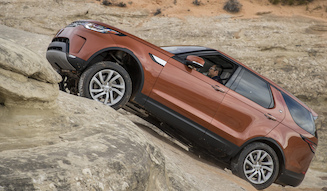
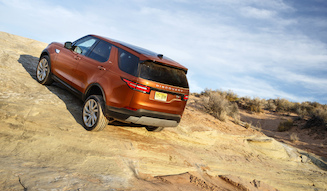
In sections set up within the vast natural landscape of Utah, the new Discovery demonstrated the full capabilities of these devices, conquering rocky ascents, steep sand dunes, and deep ruts. It was also subjected to mud that would require a high-pressure wash to clean.
You can imagine its astonishing off-road capability when you consider that it can drive through places where you couldn't even walk. The many photos featured here are not tricks.
What impressed me was the addition of "ATPC," which is already available on the Range Rover. By turning on this function, you can continue driving over rough rocky terrain at a set speed.
Indeed, when I tried it on a steep rocky climb, I truly appreciated the value of this device. On rocky terrain, you must meticulously choose your path inch by inch to avoid puncturing a tire, and being freed from precise accelerator control at such times is immensely significant.
This is a testament to Land Rover's development team's deep understanding of real-world usage. This technology will likely evolve into off-road autonomous driving in the not-too-distant future. The new Discovery embodies the potential that foretells such a future for SUVs.
The concept car announced at the 2015 New York Auto Show could scan the road surface with a camera and drive along the safest path. It offered an automatic mode where the car handled the driving while projecting the path onto the windshield, as well as a semi-automatic mode where the driver steered while the car assisted.
The longitudinally mounted Land Rover vehicles, such as the previous Discovery, Range Rover, and Range Rover Sport, are equipped with devices for serious off-road driving, including "Terrain Response 2," but these are even easier to use in the Discovery.
While you may not always need this level of off-road capability, the new Discovery's ability to intelligently confront nature is its charm and strength. That remains unchanged.
Combined with its off-road prowess, the aforementioned improvement in on-road comfort can be confidently stated to have returned the Discovery to its position as the benchmark for modern SUVs. While the fifth-generation Discovery has undergone a significant visual transformation, its content and performance have correspondingly moved upmarket. I eagerly await the Japanese specifications.