Test drive of the 3rd generation TT's high-performance model, the "TT RS" | Audi
Audi TTRS | The Audi TT RS
Test drive of the 3rd generation TT's high-performance model, the "TT RS"
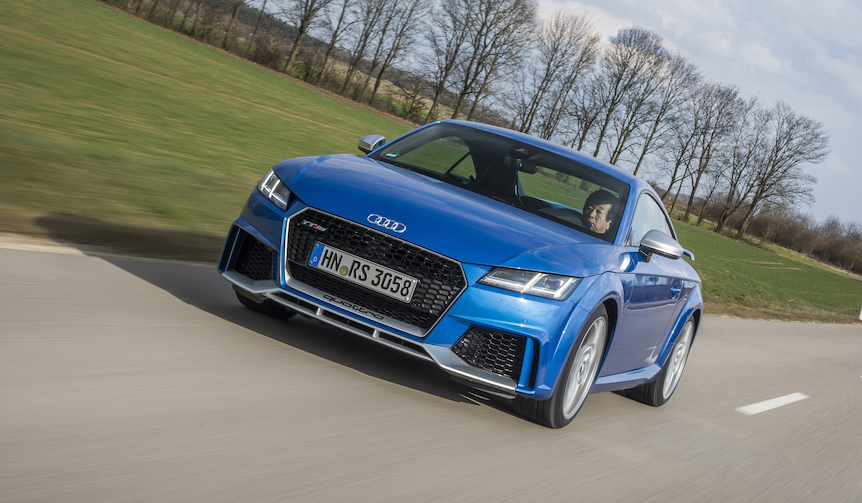
The Audi "TT RS," unveiled at last year's Beijing Motor Show, is the high-performance version of the 3rd generation "TT" that debuted in 2014, enhanced by Audi Sport. The domestic launch of this new TT RS was recently announced, and Yasuhiko Kawamura took it for a test drive in Germany. He reports his impressions ahead of the car's delivery in Japan.
Text by KAWAMURA Yasuhiko
A Rare 2.5-Liter Inline-Five Heart
The most sporting of Audi's cars, and the image leader for the entire brand, is theR8and no one would dispute that.
With styling that defies conventional sports car norms, a body structure built around an aluminum space frame, and a host of other advanced technologies. Furthermore, its outstanding driving performance, among the world's best—it is undoubtedly a car that deserves its place at the pinnacle of the Audi lineup.
On the other hand, many might find the specifications, such as the 5.2-liter V10 engine and a width exceeding 1.9 meters, to be somewhat unrealistic. After all, with a price tag starting in the mid-20 million yen range, it's likely that for most people, it wouldn't even be on their shopping list.
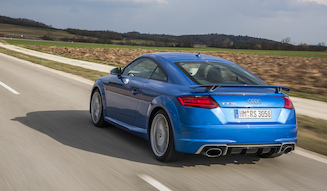
Compared to the R8, which is exceptionally exclusive within the Audi lineup, theTToffers a much more accessible sense of proportion, even as a sports model.
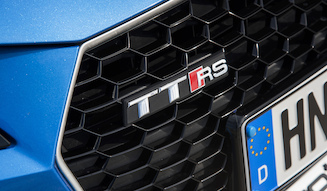
The car introduced here is based on the current, 3rd generation model that underwent a full model change in 2015. It was developed and produced by Audi Sport, a subsidiary specializing in high-performance models, and is touted as the "strongest and fastest TT in history" thanks to its new engine producing up to 400 ps.TT RSis that car.
Paired with a 7-speed dual-clutch transmission, the new 2.5-liter turbo engine features a rare inline-five configuration. Audi first fitted an inline-five engine in 1976. Although it disappeared from the lineup for a time, it has since made a comeback, and its distinctive sound is now a selling point. This engine is the primary distinguishing feature of the TT RS.
Audi TTRS | The Audi TT RS
Test drive of the 3rd generation TT's high-performance model, the "TT RS" (2)
Acceleration rivaling supercars
With a compact body under 4.2 meters long, a 4WD system, and a weight under 1.5 tons, it's no wonder this car is fast when paired with an engine producing up to 400 ps. In fact, this model possesses astonishing acceleration, capable of outperforming many supercars.
The car tested in Germany was the "TT RS Coupe," weighing 90 kg less than the "TT RS Roadster," which has structural reinforcements for its open-top design. The 0-100 km/h acceleration time for this model is a mere 3.7 seconds.
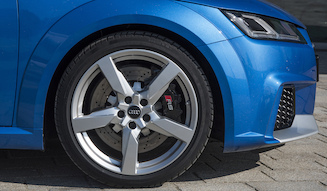
Comparing this figure, widely used globally as an indicator of initial acceleration, with that of the Porsche 911 series, the latest twin-turbocharged 450 ps engine-equipped"GTS" gradealso boasts a 3.7-second time. Even the base R8 achieves 3.5 seconds, which helps illustrate the tremendous speed of the TT RS.
Indeed, full acceleration is not only blindingly fast but also remarkably entertaining. The primary contributor to this feeling is the distinctive five-cylinder sound, with a hint of dissonance, that becomes clearly audible above 3,800 rpm. This, combined with the relentless acceleration, undoubtedly serves as a "spice" that excites sports car enthusiasts.
Interestingly, while the engine shares the same 2,480cc inline-five displacement, the unit in the new TT RS is different from the previous model's. The new engine unit achieves a significant 26 kg weight reduction through the use of an aluminum block and hollow crankshaft, while also improving fuel efficiency and increasing power by 60 ps compared to the previous model, thanks to a larger turbocharger, dual injection (combining direct and port injection), and reduced internal friction.
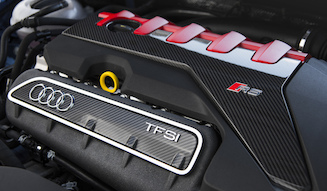
As mentioned, the engine powering the new TT RS is an updated version of the 5-cylinder unit, which has a 40-year history, utilizing the latest technology.
Audi TTRS | The Audi TT RS
Test drive of the 3rd generation TT's high-performance model, the "TT RS" (3)
From casual coupe to sports car
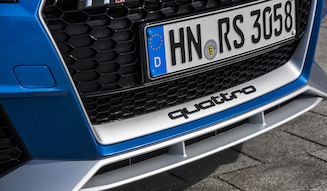
As the test drive took place in Germany, the "country of the Autobahn," checking speeds over 200 km/h was naturally part of the agenda. The acceleration's persistence even at those speeds was impressive, a testament to the 400 ps engine. Simultaneously, the car's remarkable straight-line stability, despite its compact wheelbase of about 2.5 meters, highlighted the effectiveness of Audi's signature "quattro" all-wheel-drive system.
The stated top speed is 250 km/h, but this is electronically limited. The availability of an option to increase this to 280 km/h is characteristic of Audi Sport's creations.
The explosive power and firm brake pedal feel suggest suitability for track driving. While a test in such conditions was not possible this time, the ride, which felt somewhat firm in urban driving, might feel more settled on a racetrack with larger suspension inputs.
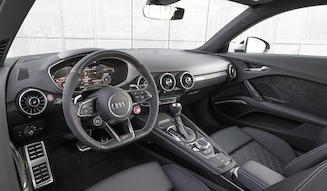
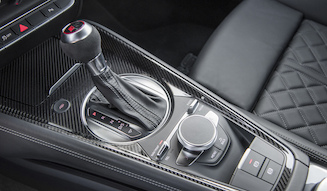
On the winding roads of Germany, with a speed limit of 100 km/h, the handling felt fundamentally "on rails." Even when accelerating assertively with the throttle on wet surfaces, there were no instances where the car lost its composure or the stability control intervened.
Examining the latest TT RS reveals its clear intention to be a "pure sports car." The original TT, launched in 1998, was initially conceived as a "casual coupe for younger users." The TT RS's greatest significance may lie in its role as a litmus test for whether the TT can achieve this "brilliant transformation" into a pure sports car.

Audi TTRS Coupe
Body Dimensions | Length 4,191 x Width 1,832 x Height 1,344 mm
Tread Front/Rear | 1,564 / 1,543 mm
Wheelbase | 2,505 mm
Weight (EU) | 1,440 kg
Engine | 2,480cc Inline-5 DOHC Turbo
Bore x Stroke | 82.5 x 92.8 mm
Compression Ratio | 10.0
Max. Output | 294 kW (400 ps) / 5,850-7,000 rpm
Max. Torque | 480 Nm / 1,700-5,850 rpm
Transmission | 7-speed AT (S tronic)
Drivetrain | 4WD
Top Speed | 250 km/h (280 km/h optional)
0-100 km/h Acceleration | 3.7 seconds
Fuel Consumption (European spec) | 8.4 - 8.2 L/100km (11.9-12.2 km/L)
CO2 Emissions | 192 - 187 g/km
Trunk Capacity | 305 - 712 liters
Price | 9,620,000 yen
*European specifications except for price