January 27, 2015
Test Drive the Volkswagen up! | Volkswagen
Volkswagen up! | Volkswagen up!
Shaking the Stronghold of Kei Cars
The Volkswagen up!: A "Black Ship" Arrives
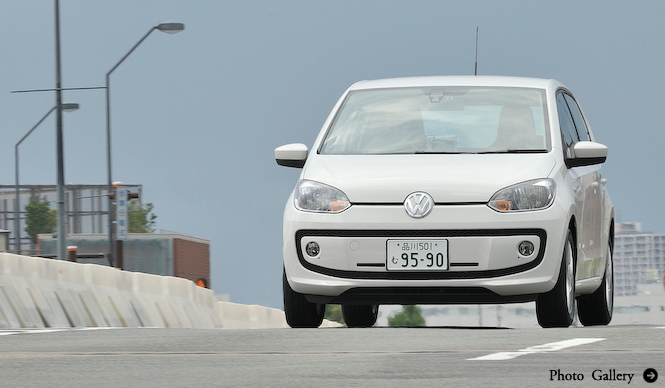
This is the "up!" – a car that will likely be the biggest rival for all small cars for some time to come.
Text by OTANI TatsuyaPhotographs by ABE Masaya
The up! Has Finally Arrived in Japan
It clearly shows the difference in thinking between Japan and Germany. What I mean is,Announced in Japan TodayWe're talking about the Volkswagen up!.
The up! is a compact car with a length of 3.5 meters, powered by a 1.0-liter, three-cylinder engine. Its price in Japan starts from 1.49 million yen. Volkswagen Group Japan anticipates it will compete not only with Japanese compact cars but even with kei cars.
Indeed, at 1.49 million yen, it can be a rival to kei cars. The prices of popular tall-wagon kei cars (like Daihatsu Tanto and Honda N-BOX) are all over 1 million yen, with some exceeding 1.5 million yen. Furthermore, when you decide to buy, you often end up ordering various options, and before you know it, you've exceeded your initial budget.
The up!, on the other hand, comes fully equipped from the start, as is often the case with imported cars (surprisingly, it even includes an automatic emergency braking system with laser sensors as standard). The only factory option is an electric sunroof. Dealer options include a PDA-type navigation system for around 50,000 to 60,000 yen, but many people today might say, "I can just use my smartphone for that." Therefore, the actual price difference with kei cars narrows further. It's understandable why Volkswagen names them as rivals.
The Heritage T-Shirt
However, the manufacturing philosophy and concept behind the up! and kei cars are diametrically opposed.
If we were to compare this difference to fashion, I believe the gap is as significant as that between a fast-fashion dress shirt and a T-shirt from a heritage luxury brand.
I myself am a fan of fast fashion. Not only are the prices affordable, but the designs, which quickly incorporate trends, are quite stylish. The quality isn't as bad as to be derided as "cheap and nasty." For 10,000 yen, you can get a dress shirt that looks quite presentable.
What can you buy for the same 10,000 yen from a heritage luxury brand? Perhaps a simple, plain white T-shirt. At first glance, it might seem like an unremarkable shirt, but upon closer inspection, the quality of the material is evident. Even the design, which might appear uninspired, possesses a unique character—a certain "presence" that only a heritage brand can express. The more you wear it, the more you'll likely feel, "This heritage brand is truly different."
Needless to say, in my view, kei cars are fast fashion, and the up! is the heritage brand T-shirt. Now, let me elaborate on what makes the up! feel that way.
Volkswagen up! | Volkswagen up!
Shaking the Stronghold of Kei Cars
The Volkswagen up!: A "Black Ship" Arrives (2)
No Special Tricks Needed for 23.1 km/L
Looking only at the catalog, the up! doesn't seem to employ cutting-edge technology. While its 1.0-liter, three-cylinder engine features DOHC 4-valve timing, it's naturally aspirated, without a turbo. It doesn't have hybrid technology, nor does it feature the increasingly popular idling stop system.
Yet, its JC08 mode fuel economy is 23.1 km/L. Among gasoline-powered passenger cars not using hybrid technology, only three models surpass this: the Mitsubishi Mirage 1.0, the soon-to-debut Nissan Note 1.2, and the Mazda Demio 1.3 Skyactiv.
The up!'s engine is part of a new generation of engines that Volkswagen will be rolling out sequentially. It possesses inherent qualities that achieve low fuel consumption without any special mechanisms. Furthermore, it even omits the balance shaft, which is typically essential for suppressing vibrations in a three-cylinder engine, in order to improve fuel efficiency.
You might think, "Won't the vibrations be unbearable?" However, this issue has been resolved through excellent fundamental design. In reality, it achieves a smoothness comparable to a four-cylinder engine.
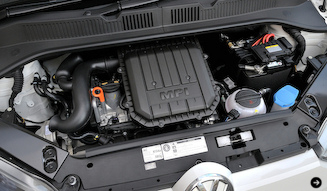
Despite its small size, the engine developed exclusively for it weighs only 69kg
Small in Stature, but Still a German Car
It has ample power, too. In fact, prior to this test drive, I experienced the up! in Germany, where it effortlessly maintained a cruising speed of 170 km/h on the Autobahn with three adults and plenty of luggage. While the acceleration to reach that speed isn't comparable to high-powered models, it wasn't sluggish either. The impression was one of "sufficient for the need."
The suspension uses MacPherson struts at the front and trailing arms at the rear, a conventional setup for compact cars. It's soft and yielding at low speeds, yet it keeps the body remarkably flat during high-speed driving. I drove it for nearly 200 km on the Autobahn in Germany, and I wouldn't hesitate to take it on a 300-400 km domestic business trip. Despite its small size, the up! is, after all, a German car.
Volkswagen up! | Volkswagen up!
Shaking the Stronghold of Kei Cars
The Volkswagen up!: A "Black Ship" Arrives (3)
The up!'s Premium Feel and its Relation to the iPhone
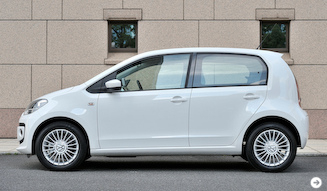
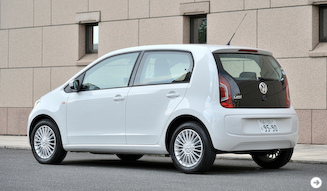
The design, both exterior and interior, is minimalist to the extreme – very simple. However, upon seeing it in person, you notice the meticulous finish, which creates a sense of luxury despite its simplicity.
This is precisely why it reminds me of a heritage brand T-shirt. A Volkswagen designer I interviewed in Germany told me, "Our approach, using high-quality materials and precise engineering to enhance the sense of quality in a simple design, is reminiscent of the iPhone." In fact, the up! was the first project under Walter de Silva's leadership of design for the Volkswagen Group. Consequently, this approach will likely be adopted in future Volkswagen models. You can see this tendency in the styling of the recently unveilednew Golf (Golf 7)as well.
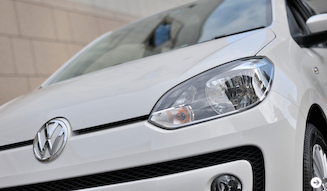
The boundary line of the hood crossing the surface from the A-pillar, the edges of the headlights – these details reveal the high precision of its construction.
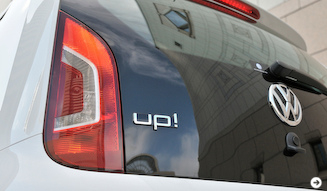
The combination lights, which appear integrated with the rear hatch from a distance, are actually mounted on the body. This is a testament to its high quality.
However, even a product from a heritage brand, being a T-shirt, has its limitations compared to a dress shirt.
For example, the power window switch for the passenger side is not located on the driver's side, meaning the driver must reach over to the left to operate it. A more extreme example is the rear window of the 4-door model; instead of sliding, it opens from a hinge at the front, causing the rear of the window to lift only a few centimeters. This means it doesn't open very wide.
The gearbox, a semi-automatic type, is a single-clutch system. Consequently, compared to the CVTs commonly found in Japanese cars of this class, it can be a bit jerky, and it might require a bit of skill to overcome this.
These are aspects that would be unthinkable in Japanese cars, which prioritize convenience. "That's why I prefer Japanese cars," some people might say. Just as some people find fast-fashion dress shirts stylish.
On the other hand, some might say, "I don't mind the power window switches, the rear window, or the gearbox at all. What resonates with me is the robust feel of the up!, which prioritizes the essence of driving." Just as some people choose heritage brand T-shirts.
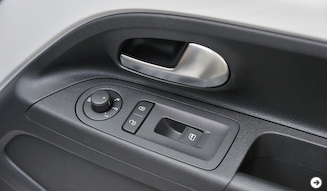
The driver's side has window switches only for the driver's door; there are none for the passenger.
Ultimately, this is no longer a matter of which is better or worse. It's purely a difference in preference, a difference in mindset, a difference in philosophy.
Volkswagen up! | Volkswagen up!
Shaking the Stronghold of Kei Cars
The Volkswagen up!: A "Black Ship" Arrives (4)
The up! in Japan
However, there is one thing I would like you to keep in mind.
The up! is clearly closer to global standards than Japanese kei cars.
The Japanese people, with their exceptionally refined sensibilities, have created numerous excellent industrial products. However, these refined sensibilities can sometimes delve too deeply into minor details, leading to manufacturing that loses sight of the bigger picture.
Televisions and mobile phones. Both were fields where Japan excelled, but they eventually developed along uniquely Japanese lines, becoming "Galapagosized." Before we knew it, manufacturers from South Korea and China were dominating the global market. I cannot help but worry that the same thing might happen in the automotive industry.
Aren't the up! and kei cars a prime example of this? While I cannot abandon my desire to support the Japanese automotive industry, if asked whether I would buy the up! or a kei car personally, I would answer "up!" without hesitation.
As a car enthusiast, I wholeheartedly welcome the arrival of the up!.
At the same time, I sincerely hope that the Japanese automotive industry will absorb the strengths of the up! to avoid repeating the same mistakes made with televisions and mobile phones.
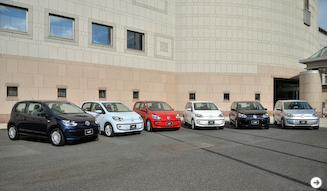
I am sure that Japanese manufacturers have already begun this process.
Volkswagen up! | Volkswagen up!
Body Dimensions | Overall Length 3,545 x Width 1,650 x Height 1,496mm
Wheelbase | 1,495mm
Tread Front/Rear | 1,430/1,425mm
Minimum Ground Clearance | 145mm
Engine | 999cc Inline 3-cylinder DOHC (4 valves)
Maximum Output | 55kW (75ps) / 6,200rpm
Maximum Torque | 95Nm (9.7kgm) / 3,000-4,000rpm
Transmission | 5-speed ASG
Weight | 900kg (4-door model: 920kg)
Minimum Turning Radius | 4.6m
Suspension Front/Rear | MacPherson Strut (with stabilizer) / Trailing Arm
Brakes Front/Rear | Ventilated Disc / Drum
Tire Size | 165/70 R14 (high up!: 185/55 R15)
Fuel Economy | 23.1km/L (JC08 mode)
Price | move up! 2-door: 1.49 million yen, move up! 4-door: 1.68 million yen, high up! 4-door: 1.83 million yen