Testing the Turbocharged 911 GTS | Porsche
Porsche 911 GTS | The Porsche 911
Testing the Turbocharged 911 GTS
Porsche911 Carrera S and the sports model 911 GT3, the 911 GTS fills the gap between them.Revised in January 2017The latest GTS, now turbocharged with a smaller displacement engine in line with the latest 911 series, was tested by Yasuhiko Kawamura. He explores the position of the GTS model within the highly segmented 911 family.
Text by KAWAMURA Yasuhiko
A Grade System Forged Over Time
There's the most "basic" entry-level grade, then one step higher in performance, the "S" grade. Beyond that, there are the exceptionally sporty "special" models designated by symbols like "GT" or "R," and finally, the flagship "Turbo" grade, which is practically a brand and deity in itself.
Today, the Porsche 911 lineup offers such a wide variety that many might find it difficult to grasp the differences when presented with a general overview. Perhaps this is true for quite a few people.
Since its debut in 1964, the Porsche 911 has carved out a history spanning over half a century, steadfastly adhering to the fundamental principle of housing a horizontally opposed six-cylinder engine low at the rear of the body.
Alongside the proliferation of various grades, another characteristic unique to this model is the parallel existence of multiple body types, such as the Cabriolet and Targa, in addition to the original coupe. This can be seen as a manifestation of the "weight of history" inherent to a sports car that has evolved alongside users with diverse needs over a long period.
Porsche 911 GTS | The Porsche 911
Testing the Turbocharged 911 GTS (2)
The 911 Series: Evolving Through the Ages
Historically, the 911 series could be broadly categorized by its core design elements, such as the horizontally opposed six-cylinder engine and rear-engine layout, and further distinguished by whether the engine was naturally aspirated or turbocharged.
However,the current 991 generationintroduced in 2011,with the minor model change in 2015saw the basic Carrera series engines also equipped with turbochargers. This led some to lament that "one of the 911's traditions has been lost."
Yet, we must not forget that this model has continuously evolved in response to the demands of the times, and precisely because of this, it has never lost its position as the "world's premier sports car" since its inception.
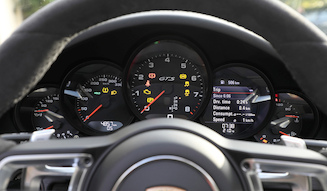
While there were criticisms when the air-cooled engine was replaced by a water-cooled one, and when 4WD models were introduced, its enduring reputation is a testament to its unwavering pursuit of what it believed to be the right path, unswayed by dissenting voices.
Thus, the time for change has arrived even for the "GTS," a designation that once signified "the hottest and highest performance within the naturally aspirated engine series."
Mirroring the refinements made to the Carrera series, the 911 GTS has finally been equipped with a new generation turbocharged engine.
Porsche 911 GTS | The Porsche 911
Testing the Turbocharged 911 GTS (3)
Maintaining the GTS Character
The engine, tuned from the base "S" grade unit, delivers higher output. Some of Porsche's signature "driving options" are now standard, and cosmetic enhancements align it with other GTS grades across the Porsche lineup, further emphasizing its unique presence. These methods, employed in previous GTS models, are carried over to this latest 911.
The maximum output of 450 hp is a 30 hp increase over the base S grade and a 20 hp increase over the previous 3.8-liter naturally aspirated GTS engine. Notably, thanks to the turbocharger, the maximum torque has increased by 110 Nm compared to the previous model.
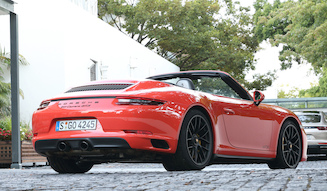
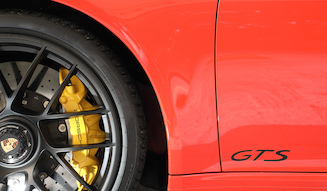
While the 911 tradition dictates that the 4WD model receives a wider "wide body" than the RWD model, the GTS features this wider body even on the RWD version.
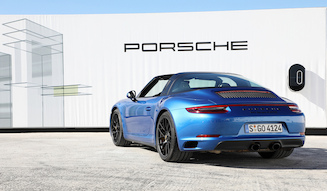
The lowered front apron and the rear spoiler, which extends higher, are designed to reduce lift. Smoked taillights, centrally positioned black exhaust tips, and center-lock wheels are distinctive exterior features of the GTS.
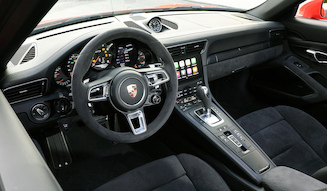
Inside, the extensive use of Alcantara creates a more luxurious atmosphere alongside its sporty feel. This distinctive appearance is a hallmark of the GTS.
Porsche 911 GTS | The Porsche 911
Testing the Turbocharged 911 GTS (4)
For the Discerning
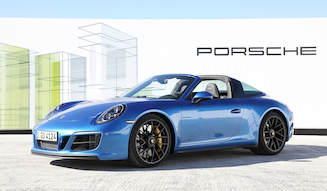
The test drive, held in Cape Town, South Africa, included a track session with the coupe GTS and a road session with the Targa 4 GTS. It was a unique experience to drive on the left-hand side of the road, similar to Japan, in a left-hand drive German-registered car brought from Stuttgart.
In addition to the aforementioned higher-output engine, the GTS grade comes standard with a sports exhaust system that produces a powerful sound and the Sport Chrono Package for integrated driving mode selection. The test models were fully equipped with optional features such as the PDCC active stabilizer system, PCCB ceramic composite brakes, and rear-axle steering.
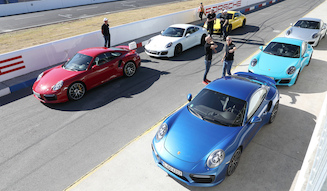
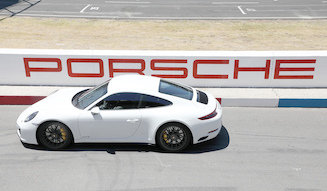
Despite its hardcore specifications, the Targa 4 GTS proved surprisingly comfortable to drive. In fact, I started my drive in this model shortly after arriving at the hotel, having traveled for 26 hours from Japan.
Despite my exhaustion, I was genuinely surprised by how the car's comfort seemed to rejuvenate me the more I drove. The 911 bearing the GTS name possesses this gentle side as well.
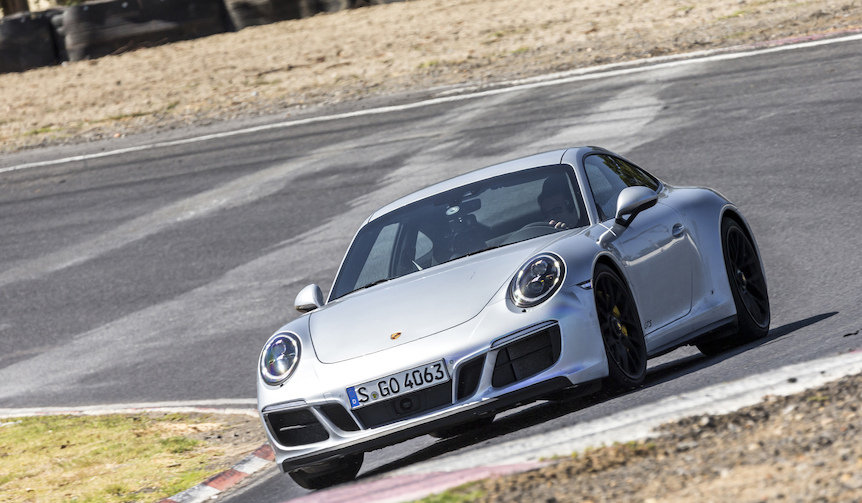
On the other hand, the coupe I drove on the track impressed me with its sheer speed. While it lagged slightly on acceleration out of corners, it was fast enough to keep pace with the lead 911 Turbo S driven by an instructor.
In fact, the new Carrera GTS, equipped with all these optional features, completed a lap of the Nürburgring's old course in 7 minutes and 26 seconds. This is an astonishing 12-second improvement over the previous generation.
If you don't fancy the flamboyant styling of the "GT3" series, and don't require the absolute invincibility of the "Turbo," but still desire the occasional serious track driving session – then this GTS designation is the perfect choice for you.
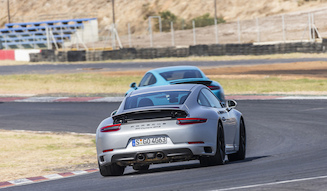

Porsche 911 Carrera GTS
Body Dimensions | Length 4,528 x Width 1,852 x Height 1,284 mm
Wheelbase | 2,450 mm
Engine | 2,981cc Horizontally Opposed 6-Cylinder Turbo
Compression Ratio | 10.0
Max. Output | 331 kW (450 ps) / 6,500 rpm
Max. Torque | 550 Nm / 2,150-5,000 rpm
Transmission | 7-speed Automatic (PDK)
Drivetrain | RR
Top Speed | 310 km/h
0-100 km/h Acceleration | 3.7 seconds
0-160 km/h Acceleration | 7.9 seconds
Price | 17,500,000 yen
Porsche 911 Targa 4 GTS
Body Dimensions | Length 4,528 x Width 1,852 x Height 1,291 mm
Wheelbase | 2,450 mm
Engine | 2,981cc Horizontally Opposed 6-Cylinder Turbo
Compression Ratio | 10.0
Max. Output | 331 kW (450 ps) / 6,500 rpm
Max. Torque | 550 Nm / 2,150-5,000 rpm
Transmission | 7-speed Automatic (PDK)
Drivetrain | 4WD
Top Speed | 306 km/h
0-100 km/h Acceleration | 3.7 seconds
0-160 km/h Acceleration | 8.4 seconds
Price | 21,160,000 yen