Test Drive: Toyota's Latest Compact SUV, the C-HR | TOYOTA
TOYOTA C-HR | Toyota C-HR
Test Drive: Toyota's Latest Compact SUV, the C-HR
A Quality That Rivals the Prius
The compact SUV, the "C-HR," which retains a strong image of the concept car unveiled at the 2014 Paris Motor Show,C-HR Conceptis characterized by its innovative styling. OPENERS has already published a test drive review of the prototype, but we were recently fortunate enough to test drive the production model.
Photographs by ARAKAWA MasayukiText by OGAWA Fumio
The Second Model to Adopt Toyota New Global Architecture
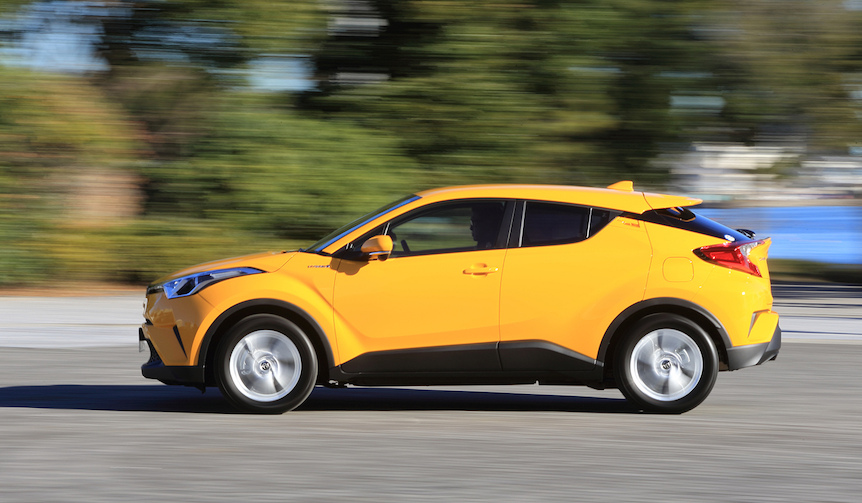
The "C-HR," which can be considered a global strategic model for Toyota,C-HRboasts a distinctive style that catches the eye, as well as a solid driving performance. It is a SUV that Toyota has poured its passion into, aiming to create a great car.
The Toyota C-HR was released on December 14, 2016.Prototype Test Drive Reviewhas already been reported, but we were able to drive the production model.
The C-HR is an SUV that shares its basic platform with thePriusThe C-HR is an SUV that shares its basic platform with the "Prius." While its overall length of 4,360mm is compact, its height of 1,550mm gives it a strong presence. Not only its dimensions but also its detailed styling contribute to its distinctive character.
The lineup consists of two engine options: one with a 1.2-liter 4-cylinder gasoline engine and another with a 1.8-liter 4-cylinder engine combined with an electric motor. The former is available with four-wheel drive.
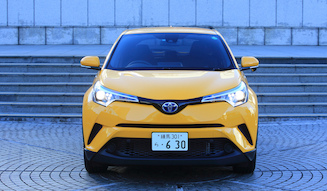
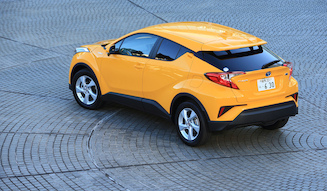
The C-HR's defining feature is its styling, which the manufacturer defines as "distinctive." The impression it gives varies significantly depending on the time of day and the body color, but in the evening, its taut surfaces and bold lines are particularly striking.
But that's not all. The C-HR is a landmark vehicle for Toyota's development team.
This is because it was developed under a new generation of car manufacturing project called the Toyota New Global Architecture (TNGA). The first model was the Prius. The C-HR, developed in parallel, is said to have undergone even more thorough refinement.
TNGA is a concept that is difficult to explain simply, but it involves developing platforms with cross-departmental collaboration to create ideal cars.
The C-HR, which the developers presented saying, "This is the result," had a charm that made you not want to get out once you started driving.
TOYOTA C-HR | Toyota C-HR
Test Drive: Toyota's Latest Compact SUV, the C-HR
A Quality That Rivals the Prius (2)
A Car Free from Discomfort or Dissatisfaction
Two models of the Toyota C-HR were released simultaneously: one with a 1.2-liter turbo engine paired with a Super CVT-i continuously variable transmission, and a 1.8-liter hybrid.
These are powertrains familiar to those who know Toyota cars well. Hearing this, wouldn't you feel like you already know what kind of car it is before even driving it?
However, once you drive the C-HR, you realize it is clearly distinct from previous models. In a word, it is remarkably natural.
We use the word "natural" because there are almost no points of concern, and it feels as if you are one with the driver. It is free from negative impressions such as "I wish it had more power," "The steering wheel feel is vague," or "The ride comfort is too stiff for its sportiness."
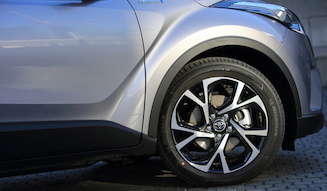
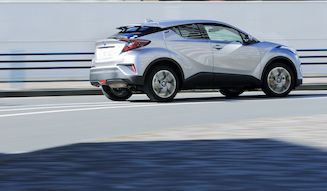
To analyze it a bit, as soon as you start driving, you'll be impressed by the solid steering feel, the way the engine torque is delivered, the skillful transmission timing, and the integrated movement of the car.
In other words, it is free from discomfort or dissatisfaction. Car enthusiasts will surely feel good, and even those who aren't might not want to get out of the car. It makes you feel that way.
The current Prius is remarkably well-executed, clearly setting itself apart from its previous three generations. Beyond its coupe-like styling, it offers a driving enjoyment that gives enthusiasts a reason to choose it actively, not just for its fuel efficiency.
The C-HR, using the same platform (though with different wheelbase, etc.), is even better as a car.
TOYOTA C-HR | Toyota C-HR
Test Drive: Toyota's Latest Compact SUV, the C-HR
A Quality That Rivals the Prius (3)
A Level of Refinement Beyond Its Price
The appeal of the Toyota C-HR lies in its lack of any sense of discomfort. As we mentioned earlier, it is a model that offers a driving experience completely free of unpleasantness.
With its solid handling, acceleration, and quietness, its quality rivals that of the Prius, or even surpasses it. And yet, with a price of around 2.5 million yen (from around 2.6 million yen for the hybrid), it is an astonishing product.
"We meticulously refined the handling so that you can drive at high speeds with confidence in any situation. We are proud that we have created a car that can be driven with peace of mind even on European roads."
The chief engineer of the C-HR's development is not exaggerating when he says this. Its feel is so convincing that it makes you believe him.
While SUVs cannot achieve a particularly low center of gravity, which is crucial for cornering performance, the C-HR achieves an excellent balance. It enters even tight corners smoothly and maintains a stable posture towards the exit.
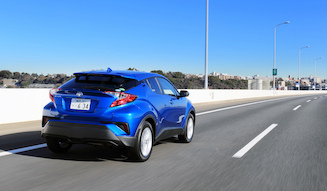
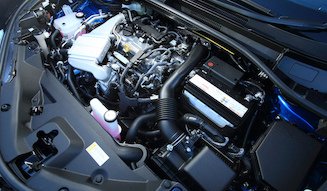
It's impressive how the torque is delivered effectively when exiting corners, allowing for smooth acceleration. This is likely due to the maximum torque of 185Nm being available across a wide band from 1,500 to 4,000 rpm, and the skillful tuning of the transmission that takes advantage of the CVT.
While I was impressed that the 1.2-liter engine felt sufficiently powerful, I was also very intrigued by the European version's 2-liter engine and front-wheel-drive combination. It has the potential to make one wish for something like a 1.5-liter engine, even though such an option doesn't exist.
Compact SUVs sometimes lack sufficient space for suspension components, which can compromise ride comfort. However, the C-HR is an exception. The suspension strokes properly, eliminating unpleasant vibrations and providing a comfortable ride.
While the styling might appeal to a younger demographic, this model doesn't seem to have been conceived with the simplistic idea that "this kind of car will be popular." On the contrary, if you were to say, "This is the car I've been wanting," you could truthfully reply, "Exactly."
TOYOTA C-HR | Toyota C-HR
Test Drive: Toyota's Latest Compact SUV, the C-HR
A Quality That Rivals the Prius (4)
Styling That Requires Some Courage for Adults to Drive
Does the Toyota C-HR have any drawbacks? Thinking about it, I personally don't find many. If I had to pick one, it might be its image.
It's a shame that in a society where this type of styling is often associated with younger people or housewives, it requires a bit of courage for a mature adult to drive.
The C-HR's ride, which conveys a sense of calm rather than overt sportiness, would also appeal to those accustomed to imported cars.
The C-HR is produced at a factory in Turkey and exported worldwide, except for the Japanese and Australian markets. To make a statement in the European market, where individuality is important, an impressive styling was likely necessary.
The diamond shape serves as the motif for the styling. Looking at the profile, the front and rear fenders are molded into a kind of blister (a large bulge), creating a distinctive look at first glance.
The front mask is also distinctive, with its sharp headlights combined with a complexly shaped, integrated bumper. The bulge of the front fender even forms part of the front mask, which is eye-catching.
As mentioned earlier, when a strong light source hits it from a certain direction, such as at dusk, the C-HR's styling, composed of edges and curves, is particularly striking. It's impressive how well it's executed.

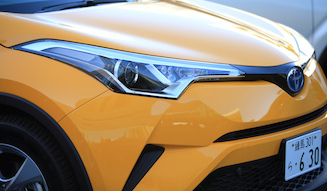
However, the actual driving feel of the car is not as sporty as the styling might suggest. The slight mismatch between the driving dynamics and the styling is a pity for the older generation who might want to drive a C-HR.
The exterior door opener (handle) for the rear doors is also a stylistic icon of the C-HR, located in an unusual position. However, it is explained that this was not done merely for the sake of being unconventional.
"We decided not to place it in the conventional position in order to respect the design of the character line that runs horizontally along the side of the body," explains the designer.
In reality, it seems that managing quality is challenging, with requirements such as "within reach of children," "a shape easily recognizable as a door handle," "prevents fingers from getting caught," and "won't break even if someone hangs on it." However, if I were to be critical, the angular shape is a bit disappointing compared to the overall styling impression. I wish they had pushed it a little further.
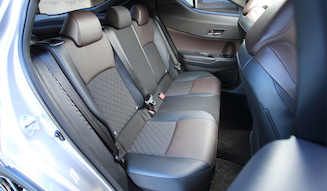
A similar sentiment was felt regarding the interior details. For example, the seat upholstery, a combination of leather and fabric available in the higher trim levels. The reddish-brown color tone and the diamond pattern pressed rather than stitched make the intention unclear.
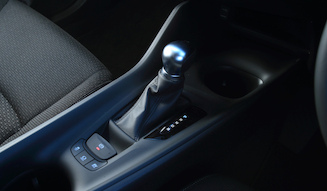
In terms of usability, the shift lever has a sophisticated shape designed to be held in the palm of your hand, but the hard material makes it a bit painful if you grip it firmly. Furthermore, the release button requires three or four fingers to pull up, which also feels a bit stiff and not entirely user-friendly.
The reason I feel compelled to write these things is, after all, because I like this car. Noticing small flaws is the flip side of the desire for "it to be perfect if this were improved."
At the test drive event, a Toyota engineer shared an interesting point. They hope to guide customers who like the C-HR to the next-generation Camry, which is also developed using TNGA (Toyota New Global Architecture). Perhaps the Camry is for the older generation?
TOYOTA Customer Relations
0800-700-7700 (9:00-18:00)
http://toyota.jp/