November 23, 2016
Test Drive: A Prototype of Toyota's Latest Compact SUV, the C-HR | Toyota
TOYOTA C-HR | The Toyota C-HR
Test Drive: A Prototype of Toyota's Latest Compact SUV, the C-HR
Feels Like Piloting a Sporty Coupe
Concept Car in 2014The Toyota C-HR, a stylish compact SUV primarily for the European market, was unveiled as a concept car in 2014 and its production model this year. This compact SUV uses the new TNGA platform shared with the Prius. We had the opportunity to test drive prototypes of both the hybrid and gasoline models. Here is the report from Fumio Ogawa.
Text by OGAWA Fumio
A Striking Styling Character
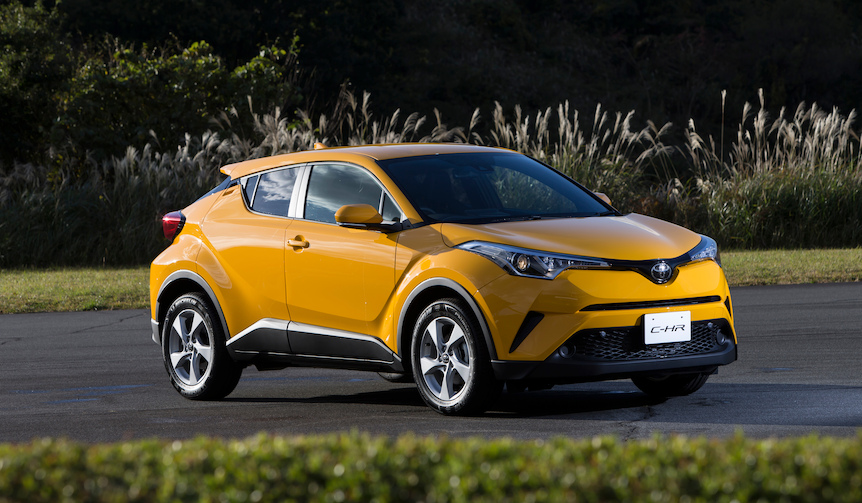
Toyota Motor Corporation is planning a major rollout of the stylish compact SUV, the Toyota C-HR, primarily in the European market. We were fortunate enough to get a chance to test drive its prototype.C-HRThe styling, with its prominently flared fenders, particularly in profile, emphasizes sharp edges and conveys a strong sense of newness.
The Toyota C-HR sold in Japan is expected to come in two main configurations: a 1.2-liter gasoline engine model and a 1.8-liter hybrid model. The former will be 4WD, and the latter will be front-wheel drive. While a 2-liter gasoline engine is planned for Europe, "we will not be offering a diesel engine," according to a development representative.
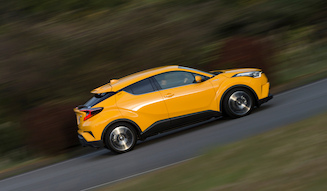
The hybrid model combines a 1797cc engine (72kW/98ps and 142Nm) with an electric motor (53kW/72ps and 163Nm).
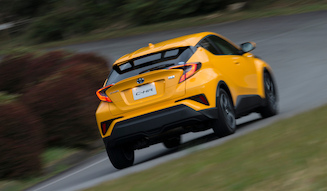
The hybrid's acceleration is brisk.
"We want to actively attract younger customers," says Kazuhiko Izawa, Chief Project Designer, and indeed, the styling has a strong character. More so than in photographs, the interplay of light and shadow highlights the flared fenders and the body's sleekness.
The C-HR's distinctive feature is its wheel height, which is 44.5 percent of its overall height. "We believe larger wheels look cooler," explains Project Chief Designer Izawa, a concept driven by a target strategy aimed at competing with the Nissan Juke and Qashqai, which remain popular in Europe.
Driving the car reveals that it's not just about the style; the performance is equally impressive, proving it's more than just a good-looking new model.
TOYOTA C-HR | The Toyota C-HR
Test Drive: A Prototype of Toyota's Latest Compact SUV, the C-HR
Feels Like Piloting a Sporty Coupe (2)
The Second Model on the New Generation "TNGA" Platform
The Toyota C-HR has several points of interest. Firstly, it's a model intended for global markets, planned for production at a Turkish plant and export to 50 countries. Secondly, it's the second vehicle to utilize the new generation TNGA (Toyota New Global Architecture) platform, following the current Prius.PriusFurthermore, its excellent driving performance is another aspect worth noting.
While it shares the basic chassis with the Prius, the suspension has been "re-engineered from the fundamental geometry," according to a suspension development representative. This allows the suspension to perform at its intended level. Additionally, the adoption of Sachs dampers, thicker stabilizers, and meticulously redesigned bushings demonstrate the extensive development effort. "While the Prius was developed with a focus on handling stability and ride comfort, the development goal for the C-HR was to add sportiness to those qualities," they added.
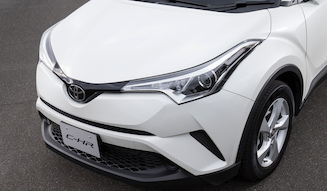
The front features a distinctive integrated design from the bumper to the fenders.
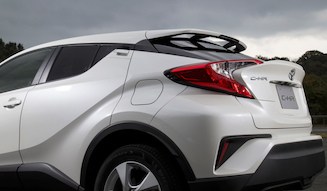
The rear design is quite emotional.
Indeed, the C-HR offers a truly enjoyable driving experience. The steering response is smooth, and the car corners cleanly without any sluggishness. The steering wheel itself is pleasingly slim with a tactile grip that feels natural in the hand – perfectly suited to my preferences. The combined effect is so compelling that it almost feels like piloting a sporty coupe. Although the seating position is relatively high, as expected in an SUV, this sensation was a fresh and delightful surprise.
The suspension seems to have skillfully balanced the challenging objectives of ride comfort and sportiness. The chassis boasts high rigidity, and there are no unpleasant vibrations even on uneven surfaces. It adeptly handles input, effectively managing kickback to the steering wheel. Here too, everything from the tires to the steering rack works in concert to deliver performance.
The driving performance held a surprising revelation.
TOYOTA C-HR | The Toyota C-HR
Test Drive: A Prototype of Toyota's Latest Compact SUV, the C-HR
Feels Like Piloting a Sporty Coupe (3)
Scheduled for Release in Japan at the End of 2016
As previously mentioned, the Toyota C-HR will be available with two powertrain options: a 1.2-liter engine and a 1.8-liter hybrid. The 1.2-liter features a turbocharger, producing a maximum output of 85kW (116ps) and a peak torque of 185Nm. It is paired with a continuously variable transmission and an all-wheel-drive system, primarily for front-wheel drive configurations.
This 1.2-liter model performed better than expected. While there's a slight sense of the car's weight at the initial takeoff, it accelerates quite briskly once up to speed, making overtaking maneuvers feel effortless. Despite the turbocharger, the coordination with the transmission is so refined that there's no noticeable drop in power during acceleration. This was particularly impressive.
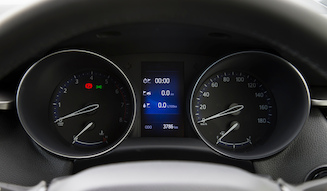
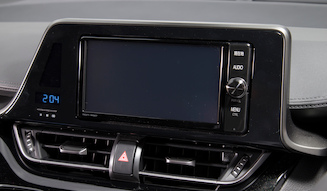
While it's a car that emphasizes sportiness, the engine feel itself doesn't quite capture the quick revving characteristic of a sports car. The focus is clearly on handling, with the powertrain playing a supporting role. The European 2-liter version is expected to offer a distinctly different experience, which certainly sparks my interest.
The hybrid model also offers ample torque. As it's not a plug-in, the transition from electric motor to engine is swift, with both powertrains working diligently to complement each other. The torque delivery when pressing the accelerator is immediate, providing a significantly stronger acceleration than the 1.2-liter. However, the regenerative braking system's initial engagement can feel slightly too abrupt, diminishing the enjoyment of modulating braking force with pedal pressure. This is a minor disappointment with the hybrid model.
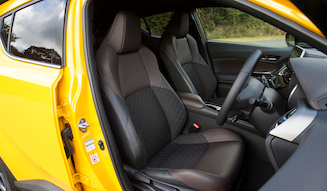
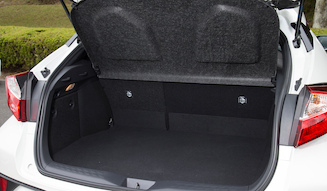
The interior has a passenger-car feel, with seats available in two types: a combination of fabric and synthetic leather.
The interior design was inspired by "Audi's quality," according to the designer, but it hasn't quite reached that level yet. Minor issues, such as a rattling sound from the window frame when operating the power windows, remind one of the car's price point. While areas like the seat construction, the tactile feel of the steering wheel, and the natural pedal angle demonstrate careful craftsmanship and a significant improvement in perceived quality, there are still aspects that fall short of Audi's standards.
Another minor but noticeable point is the exterior rear door handle, whose shape doesn't quite blend seamlessly with the overall form. The cabin noise level is also somewhat high, with the engine sound being less than ideal.
Toyota has indicated that the C-HR will be released in Japan at the "end of 2016," with pricing yet to be determined. However, if the quality were to be further enhanced even with a slight price increase, I believe it would be a worthwhile investment. Given the quality of the ride, it already possesses a considerable premium feel.