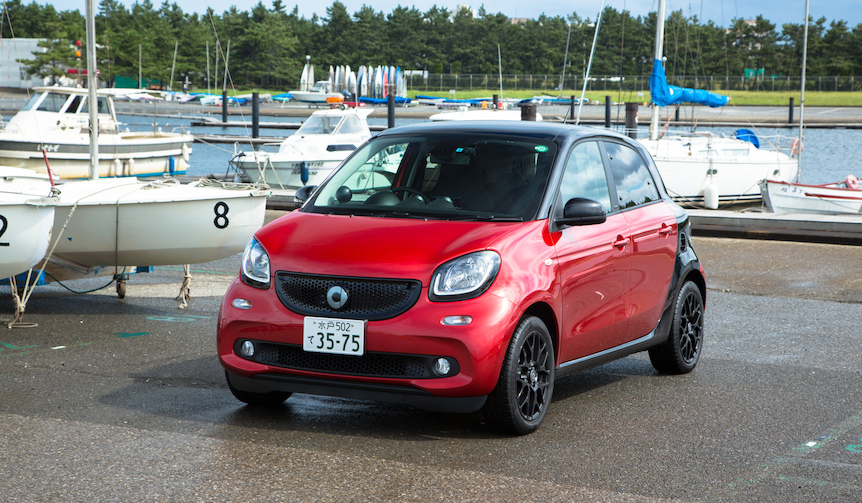
Test Drive: The Smart Forfour Turbo | smart
smart forfour turbo | Smart Forfour Turbo
The Ultimate All-Rounder
A turbocharged grade was added in August to the third-generation Smart "forfour," which was released in Japan in October 2015. How does the turbo model, with its improved maximum output and torque thanks to the turbocharger, make a difference? Fumio Ogawa reports.
Text by OGAWA FumioPhotographs by KAWANO Atsuki
Handling That Belies Its Rear-Engine Layout
Smart's compact four-door hatchback, theforfour" has been joined by the powerful "Smart Forfour Turbo," released on August 3, 2016.The importer, Mercedes-Benz Japan, claims it "enhances sportiness and makes highway driving even more comfortable."
The Smart Forfour Turbo (¥2.56 million) features an engine mounted behind the rear axle, driving the rear wheels, similar to the two-seater, more compact "fortwo" released at the same time.Porsche "911", this mechanical layout is rare today.
The reason for choosing a rear-engine layout is its excellent maneuverability. Because the engine doesn't interfere, the steering angle can be larger. In fact, the Forfour's minimum turning radius is a very small 4.1 meters, "among the best for a four-door hatchback" (according to the importer). (The Porsche 911's is larger, but that's to ensure sufficient grip for sporty driving.)
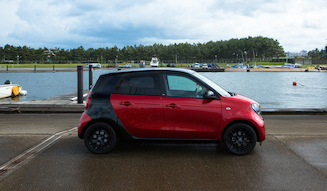
The wheelbase is a considerable 2,495mm.
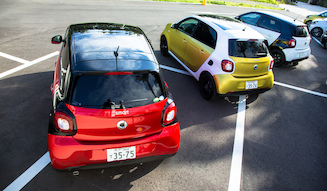
The overall width is a surprisingly generous 1,665mm.
Until the 1960s, the rear-engine layout was used in Italian cars like the Fiat "600" and "Nuova 500," and French cars such as the Renault "8," Alpine "A110," and "A310," all of which are reasonably well-known in Japan. However, with advancements in performance, issues like maintaining grip at high speeds led to its decline. Even the first-generation Smart tended to feel light in the front at high speeds.
It can be said that all of that is now a thing of the past with the current Smart.
When driving the Smart Forfour Turbo, you might not immediately know where the engine is or which wheels are driven. The sensation is that natural. This is thanks to the lightweight engine, along with advancements in suspension performance and electronic control technology. Front grip is maintained, and cornering stability is at a very high level.
Smart Forfour Turbo | Smart Forfour Turbo
The Ultimate All-Rounder (2)
Impressively Strong Acceleration
The engine mounted behind the rear axle in the Smart Forfour Turbo is an 897cc three-cylinder. With the turbocharger, it produces a maximum output of 66kW (90ps) and a maximum torque of 135Nm. Compared to the Forfour (naturally aspirated engine) released earlier, this is an increase of 14kW (19ps) in maximum output and 44Nm in maximum torque.
The car was faster than I expected. The suspension is solid, and it pairs well with the 6-speed dual-clutch transmission. Even with a light press of the accelerator, the strong acceleration is impressive. With maximum torque available at 2,500rpm and well-tuned turbo settings, the acceleration is smooth and natural.
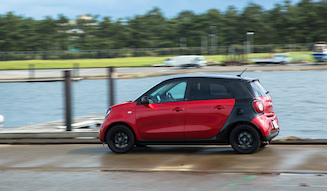
An 897cc three-cylinder turbo engine is mounted at the rear, driving the rear wheels.
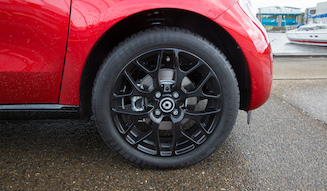
The turbo model is equipped with 16-inch wheels.
The impact of the turbocharger can be felt in other areas as well. The suspension seems to have become slightly stiffer due to the increased power, particularly noticeable in the rear suspension. Depending on road imperfections, you might feel a rather significant jolt. Perhaps the compact body and the engine's placement impose design constraints. The length of the suspension arms, for instance, felt somewhat affected by the design.
While this is a sensation shared with the Fortwo Turbo, if you prefer a smoother ride, I recommend test-driving the naturally aspirated Forfour as well. As mentioned earlier, the turbo version, perhaps as a trade-off for the increased power, has a stiffer suspension setting, especially for handling.
The lightness of the steering wheel is a characteristic of Smart cars that don't have an engine in the front. Conversely, with the quick acceleration of the turbo, it can feel slightly less reassuring when entering corners at high speeds. However, this is likely a matter of getting used to the feel. As an owner, you'll quickly learn how to handle its unique character.
Smart Forfour Turbo | Smart Forfour Turbo
The Ultimate All-Rounder (3)
What's the Difference from the Renault Twingo?
The Smart Forfour Turbo's strength lies in its versatility. Despite its compact 3.5-meter length, it has four doors and offers adequate rear-seat space for four adults. The luggage capacity is 185 liters. It combines functional design, comfort, and a rather cute interior and exterior. In addition to the Forfour's appeal, the turbo version adds power. The Forfour Turbo has many distinct features.
It's surprisingly quiet even on the highway, the seats are comfortable, and it can easily handle a round trip of about 200km. The floor is high, and the sporty driving position, where you extend your legs forward like in a Jaguar "XJ", is interesting. However, the seating position is relatively high, and the good forward visibility contributes to a sense of security.
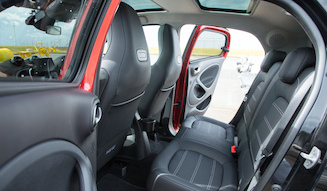
The turbo model comes standard with a panoramic roof.
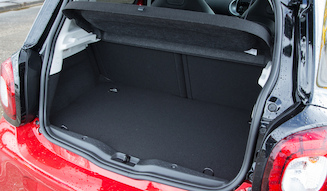
Luggage capacity is 135 liters, expanding to 975 liters with the rear seats folded.
The Renault "Twingo", which shares basically the same chassis and turbo engine, leans more towards comfort. However, the Forfour Turbo, perhaps to differentiate itself from the naturally aspirated model, emphasizes sportiness more, with its firmer suspension and sporty two-tone color schemes like black and red.
Mercedes-Benz, which developed the car, vouches for its safety. The "Tridion" safety cell, made of high-strength steel, ensures high collision safety. Although it's a compact body, the fuel tank is placed in front of the rear axle to enhance safety in rear-end collisions. Compatibility, in this case meaning collision compatibility, is also pursued to ensure safety when colliding with larger or heavier vehicles.
It is equipped with useful features for daily driving, such as a collision warning system that monitors the distance to the vehicle ahead using radar sensors and alerts the driver with a warning sound, and a crosswind assist that supports straight-line driving with brake control even in sudden crosswinds.

Smart Forfour Turbo
Body Dimensions: Length 3,550 x Width 1,665 x Height 1,545 mm
Wheelbase: 2,495 mm
Tread (Front/Rear): 1,445 / 1,435 mm
Minimum Turning Radius: 4.1 meters
Engine: 897 cc DOHC Inline 3-Cylinder Turbo
Maximum Output: 66 kW (90 ps) / 5,000 rpm
Maximum Torque: 135 Nm (13.8 kgm) / 2,500 rpm
Transmission: 6-Speed DCT
Drivetrain: RR
Brakes (Front): Disc
Brakes (Rear): Drum
Tires (Front/Rear): 185/50R16 / 205/45R16
JC08 Mode Fuel Economy: 23.1 km/ℓ
Seating Capacity: 4 people
Steering: Right
Price: ¥2.56 million
smart
0120-610-910(Mercedes Call)
http://www.smart-j.com/