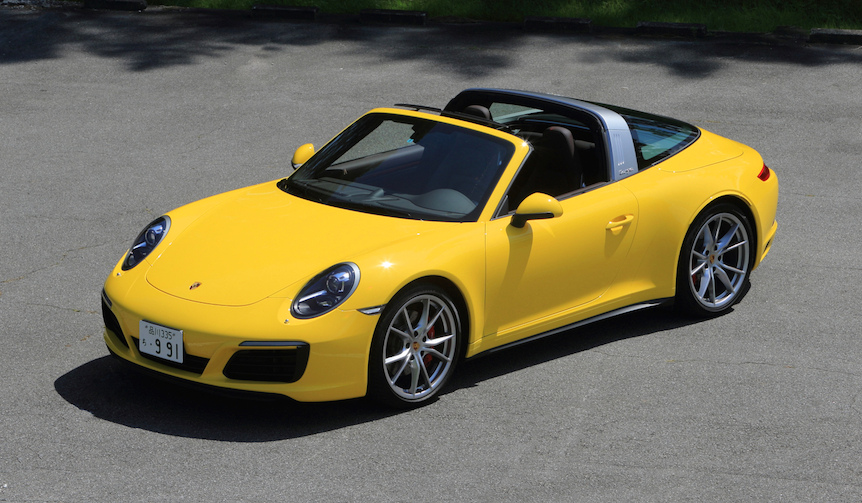
Test Drive the New Porsche 911 Targa 4S | Porsche
Porsche 911 Targa 4S | Porsche 911 Targa 4S
The Feel of a Solid Sports Racing Car
Porsche's Car Manufacturing Philosophy Remains Strong
The "991 (codename) II generation" Porsche 911, featuring a new turbocharged engine, is here. Fumio Ogawa test drove the "Targa 4S," which perfectly blends the exhilaration of open-air driving with practicality.
Photographs by ARAKAWA MasayukiText by OGAWA Fumio
Torque Distribution Control Program is More Precise
Porsche's unique enjoyment lies in its permutations and combinations. The new911 Seriesseries, from the rear-wheel-drive "Carrera" to the "Turbo S Cabriolet," offers a wide range of models. The engine, drivetrain, and body style can be combined to suit your preferences, offering abundant variations. Additionally, the sporty "R" and "GT3 RS" are also available.Carreraseries, from the rear-wheel-drive "Carrera" to the "Turbo S Cabriolet," offers a wide range of models. The engine, drivetrain, and body style can be combined to suit your preferences, offering abundant variations. Additionally, the sporty "R" and "GT3 RS" are also available.R" and the "GT3 RS" are also available. Among these, considering practicality, the "911 Targa 4S" is arguably the model with the most favorable combination of high speed, driving stability, and exhilarating feel.
The Targa itself was first introduced in 1965. Its appeal lies in its ability to combine the exhilaration of open-air driving with the robustness of a coupe. Furthermore, the Targa bar, the rear pillar, and the sharply curved rear window create a beautiful style.
It is equipped with the new 3-liter flat-six engine that powers the 911 series. A full-time 4WD system using an electro-hydraulic controlled multi-plate clutch is integrated with the front and rear torque splitters. The "S" model boasts a maximum output of 309 kW (420 hp), which is 37 kW (50 hp) higher than the Targa 4's 272 kW (370 hp).
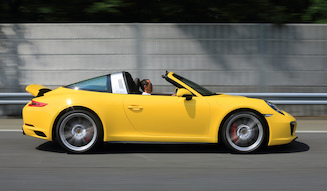
Overall length 4,499 x width 1,852 x height 1,293 mm. Wheelbase is 2,450 mm.
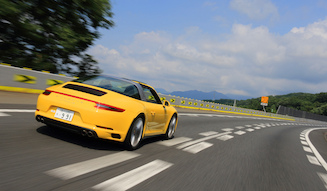
Vehicle weight is 1580 kg.
Along with the new engine, the 4WD system has also been improved in this model. In low-load driving conditions, such as on highways, torque is distributed almost 100 percent to the rear wheels. Depending on road and driving conditions, torque distribution to the front wheels may exceed that to the rear. In the new generation, known as the "991 (codename) II," the program controlling torque distribution between the front and rear has become more sophisticated. While friction is reduced in low-load and no-load conditions to improve fuel efficiency, the sporty character is enhanced during acceleration.
When the accelerator pedal is pressed further, computer control optimizes the drive force to the wheels. Instead of indiscriminately sending full power to the road, optimal torque is applied to the front and rear wheels according to road conditions. As a result, the car can travel faster. Therefore, the Carrera 4 achieves superior acceleration performance compared to the Carrera 2.
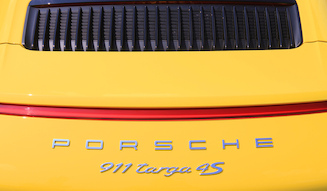
The flat-six engine is equipped with variable valve timing (intake/exhaust side) and variable valve lift (intake side) systems.
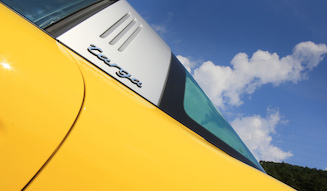
Steel rollover bar
The test car was equipped with the optional "Sport Chrono Package" (¥379,000). This package controls the damping force of the shock absorbers and throttle response, allowing for sporty settings to be adjusted manually according to preference. This is one of Porsche's great appeals, pursuing comfort while not abandoning its identity as a sports car manufacturer.
Owners will appreciate the small rotary dial added to the right of the steering wheel in the "Sport Chrono Package." By turning it, one can select from four modes: "Normal," "Sport," "Sport Plus," and "Individual." Additionally, a "Sport Response Switch" is provided for quicker overtakes. This system automatically selects the optimal gear for acceleration without manual shifting. The acceleration gear is held for 20 seconds.
The equipment is also quite comprehensive.
Porsche 911 Targa 4S | Porsche 911 Targa 4S
The Feel of a Solid Sports Racing Car
Porsche's Car Manufacturing Philosophy Remains Strong (2)
Safety Features are Also Reasonably Comprehensive
The Porsche 911 Targa 4S, with its new engine, was launched in the Japanese market in January 2016. The previous Targa 4S with a 3.8-liter six-cylinder engine had a maximum output of 294 kW (400 hp) at 7,400 rpm and a maximum torque of 440 Nm at 5,600 rpm. In contrast, the new generation, downsized to 2,981 cc and equipped with turbochargers, produces 309 kW (420 hp) at 6,500 rpm and 500 Nm between 1,500-5,000 rpm.
The price has also increased from 18.25 million yen (April 2015) to 19.13 million yen (as of October 2016). There are also several new features. The rear-wheel steering system, called "Rear Axle Steering," is new, while the brakes have been enhanced for improved drivability. The "PASM (Porsche Active Suspension Management)" with electronically controlled variable dampers automatically adjusts damping force according to driving conditions. Additionally, the adjustable ground clearance is touted to improve practicality.
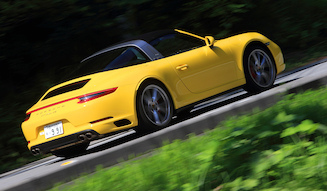
The top speed is announced as 303 km/h.
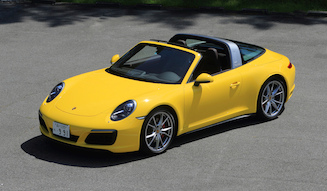
Aluminum is used for the fenders, doors, trunk lid, and engine hood.
Styling-wise, the first changes are to the front and rear designs. The headlights feature "Welcome Home Lights" with four LEDs, while the rear combination lamps have a more three-dimensional design. Additionally, four brake lights are equipped. The interior largely retains the familiar design, such as the two-tone dashboard. The "Connect Plus" infotainment system has also been enhanced, offering online navigation, Apple CarPlay, a telephone module, and Connect apps.
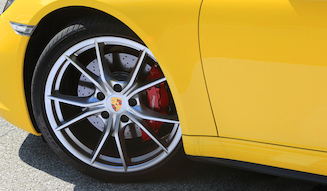
Suspension type: Front McPherson strut, Rear multi-link.
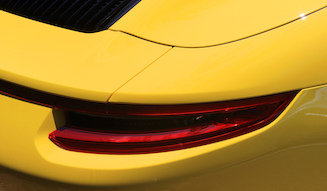
More three-dimensional taillight design.
While the 911 is cautious about autonomous driving, aligning with its positioning as a true sports car, safety features have increased. These include the "Post Collision Braking System" to mitigate secondary collisions and the optional "Lane Change Assist." The latter uses radar sensors to monitor the blind spots on both sides of the vehicle while driving. Within the speed range of 30 km/h to 250 km/h, it alerts the driver to the presence of vehicles in adjacent lanes via LED lamps integrated into the door mirrors. It's a convenient system to have.
The mechanism of the Targa top, its greatest appeal, remains unchanged. The 911 Targa 4S features an elaborate system where the rear glass slides back and the top retracts into it, all in about 19 seconds. This quick opening and closing time is incredibly useful in regions like Europe, where weather can change rapidly.
Driving it is a joy that makes you fall in love.
Porsche 911 Targa 4S | Porsche 911 Targa 4S
The Feel of a Solid Sports Racing Car
Porsche's Car Manufacturing Philosophy Remains Strong (3)
Acceleration Feels Like a True Sports Car
The appeal of the Porsche 911 Targa 4S lies in its substantial feel. Beyond its top speed, its acceleration from a standstill and in-gear acceleration are impressive. Specifically, with the Sport Chrono Package, it can accelerate from 0 to 100 km/h in just 3.8 seconds (0.3 seconds faster than the previous 3.8-liter model). Yet, unlike lighter sports cars, the heavier steering wheel contributes to its unique character.
It doesn't feel nimble and agile, but rather like a solid sports racing car. Due to the 500 Nm of torque and the easily revving engine, it's advisable to drive with a certain degree of caution, especially when cornering. The heavier steering wheel unconsciously reminds the driver of this. If you consciously make quick steering inputs, the car responds with exhilarating movements that can be almost overwhelming. It changes character beyond a certain point. This reflects Porsche's long-standing car manufacturing philosophy, which remains intact. It's a mature car.
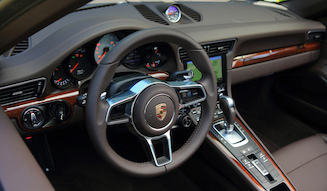
The steering wheel, derived from the Spyder, features mode switches.
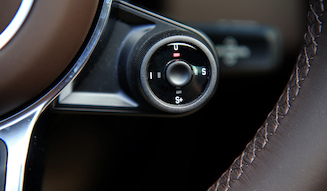
Four modes: Normal, Sport, Sport Plus, and Individual.
The feel when revving the engine is superb, beyond compare. On highways, unlike winding roads, you experience overwhelming acceleration, combined with a sense of security transmitted through the steering wheel and a remarkable balance in the car's stable movement. As the maximum output is generated at 6,500 rpm, the sensation of accelerating faster and faster as you rev the engine is truly that of a sports car.
If you want to push it on winding roads, select "Sport" using the rotary switch of the "Sport Chrono Package" on the steering wheel. However, on highways, "Normal" is more than sufficient. While the shift-up timing of the 7-speed PDK is slightly quicker, the response when selecting the optimal gear, including for sudden acceleration, is sharp. There are no complaints.
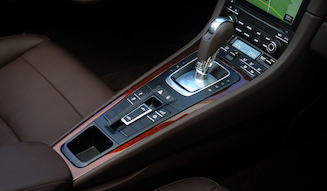
Pull the PDK shifter towards you to shift up, push it to shift down.
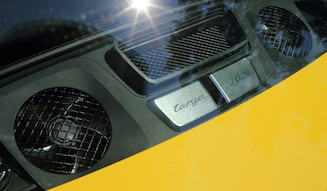
The engine is equipped with twin turbochargers.
When driving with the Targa top open and the side windows down, wind buffeting at highway speeds was greater than expected. This was surprising because I had assumed it would be remarkably draft-free. However, it's natural for a Targa to experience wind when open. One should simply enjoy it.

Porsche 911 Targa 4S | Porsche 911 Targa 4S
Body Dimensions | Overall Length 4,499 x Width 1,852 x Height 1,291 mm
Wheelbase | 2,450 mm
Tread Front/Rear | 1,538 / 1,552 mm
Trunk Capacity (VDA) | Front 125 liters
Weight (DIN) | 1,600 kg
Engine | 2,981 cc Flat-six, Direct Injection, DOHC, Twin-turbo
Compression Ratio | 10.0 : 1
Maximum Output | 309 kW (420 hp) / 6500 rpm
Maximum Torque | 500 Nm / 1700–5000 rpm
Transmission | 7-speed Twin-Clutch (7 PDK)
Drivetrain | 4WD
Suspension Front | McPherson Strut
Suspension Rear | Multi-link
Tires Front/Rear | 245/35ZR20 / 305/30ZR20
Brakes Front/Rear | Ventilated Discs
Top Speed | 301 km/h
0-100 km/h Acceleration | 4.2 seconds (4.0 seconds with SPORT PLUS button)
0-160 km/h Acceleration | 18.7 seconds (8.4 seconds with SPORT PLUS button)
Top Speed | 301 km/h
Fuel Economy (NEDC) | 8.0 ℓ/100km
CO2 Emissions | 184 g/km
Fuel Tank Capacity | 68 Liters
Price | 19.13 million yen
Porsche Customer Care Center
0120-846-911