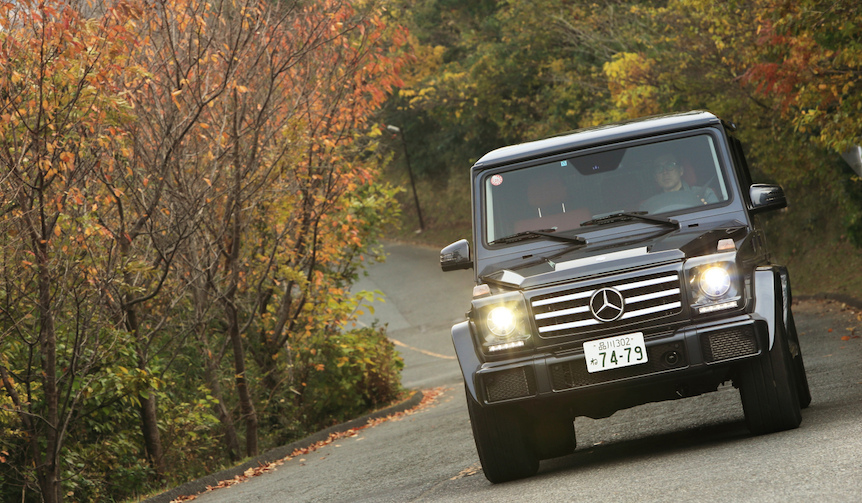
Test Drive: Mercedes-Benz G550
Mercedes-Benz G550
Test Drive: Mercedes-Benz G550
The Reason It's Loved by Celebrities Worldwide
The G-Class has remained in production since its debut in 1979, largely unchanged in appearance and mechanics. The "G550" is the first and only model to feature electronically controlled dampers. Tatsuya Otani took it for a spin to assess its evolution.
Text by Tatsuya OtaniPhotographs by Masayuki Arakawa
Built with an Entirely Different Philosophy Than Modern SUVs
You sometimes hear stories like, "The Mercedes G-Class was developed for NATO forces," but the truth seems closer to the reality that it was originally planned for general consumers and then adopted by various military forces due to its exceptional potential.
Still, one can understand the desire to say it was repurposed from military to civilian use, given its robust-looking frame, suspension, and its rugged yet overwhelmingly commanding presence. The frame running front to rear beneath the body resembles the steel skeleton of a building more than automotive components, and the differential gears mounted on the front and rear axles are as large as oversized watermelons. Even the trailing and leading arms that position these axles are as thick as logs. Seeing these, it's clear that it was built with an entirely different philosophy than modern SUVs, which prioritize on-road use.
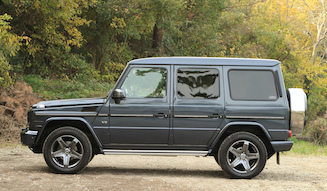
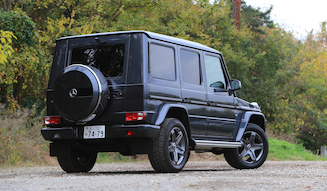
This sturdy construction is undoubtedly reassuring for serious off-road driving, and certainly for military purposes. However, when driving it for everyday errands, some drawbacks become apparent. The robust suspension can lead to increased unsprung weight, potentially causing a bouncy ride. Furthermore, the rigid axles, a powerful asset in rough off-road conditions, struggle to distribute impacts from the road, making it difficult to achieve a high level of balance between on-road handling and ride comfort. In essence, the G-Class's tough build is a double-edged sword: it can be an object of desire in itself, yet it can negatively impact ride comfort in daily use.
To address this, Mercedes developed the "GL" for those who prioritize on-road performance. Meanwhile, the G-Class has also tackled the challenging task of improving handling and ride comfort while maintaining its fundamental character. The latest outcome of these efforts is the "G550" introduced here.
Mercedes-Benz G550
Test Drive: Mercedes-Benz G550
The Reason It's Loved by Celebrities Worldwide (2)
A Ride Unlike Any Previous G-Class Experience
The presentation mentioned that the suspension now features electronically controlled dampers, a first and only for the G-Class. However, after actually driving it, the improvement felt so significant that it seemed impossible to achieve solely through damper modifications.
Earlier, I mentioned that rigid axles have difficulty distributing road impacts according to their direction. In reality, modern suspensions use complex link structures to distribute forces into directions that improve handling and directions that enhance ride comfort. They then employ stiffer rubber bushings for the former and softer ones for the latter, aiming to balance both handling and comfort. However, with rigid axles, it's difficult to distribute forces so conveniently, leading to an either-or choice between ride comfort and handling.
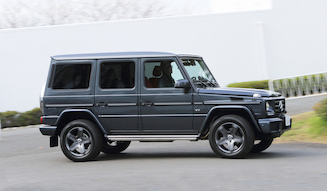
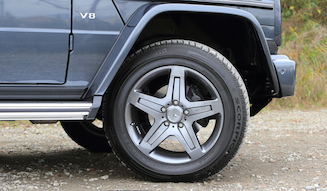
Recent G-Class models have tended to use slightly softer bushings to ensure comfort, which sometimes made the suspension and body feel like they were moving independently. However, this new model has been refined in this regard, and the time it takes from turning the steering wheel to the car actually beginning to change direction has been significantly reduced. In other words, the handling response has been greatly improved.
But has the ride comfort suffered? Not at all. While it absorbs shocks from the road gently, the vibrations dissipate quickly without lingering, unlike with some rubber bushings. The ride quality was exceptionally comfortable, unlike anything experienced in previous G-Class models.
Mercedes-Benz G550
Test Drive: Mercedes-Benz G550
The Reason It's Loved by Celebrities Worldwide (3)
The Classic G-Class Character Remains Fully Intact
That said, it's not as refined as the GL. Nevertheless, achieving such a balance of handling and ride comfort with such robust suspension is undoubtedly the result of 36 years of continuous improvement since its debut in 1979.
It's not just the suspension that has changed in the G550. Equipped with the latest V8 4.0-liter twin-turbo engine from the AMG GT, it boasts 34 hp and 80 Nm more power than the previous model, along with improved fuel efficiency. This engine produces a V8-like "purrrr..." exhaust note up to around 3,000 rpm, after which it emits a smooth, clear tone befitting a modern high-performance unit. The power delivery also increases linearly with engine speed, making its drivability surprisingly good.
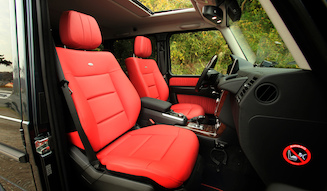
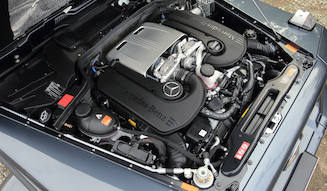
On the other hand, the classic G-Class character remains fully intact. As mentioned, the robust suspension is unchanged, but other elements persist: the high seating position offering excellent visibility, the clear view through the nearly vertical front windshield, the shallow dashboard design rarely seen in modern cars, and even the distinct "clack!" sound when locking the doors. These are all unforgettable details for long-time G-Class fans.
The G-Class strives to retain its authentic essence while embracing modern values. Perhaps this is the reason it is so beloved by celebrities around the world.

Mercedes-Benz G 550
Body Dimensions | Length 4,575 x Width 1,860 x Height 1,970 mm
Wheelbase | 2,850 mm
Tread Front/Rear | 1,540 / 1,540 mm
Weight | 2,560 kg
Ground Clearance | 235 mm
Engine | 3,982 cc V8 DOHC Twin-Turbo
Max Output | 310 kW (421 ps) / 5,250–5,500 rpm
Max Torque | 610 Nm (62.2 kgm) / 2,000–4,750 rpm
Transmission | 7-speed Automatic
Drivetrain | 4WD
Tires Front/Rear | 275/55R19 / 275/55R19
Trunk Capacity | 480–2,250 Liters
Price | 14,700,000 Yen
Mercedes-Benz Call
0120-190-610