Test Drive: The New Mercedes-Benz E-Class | Mercedes-Benz
Mercedes-Benz E Class | MERCEDES-BENZ E-Class
Test Drive: The New Mercedes-Benz E-Class
A New Standard for Passenger Cars
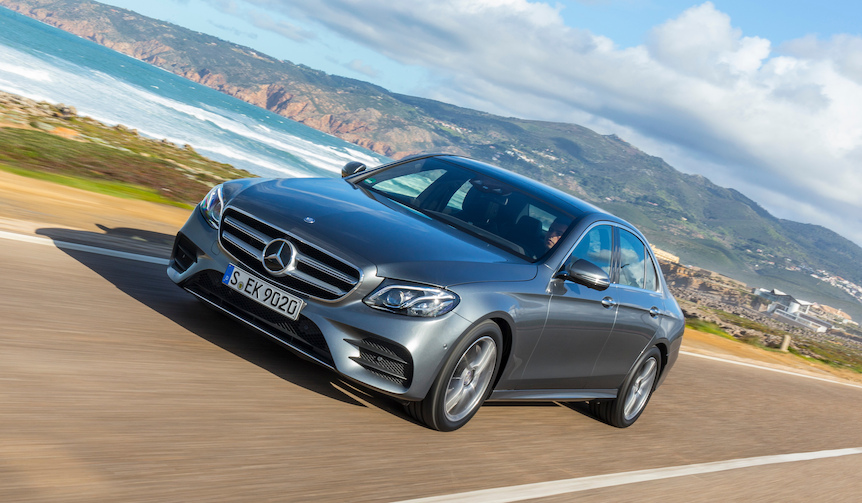
The new Mercedes-Benz E-Class, unveiled at the North American International Auto Show (Detroit Auto Show) in January of this year. We bring you a test drive report of this model, which has evolved significantly with its first full model change in seven years.
Text by SHIMASHITA Yasuhisa
The Standard for Passenger Cars
The history of the "E-Class," whose ancestor is the 1953 Mercedes-Benz 180, has always been about updating the standard for passenger cars by incorporating cutting-edge technology. Moreover, this has not just been about adoption, but has always led to widespread use.
For example, in recent years, ABS in the W124 model (1985-1995) and ESP in the W210 model (1995-2002), although first introduced in the "S-Class," became popular features after their adoption in the E-Class. In this way, the E-Class has consistently presented the ideal form of a passenger car for each era.
The new E-Class is no exception. Frankly, it could even be described as the most innovative model in several generations.
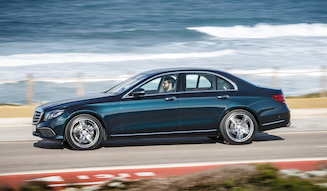
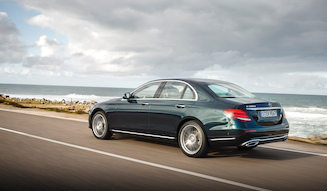
The exterior, which can be mistaken for an S-Class or C-Class at first glance, lacks novelty, and the interior, with its two high-definition liquid crystal monitors arranged within the instrument panel, also has a similar atmosphere to the S-Class. However, the high-tech features have been further advanced, and the control system has been significantly revised.
Particularly striking are the touch sensor switches located on the spokes of the steering wheel. The left screen can be operated with the thumb of the left hand, and the right screen with the thumb of the right hand, allowing for instant access to a wealth of functions without removing either hand from the wheel. While the number of switches is not small, most operations can actually be performed by combining these thumb movements with voice input.
Mercedes-Benz E Class | MERCEDES-BENZ E-Class
Test Drive: The New Mercedes-Benz E-Class
A New Standard for Passenger Cars (2)
Incorporating All Available Driving and Collision Avoidance Functions
Even more noteworthy is "Drive Pilot," activated by pulling the lever for Distronic Plus on the left side of the steering column twice towards you. This is the next step for Mercedes-Benz, which already claims to have achieved semi-autonomous driving.
Adaptive Cruise Control maintains the set speed and automatically adjusts the distance to the vehicle ahead. It also steers automatically along the lane markings and follows the vehicle ahead even when lane markings are not visible. Furthermore, if the vehicle stops due to traffic congestion, it will restart automatically without any driver input if the stop is within 30 seconds. In other words, while legally the driver is always in control, the car can essentially handle most highway driving smoothly on its own.
That's not all. Drive Pilot is also equipped with a lane change function for the first time. By holding the turn signal lever in the desired direction for more than two seconds, the vehicle detects the distance to following vehicles and, if possible, automatically moves to the adjacent lane. Thanks to highly accurate millimeter-wave radar, this operation is extremely smooth. Although initially hesitant, I quickly became accustomed to it and found myself using it more and more.
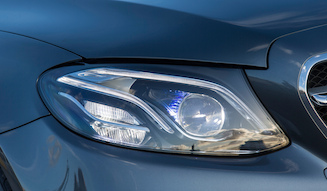
The advanced safety features pioneered by Mercedes-Benz have also been enhanced. Active Brake Assist, which warns of potential collisions and automatically applies the brakes if necessary, can now avoid collisions up to 100 km/h. It also includes functions that initiate braking earlier in situations with limited evasive space, such as at the end of a traffic jam, and detects vehicles or pedestrians suddenly crossing in front at intersections.
Additionally, it features a function that assists steering operations by adding torque during evasive maneuvers, and Active Emergency Stop Assist, which automatically brings the vehicle to a stop if the driver becomes incapacitated due to sudden illness. A feature allowing parking the vehicle remotely via smartphone is also available, which is useful in tight parking spaces. In short, it is no exaggeration to say that all currently conceivable driving assistance and collision avoidance functions have been incorporated.
Mercedes-Benz E Class | MERCEDES-BENZ E-Class
Test Drive: The New Mercedes-Benz E-Class
A New Standard for Passenger Cars (3)
Comfort Exceeding the S-Class
As for the driving experience itself, it also offers a remarkable evolution. The combination of a lightweight, high-rigidity body, with a significantly increased proportion of aluminum and high-tensile steel, and the "Air Body Control" air suspension, which uses multiple chambers (two at the front, three at the rear) to achieve a supple ride regardless of the input magnitude, provides an exceptionally smooth ride. The integrated feel and precision of the chassis are flawless, offering an enjoyable and stress-free driving experience, even for those who aren't necessarily enthusiasts. In terms of comfort, it can even be described as surpassing the S-Class at present.
Among the available power units, which include gasoline, diesel, and plug-in hybrid options, the newly developed 2.0-liter diesel engine in the E220d is particularly noteworthy. This engine, which has been made lighter with an aluminum block and features steel pistons with minimal thermal expansion, as well as an exhaust after-treatment system integrated as a module directly beside the engine, not only improves fuel efficiency but also enhances emission performance. With a power output of 195 ps and a maximum torque of 400 Nm, it offers more than sufficient performance and is sure to be accepted as a core unit.
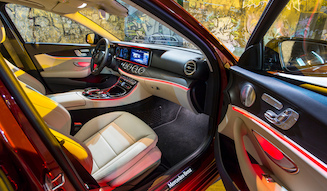
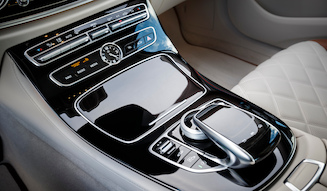
In this way, the new E-Class is an ambitious creation that redefines the standard for passenger cars, incorporating new features throughout, from its driving dynamics, comfort, and advanced safety systems to its autonomous driving capabilities. As mentioned at the outset, the E-Class has always been such a presence, but the leap forward with this tenth-generation model is undeniably greater than that of any previous generation.
Therefore, it is all the more regrettable that the exterior design is so similar to the S-Class, and especially the C-Class, that it can be mistaken at first glance, or even after a prolonged look. While the W124 and W201 190E were also similar, one could at least distinguish them once they looked at the rear. Considering customer satisfaction, it might have been better to have more differentiation. At the very least, I hope that for the Japanese market, there will be more options for the classic grille with the three-pointed star standing proudly on the hood.
Its arrival in Japan is scheduled for around June. Initially, gasoline engine models will be introduced, with variations expected to increase throughout the year.
Mercedes Call
0120-190-610
http://www.mercedes-benz.co.jp/