Test Drive the New Renault Twingo in Paris | Renault
Renault Twingo
Test Drive the New Renault Twingo in Paris
Why I'm Drawn to the Twingo
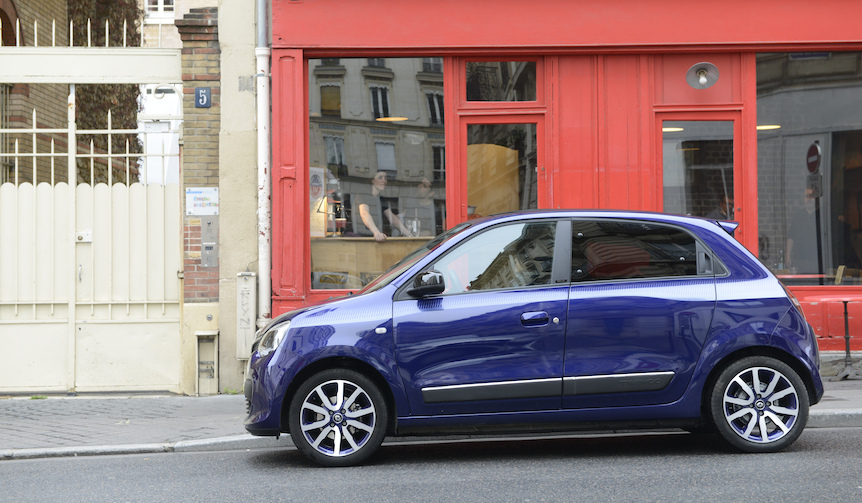
The third-generation Renault Twingo, which debuted at the 2014 Geneva Motor Show and is scheduled for introduction to Japan this spring. Unlike previous models, this model arrives with an RR layout, and automotive journalist Tatsuya Otani test-drove it in Paris.
Text by OTANI TatsuyaPhotographs by MATSUNAGA Manabu
The First-Generation Twingo Embodied the Value Unique to French Cars
I visited Paris specifically to drive the new RenaultTwingoTo be honest, I had other business in France besides test-driving the Twingo, but since I was going anyway, I really wanted to try the Twingo, so I borrowed a press car in Paris and drove around for about half a day.
Why am I so drawn to the Twingo? While it's partly related to the fact that I owned a sporty model, the GT, of the second-generation Twingo for about two years, what truly shocked me was encountering the first-generation Twingo when it debuted in 1993. Around this time, French cars were rapidly becoming internationalized, and models with long suspension travel and a soft ride, which were once common, were gradually disappearing, with solid suspensions reminiscent of German cars becoming mainstream.
However, the Twingo appeared as if defiantly confronting this trend, bringing with it the traditional soft ride of French cars. It presented itself with a value that was so typically French: a cute styling with an interior space that could comfortably seat four adults. I absolutely loved this car.
The second-generation Twingo was also a seriously well-made compact car, and I spent two very happy years with it. However, compared to the first-generation Twingo, its "French character" was more diluted, and I couldn't help but feel a tinge of sadness, thinking, "Is this also the way of the times..."
Perhaps because of this, when the third-generation Twingo appeared at the 2014 Geneva Motor Show, I wasn't particularly interested for some reason. I might have wrongly assumed, "It's probably just another compact car that's lost its fun factor due to increased efficiency."
I realized this was a major misconception atthe 2015 Tokyo Motor Show.A cutaway model of the third-generation Twingo displayed there showed that the engine was mounted at the rear (!), not the front, as is usual! From that moment on, my view of the third-generation Twingo completely changed.
Renault Twingo
Test Drive the New Renault Twingo in Paris
Why I'm Drawn to the Twingo (2)
The Refinement of the Chassis is Quite High
As exemplified by the VW Beetle, Fiat 500 (second generation), and Renault 4CV, compact cars used to be a treasure trove of rear-engine, rear-wheel-drive (RR) configurations. However, with the advent of the Mini in 1959, the trend for compact cars gradually shifted towards front-engine, front-wheel-drive (FF). While FF is certainly advantageous for its spacious interior, good straight-line stability, and cost-effectiveness due to high production efficiency, with so many compact cars being FF, my contrarian nature makes me want to ask, "Aren't there any manufacturers with the ambition to build a compact car with an RR layout?"
However, it's not that there were no RR compact cars in modern times. The Smart Fortwo is a prime example, and the concept car for the VW up! was also RR. Yet, I was not satisfied with the refinement of the Fortwo, and the up! also debuted as an FF production car. The day my pent-up feelings would be resolved did not seem to be coming soon.
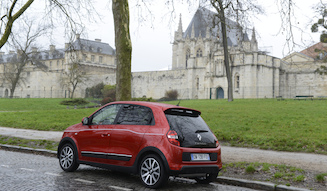
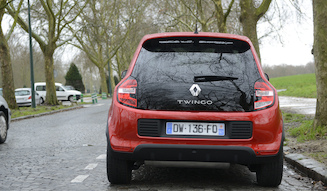
Thus, I was very curious about the third-generation Twingo, but I also had some concerns. It's common knowledge in the automotive world that RR layouts tend to have issues with straight-line stability. Would the Twingo ensure sufficient straight-line stability for long drives? Above all, does this RR model, which Renault has finally produced after a long time, possess handling and ride comfort that are sufficiently refined by modern standards? Furthermore, does the third generation inherit the soft ride characteristic of French cars? With these numerous questions in mind, I set out to drive the new Twingo through the streets of Paris.
To reveal the answer upfront, all my worries turned out to be unfounded. The new Twingo runs straight and true, the balance between ride comfort and handling is excellent, and it's equipped with suspension that is as soft and supple as the Kangoo, among Renault's current lineup.
However, looking closely, the power steering feels a bit dead, and the slight self-centering function incorporated into the power assist to ensure good straight-line stability is somewhat noticeable. Because of this, when you turn the steering wheel gently and slowly from a straight position, you can feel a subtle increase or decrease in steering effort at a certain point.
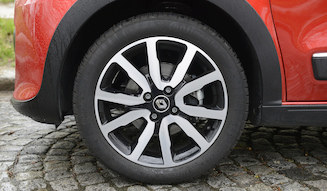
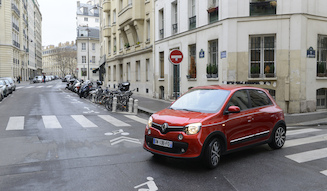
But this is a level you'd only notice if you were observing very closely. You'd quickly get used to the dead steering feel, and conversely, as you become accustomed to this sensation, you'll gain a clearer sense of the front tires' grip on the road, increasing your sense of security. Incidentally, it was raining unfortunately on the day of the interview, but I felt no anxiety even when driving on Paris's slippery cobblestone streets.
As you may have gathered from the above, the refinement of the chassis is quite high. I had no complaints about the body's rigidity, and the quietness also earned a passing grade. However, when the engine is cold, the vibrations are a bit pronounced, and as a result, I could sometimes hear a rattling sound from some of the interior trim. That said, for those who have loved French cars for a long time, this is a level that wouldn't bother them at all.
Renault Twingo
Test Drive the New Renault Twingo in Paris
Why I'm Drawn to the Twingo (3)
Two Engine Options: 0.9-liter Turbo and 1.0-liter Naturally Aspirated
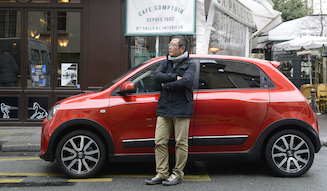
Meanwhile, the exterior and interior design exceeded expectations in terms of finish. The flatness of the body panels is high, and the gaps between the panels (the "chili" as it's called) are precise, exuding a sense of luxury. The styling, with its subtle curves throughout, strikes a perfect balance between being glamorous yet delicate, and mature yet cute. The car's expression will likely change significantly depending on the body color and the design of the optional stickers.
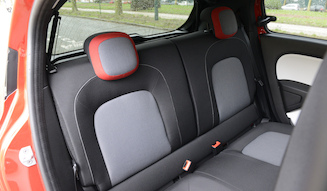
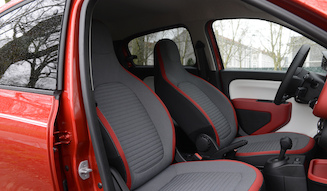
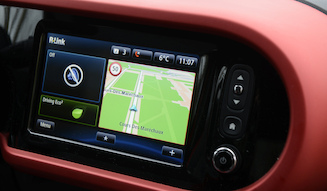
The interior design was also excellent. No, it was more than excellent. It was pop, high-quality, easy to use, and I loved it. The interior space is also generous. The only thing that bothered me was that the rear seat floor is a bit high, causing adults to sit with their knees bent slightly. However, with ample headroom and legroom, even if the posture is a bit unnatural, you won't feel cramped by any means.
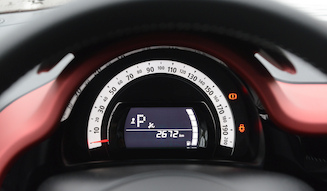
There are two engine options: a 0.9-liter turbo and a 1.0-liter naturally aspirated, and two gearbox options: a 5-speed manual and a 6-speed dual-clutch transmission. However, for the Japanese launch, expected in spring 2016, it is anticipated that only the combination of the 0.9-liter turbo and the 6-speed DCT will be available. The 0.9-liter turbo engine, basically the same as in theLutecia Zen 0.9L, felt stronger in the low to mid-range than in the Lutecia for some reason, but its pairing with the 6-speed DCT is excellent. In city driving, it delivers nimble performance by shifting gears sequentially while maintaining low engine speeds. While the gear changes themselves are not particularly quick, they are smooth enough not to cause dissatisfaction. Trying to achieve similar performance with a manual transmission would likely be quite hectic. If I were to drive it in Japan, I would undoubtedly choose the DCT.
Up to this point, I have deliberately avoided mentioning the relationship with the new Smart Forfour, but in reality, the third-generation Twingo and thenew Forfourare both produced at Renault's Novo Mesto factory in Slovenia. Furthermore, both cars share the commonality of using Renault engines as their base. In other words, the two are sibling cars. Considering this, you might understand why the Forfour has a soft ride. Incidentally, the Japanese specification Forfour uses a 1.0-liter naturally aspirated engine with a 6-speed DCT, but this does not mean it lacks power. For driving on regular roads and expressways, this should be sufficient.
So, if you ask me which is better, the Twingo or the Forfour, I can only say it depends on your preference for brand and design. Incidentally, the Twingo's design is surprisingly more mature. Also, it was surprising that the Twingo had more headroom and legroom in the rear seats.
A compact car that's convenient for quick errands can add color to your daily life. That's why you want to choose a car that brightens your mood. With its excellent practicality and appealing design, the new Twingo is sure to broaden the joy of choosing a compact car.