December 11, 2014
A Test Drive of the Mercedes-Benz E300 BlueTEC HYBRID | Mercedes-Benz
Mercedes-Benz E300 BlueTEC Hybrid
Introducing Mercedes' Diesel Hybrid
Test Drive: Mercedes-Benz E300 BlueTEC Hybrid
The E300 BlueTEC Hybrid is Mercedes-Benz's vanguard diesel hybrid, showcasing their commitment to hybridization. Few would argue against the benefits of environmental friendliness and fuel efficiency. But why is Mercedes-Benz pursuing hybridization? What is the system? Motor journalist Yasuhiko Kawamura delves into Mercedes-Benz and the issue of ecology with a test drive of the E300 BlueTEC Hybrid.
Text by KAWAMURA Yasuhiko
Photographs by Mercedes-Benz
What is the Mercedes Diesel Hybrid System?
Hybrid cars are fuel-efficient. Diesel cars are also fuel-efficient. Therefore, combining the two should result in an even more fuel-efficient vehicle... and that idea is precisely correct. The E300 BlueTEC Hybrid, introduced here, is Mercedes-Benz's first realization of this concept.
However, this model is not the one that earned the title of "world's first mass-produced diesel hybrid passenger car." That distinction went to the French PSA (Peugeot Citroën) group, which added a model with such specifications to its catalog last year. Recently, François Hollande, who has just become the new President of France, paraded on the Champs-Élysées in the rain in a diesel hybrid version of the Citroën DS5, so many people may have unknowingly seen its imposing figure (?) on TV.
Incidentally, the "PSA method" system is quite clever, evolving a conventional FWD diesel vehicle into a 4WD chassis by using a motor to drive the rear wheels. The "Mercedes method," on the other hand, employs a method of removing the torque converter from the conventional AT and inserting a thin motor in its place. A feature of this approach is its claim of easy integration with various vehicle models by modularizing the "transmission with integrated motor."
Mercedes has also experimented with more complex two-motor systems, but the company has recently established an internal direction to "use a simpler and more effective system that limits the total weight increase to within 100kg."
Mercedes-Benz E300 BlueTEC Hybrid
Introducing Mercedes' Diesel Hybrid
Test Drive: Mercedes-Benz E300 BlueTEC Hybrid (2)
Why Diesel Hybrid?
Why, then, has a diesel engine hybrid system, which technically presents no significant difference in difficulty compared to a gasoline engine combination, not been widely implemented until now? The primary answer appears to be "cost issues."
Everyone can understand that hybrid vehicles, with their added batteries and motors, are inherently more expensive than conventional gasoline cars. At the same time, diesel cars, which have not been very common in the Japanese passenger car market, are inevitably more expensive than conventional gasoline cars due to reasons such as the need for a more robust engine construction.
However, this naturally raises a new question: "Why a diesel hybrid now!?"
This seems to be related to sales strategy.
In fact, the full implementation of "CO2 emission regulations with penalties" is imminent in the European market. The calculation method is based on the cumulative CO2 emissions of sold models. Manufacturers are compelled to reduce CO2 emissions, especially for high-volume models.
Mercedes, whose mainstream sales consist of relatively large models, has recently shown a radical shift towards adopting "eco-cars," unprecedented in its history, by equipping the S-Class with a four-cylinder engine (!) and releasing diesel hybrid variants. This is thought to be due to these "unavoidable reasons." The widespread adoption of idle-stop mechanisms in most European cars today stems from similar circumstances.
Mercedes-Benz E300 BlueTEC Hybrid
Introducing Mercedes' Diesel Hybrid
Test Drive: Mercedes-Benz E300 BlueTEC Hybrid (3)
Test Drive of the Sedan Model
With that lengthy introduction, let's get to the main topic: the E300 BlueTEC Hybrid.
The system comprises a 2.1-liter turbocharged four-cylinder diesel engine producing 204 ps and 500 Nm of torque, coupled with a 7-speed AT that has a thin motor inserted where the torque converter would normally be. A 0.8 kWh lithium-ion battery with an output of 19 kW is mounted at the rear of the engine compartment, under the cowl, taking advantage of its compact size. "No compromise on luggage space" is one of the selling points of this model.
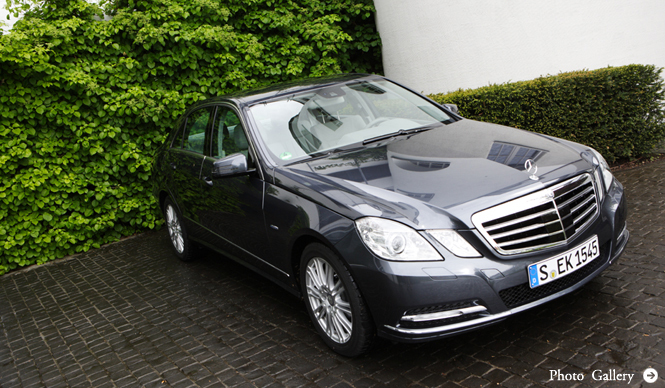
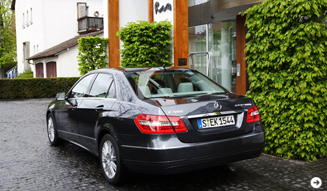
Our test drive, covering a total of approximately 300 km in a large loop from the outskirts to the suburbs of Stuttgart, Germany, was of the sedan model, one of the two body types available (the other being the wagon). Externally, it is indistinguishable from a "normal E-Class." Those who wish to advertise their contribution to environmental improvement with a hybrid model might find this somewhat understated.
Starting the engine... or rather, "activating the system" to begin the drive, the motor takes the initial role.
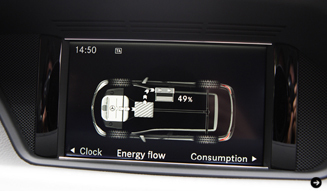
However, this is purely theoretical. The motor's maximum output is only 20 kW, equivalent to about 27 ps, so the acceleration solely from the motor feels like only about three times the "creep speed" of an automatic transmission vehicle.
In reality, at the moment of starting, the engine typically kicks in immediately after the initial movement. However, the smoothness of this transition is remarkable, and its high level of refinement means you might not even notice it happening.
While this generally positive impression forms the basis, it must be noted that occasional light jolts were felt at times. We have experienced similar subtle shift-shock-like phenomena occurring intermittently in Nissan vehicles with the same single-motor system. This type of system, where a single motor must perform multiple roles—generating drive, regenerating energy, and sometimes starting the engine—may face control challenges in this regard.
Mercedes-Benz E300 BlueTEC Hybrid
Introducing Mercedes' Diesel Hybrid
Test Drive: Mercedes-Benz E300 BlueTEC Hybrid (4)
Primarily Diesel, But...
As mentioned, due to the limited motor output, once the engine starts, the subsequent acceleration is predominantly characterized by the "feel of a diesel car." In other words, like many modern European diesel cars, strong torque is generated from very low engine speeds, and the high gear ratios, suited to this engine characteristic, allow the vehicle speed to increase smoothly without significantly raising the tachometer needle. At 100 km/h cruising speed, the engine speed is a mere 1,400 rpm. Consequently, the quietness is quite remarkable.
While the powertrain's performance is fundamentally "diesel-like," it naturally incorporates functions unique to hybrid vehicles.
Notably, the "sailing mode," which interrupts regenerative braking when the accelerator is released during coasting and maintains free-wheeling to conserve energy, is a unique idea not found in other vehicles. In actual driving, it was often difficult to decide whether it was more advantageous to use the regenerative mode, which recovers energy during light deceleration, or to extend the coasting distance with the "sailing" mode.
In fact, the development team's intention was to "allow drivers to enjoy this aspect in a game-like manner." In other words, the addition of the sailing function is not solely for fuel saving but also serves as a means to create a new driving pleasure unique to hybrid models.
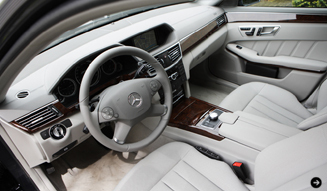
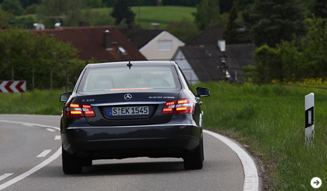
The driving feel otherwise is that of a "very ordinary E-Class." While the electric-only driving range is limited to a maximum of 1 km and the top speed is capped at 35 km/h, it is noteworthy that the chassis does not exhibit the "heaviness" characteristic of hybrid models.
However, the brake blending control, which switches to conventional hydraulic operation just before stopping to ensure maximum regenerative capacity, exhibited an unnatural relationship between pedal force and deceleration G in the very low-speed range where this transition is expected to occur. This is an area where Japanese hybrid vehicles employing similar systems demonstrate a clear advantage.
The E300 BlueTEC Hybrid is scheduled for release in the European market soon, with reports indicating a price increase of "around 3,000 euros" over the base model. The official announcement states that "introduction to Japan is currently undecided." However, depending on the future perception of diesel engines in the Japanese market, its possibility cannot be entirely ruled out.