Test Drives: Audi Q7 e-tron and A7 Sportback h-tron
Audi Q7 e-tron
Audi A7 Sportsback h-tron
Test Drive: Q7 e-tron and A7 Sportsback h-tron
Moving Beyond Fossil Fuels
Audi is committed to moving beyond fossil fuels as part of its climate change initiatives. To showcase its progress, the company hosted a workshop in Spain called "Audi Future Performance Days." We present a test drive report of the "Q7 e-tron" and "A7 Sportsback h-tron" by automotive journalist Fumio Ogawa, who participated in the event.
Text by OGAWA Fumio
A Plug-in Hybrid with a 3-Liter Diesel and Electric Motor
The way cars are powered will change dramatically in the near future. Audi is accelerating towards that future. In November 2015, a workshop called "Audi Future Performance Days" was held in Spain.
A highlight of the event was the opportunity to test drive the Audi Q7 e-tron 3.0TDI quattro. This large SUV combines a 3-liter diesel engine with an electric motor. Its high-performance, externally chargeable lithium-ion battery allows for over 50 km of driving on electric power alone.
In Japan, Audi launched the plug-in hybrid (PHV) "A3 Sportback e-tron" in 2015. The company is also planning to launch a gasoline-powered PHV version of the new Q7 in 2016. Audi is committed to moving beyond fossil fuels as part of its climate change initiatives.
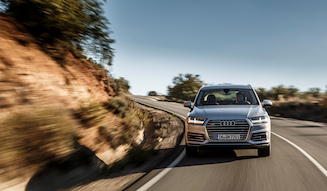
Audi Q7 e-tron
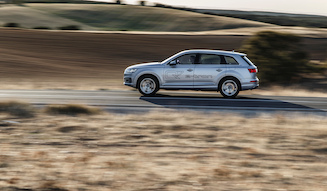
While not explicitly stated, Audi AG Chairman Rupert Stadler said in 2014, "Recent studies suggest that by 2030, about 40 percent of new passenger cars and light trucks sold will be powered entirely or partially by electricity."
Driving the Q7 e-tron 3.0TDI quattro on the outskirts of Madrid, I was struck by its surprising power, quietness, and comfortable ride. It boasts a maximum output of 275 kW (373 hp) and an astonishing maximum torque of 700 Nm. In terms of handling,New Audi Q7It is a superb vehicle.
After driving approximately 100 km on Madrid's highways and mountain roads, my car's fuel consumption was 3.5 liters per 100 km according to the European standard. This translates to over 28 km per liter in the Japanese system. These figures are incredible for a large car measuring 5 meters in length.
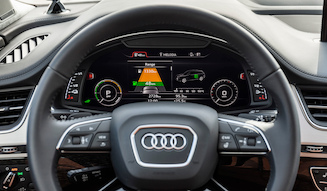
Audi Q7 e-tron
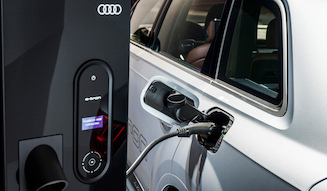
To achieve good fuel economy with a German plug-in hybrid, there's a trick: keep an eye on the battery level indicator located between the speedometer and tachometer (though it varies by car).—Try to drive using only the electric motor until the battery is depleted. Always drive on electric power alone. That is the "correct" way to drive for fuel efficiency. In this car's case, the electric motor alone can cover a distance of 56 km.
Despite carrying a relatively large battery, the car's balance when driven is excellent. The air suspension also performs well. Its cornering ability is solid, providing an enjoyable driving experience. On the highway, it offers a smooth ride and comfortable cruising.
The interior quality is also high, significantly contributed by the quietness and ride comfort. Noise from the tires on the road and wind noise from the windows are almost imperceptible. The cabin is remarkably silent. I was even more surprised to learn that it does not feature active noise cancellation, which uses out-of-phase sound waves to cancel noise.
Madrid held other surprises as well.
Audi Q7 e-tron
Audi A7 Sportsback h-tron
Test Drive: Q7 e-tron and A7 Sportsback h-tron
Moving Beyond Fossil Fuels (2)
Electricity Without Fossil Fuels
The venue for "Audi Future Performance Days" was the Institute of Aerospace Technology in a rural, or rather, pastoral area outside Madrid. A temporary studio was set up to showcase technological exhibits and alternative fuel vehicles, including the aforementioned Q7 e-tron 3.0TDI quattro. Here, Audi presented its vision for future mobility to journalists from around the world.
Audi proclaims, "We are rapidly advancing the electrification of powertrains." For the time being, the company is focusing on plug-in hybrids, like the Q7 e-tron 3.0TDI quattro. Beyond that, fuel cell and natural gas-powered vehicles are on the horizon.
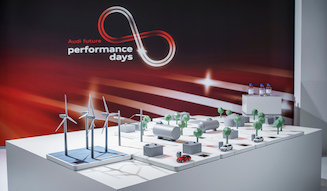
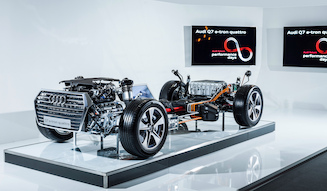
Interestingly, Audi states that its electricity is generated without fossil fuels (i.e., CO2-free). The electricity used for its "e-tron" plug-in hybrids and electric vehicles is produced from wind power, not from thermal or nuclear energy. Audi's dedicated factory produces methane gas from water and CO2 generated by biogas plants.
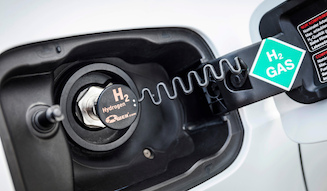
Currently, 1,000 tons of "e-gas" can be produced from 2,800 tons of CO2. This is used in the "g-tron" gas-powered vehicles. It is said that 1,500 vehicles can travel 15,000 km annually. Furthermore, CO2 emissions are zero. Methane can also be reformed to produce hydrogen, which serves as fuel for the "h-tron" fuel cell vehicle. The CO2 emitted at that time is also used for "e-gas."
Audi's efforts extend beyond this. The company is also actively involved in synthetic fuel development. They are developing "e-gasoline" and "e-diesel," which are produced through chemical synthesis without CO2 emissions. The goal is CO2-free internal combustion engines – this is Audi's commitment.
The Audi A7 Sportsback h-tron quattro, a fuel cell vehicle, also drives exceptionally well.
Audi Q7 e-tron
Audi A7 Sportsback h-tron
Test Drive: Q7 e-tron and A7 Sportsback h-tron
Moving Beyond Fossil Fuels (3)
Balancing CO2-Free Operation with High Performance
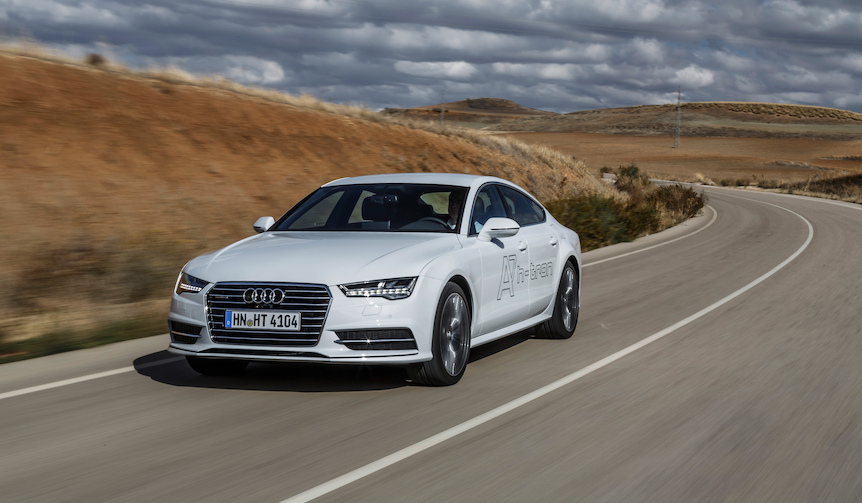
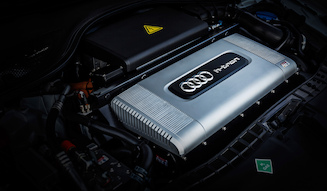
The Audi A7 Sportsback h-tron quattro, which I test drove in Madrid, is a fuel cell vehicle that uses hydrogen to power an electric motor. It is based on the existing "A7 Sportback" but replaces the engine with an electric motor, hydrogen tank, and a fuel cell stack that generates electricity from hydrogen.
The A7 Sportsback h-tron quattro can be considered in the same category as Toyota's "MIRAI", but there are significant differences. "The A7 Sportsback h-tron quattro combines a fuel cell system using hydrogen with our full-time quattro all-wheel-drive system," an Audi representative proudly stated at the event, which left a strong impression.
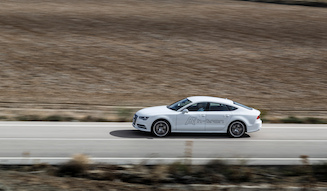
Audi A7 Sportsback h-tron
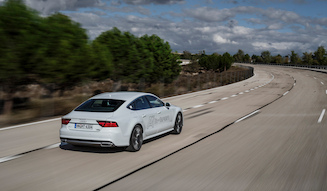
"Because we are committed to CO2-free operation using electricity, we do not believe that compromising other performance aspects is acceptable. We pursue both high performance and excellent driving dynamics simultaneously. There can be no compromises."
The A7 Sportsback h-tron quattro is powered by two electric motors driving all four wheels, a technology Audi calls "e-quattro." It is also a plug-in hybrid with external charging capability. According to Audi, it can travel over 500 km on a single full charge. "The technology is already established. As soon as we get the green light, we can move to mass production," an Audi engineer stated confidently.
What is most impressive about the A7 Sportsback h-tron quattro is its acceleration. It fully leverages the advantages of an electric vehicle, boasting a maximum torque of 540 Nm. Those familiar with electric cars will recognize this sensation, but this takes it a step further.
The handling is also surprisingly neutral. However, the vehicle's weight (which is perhaps unavoidable) means that you need to press the brake pedal firmly for effective braking. The engineers indicated that this issue will be resolved soon.
At the recent COP21 (21st Conference of the Parties to the UNFCCC) in Paris, differences in objectives between developed and developing nations led to some awkwardness, as reported. However, it is universally understood that measures must be taken to prevent global warming, which is causing significant damage to the planet, including rising sea levels, ocean acidification, and an increase in severe storms and hurricanes.
The same applies to corporations and individuals. While the situation regarding diesel in the North American market remains uncertain, Audi's progress with alternative fuel vehicles, keeping global warming prevention in mind, is something I strongly support and wish them continued success.