Test Drive of the BMW X5 Plug-in Hybrid Model | BMW
BMW X5 xDrive40e
Test Drive: BMW X5 Plug-in Hybrid
A Choice for Decarbonization
BMW plans to introduce multiple PHEV models to offer sustainable next-generation mobility. Motor journalist Fumio Ogawa test drove the first of these, the "X5 xDrive 40e."
Text by OGAWA FumioPhotographs by ARAKAWA Masayuki
A Solution for the "2020 Problem"
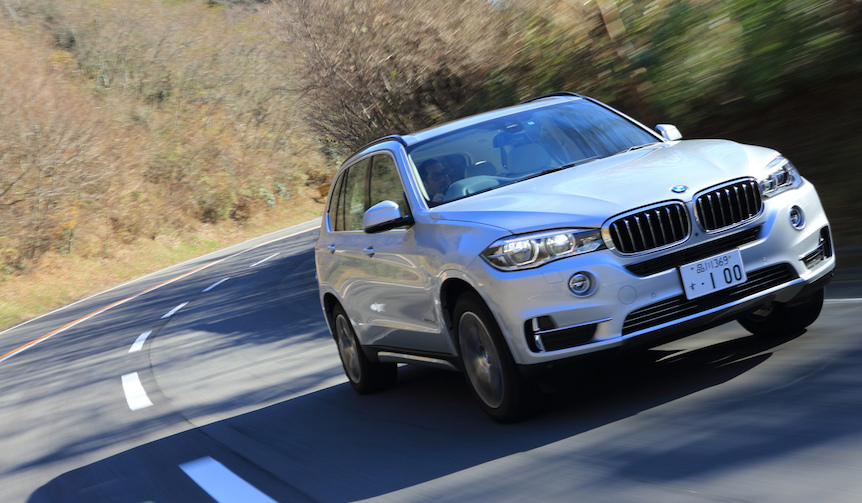
The plug-in hybrid "X5 xDrive40e" was launched in Japan in September 2015. Deliveries began in December, and a test drive event was held accordingly. This is a model that commands attention. After all, the "e" is a sub-name signifying a hybrid model. It's fresh in our memory how several BMW PHVs, in addition to the X5, were displayed at the 2015 Tokyo Motor Show as planned introductions. We can expect to see more of them in Japan in 2016.
The X5 xDrive40e combines a 2-liter, 4-cylinder gasoline engine with an electric motor powered by a lithium-ion battery. The motor is mounted in front of the 8-speed automatic transmission. It's a powerful addition to the X5, which was launched in Japan in 2013.
The on-demand 4WD system, called xDrive, is driven in three modes: engine, motor, and hybrid. Because it's externally rechargeable, it can also run on electric power alone.
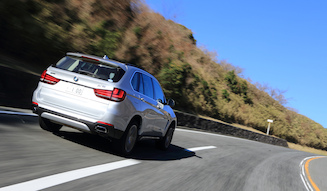
Many automotive executives predicted that 2016 would be the year of the SUV. Early in 2015, before the Chinese economy began to falter, this statement held considerable weight. Since then, they've continued to say the same thing. While the basis for this prediction isn't entirely clear, new model launches seem set to continue.
It's understandable that plug-in hybridization is rapidly advancing, particularly in Germany. As we've written many times on Openers, the "2020 Problem" is a factor. This refers to CO2 emission regulations. Failure to meet these standards incurs substantial fines, around 100 euros per vehicle. To generate profit, manufacturers need high-margin large models, but these are inherently at odds with fuel efficiency. Therefore, the plug-in hybrid powertrain is likely to become more prevalent in the future (provided lithium-ion battery supply remains stable...).
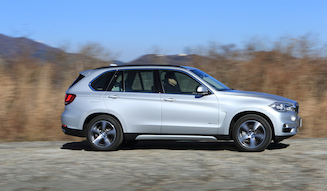
The X5 is an imposing vehicle, measuring 4.91 meters in length and 1.76 meters in height. It's also luxurious, which undoubtedly contributes to its popularity. Furthermore, for users who find its powerful feel to be another compelling reason to be drawn to this car, this plug-in hybrid model is certainly worth a thorough test drive.
BMW X5 xDrive40e
Test Drive: BMW X5 Plug-in Hybrid
A Choice for Decarbonization (2)
Electric-Only Range of Approximately 31 km
In a word, the X5 xDrive40e is faster than expected. As mentioned earlier, given its large body, nearly five meters long, I initially thought a 2-liter engine might be insufficient, but this concern proved unfounded almost immediately. Pressing the start button activates the silent electric motor, and when you step on the accelerator, the car moves off without any perceptible delay.
BMW claims that with a fully charged battery, the electric motor alone can drive the vehicle for nearly 31 km at speeds up to 120 km/h. During our test, we couldn't achieve that distance, so we were unable to verify BMW's claimed fuel economy of 3.3 L/100 km (equivalent to 30 km/L in Japanese terms). While we couldn't fully assess the overall fuel efficiency, we certainly experienced the power advantage of the electric motor.
As a hybrid, the X5 xDrive40e allows for selection of driving modes via a button labeled "eDrive" on the center console. "AUTO eDrive" is the hybrid mode, which switches between the engine and electric motor based on driving conditions. "MAX eDrive" is the all-electric EV mode. And "SAVE Battery" is the mode that runs solely on the gasoline engine.
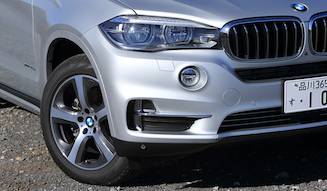
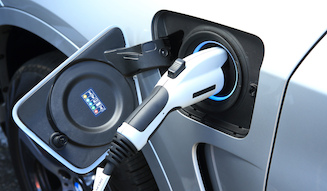
When driving in "MAX eDrive" mode, the motor, which generates an instantaneous maximum torque of 250 Nm, provides a seamless acceleration. Normally, this would continue for some time, but the test car's battery charge was not optimal, limiting the experience in this mode. A glance at the tachometer revealed the engine had engaged, indicating a smooth transition to "AUTO eDrive" mode.
If you desire even more powerful performance from the X5 xDrive40e, select the "Power" mode using the "Driving Performance Control" familiar to BMW drivers. You'll experience truly exhilarating speed.
In terms of finer details like feel, a 4-cylinder engine is, after all, a 4-cylinder, and a larger displacement engine might seem more fitting for such a luxury vehicle. However, rather than idly watching global warming progress, why not lend a hand in preventing rising sea levels from submerging many cities? Hybrid vehicles, for the purpose of decarbonization, offer a path forward. It's certainly not a bad choice in life.
Despite being a large SUV, the X5 xDrive40e possesses a distinct BMW character.
BMW X5 xDrive40e
Test Drive: BMW X5 Plug-in Hybrid
A Choice for Decarbonization (3)
Suspension with a Sense of Travel
BMW defines the X5 xDrive40e as "achieving both outstanding driving dynamics and high environmental performance." As discussed, it is indeed exceptionally well-executed within the hybrid framework. From another perspective, the electric motor's power also imbues it with a charm that a multi-cylinder engine might lack.
What's interesting is the ride quality. The suspension has a noticeable sense of travel, and there's a considerable amount of body roll. While I haven't had the opportunity to confirm the intention behind this setup, I can say it doesn't feel unpleasant. Long suspension travel is crucial for maintaining tire contact, especially for true cross-country 4WD vehicles. It made me reconsider if the X5 is indeed such a vehicle.
In recent years, as readers may know, electronic control technology has advanced significantly. Issues like one wheel losing traction and torque being diverted away from it due to the differential are no longer a concern. The car instantly determines which wheel needs torque distribution to overcome critical situations and acts accordingly. Therefore, the reliance on suspension travel, as was once the case, should have diminished. However, the situation is different on truly rough terrain. We can assume that such extreme capability is required of the X5 to compete in a market with few rivals.
The handling requires a bit of attention, perhaps due to the suspension's long travel. You need to carefully consider weight transfer when steering, accelerating, or braking, otherwise, you might experience excessive body roll or a "kickback" effect when returning the steering wheel. However, this is most noticeable at low to medium speeds; it's not an issue when driving faster. The slight sensation of the outer wheels sinking into the turn isn't unpleasant, and the enjoyment of driving is palpable as you transition from one curve to the next.
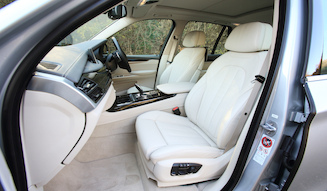
It's also highly practical. Thanks to the generous 2935mm wheelbase, both front and rear passengers have ample legroom and headroom. The wide sills might require a bit of care when getting in and out for some individuals. You need to master the "correct" way to enter. Is that part of the X5's "etiquette"? Perhaps not.

BMW X5 xDrive40e
Body Dimensions | Length 4,910 x Width 1,940 x Height 1,760 mm
Wheelbase | 2,935 mm
Tread Front/Rear | 1,645 / 1,650 mm
Weight | 2,370 kg
Ground Clearance | 210 mm
Engine | 1,997 cc Inline 4-cylinder Direct Injection DOHC
Max Engine Output | 180 kW (245 ps) / 5,000 rpm
Max Engine Torque | 350 Nm (35.7 kgm) / 1,250-4,800 rpm
Motor | AC Synchronous Electric Motor
Rated Motor Output | 55 kW (75 ps) / 5,000 rpm
Max Motor Output | 83 kW (113 ps) / 3,170 rpm
Motor Torque | 250 Nm (25.5 kgm)
Battery | Lithium-ion Battery 96 cells / 26 Ah
Transmission | 8-speed AT
Drivetrain | 4WD
Tires Front/Rear | 255/55R18
Suspension Front/Rear | Double Wishbone / Integral Arm
Brakes Front/Rear | Ventilated Disc
Fuel Economy (JC08 Mode) | 13.8 km/L
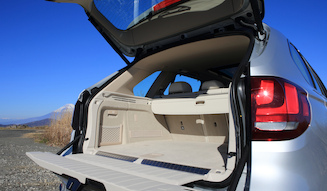
Trunk Capacity | 500 (1,720 with rear seats folded) Liters
Price | 9.27 million yen
BMW Customer Interaction Center
0120-269-437 (Weekdays 9:00-19:00, Weekends/Holidays 9:00-18:00)