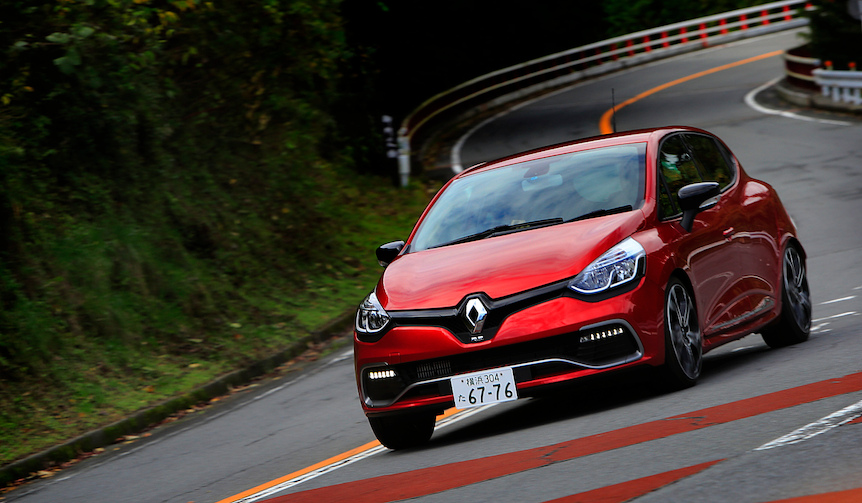
Test drive of the Renault Lutecia R.S. Trophy | RENAULT
Renault Lutecia Renault Sport Trophy
Renault Lutecia Renault Sport Trophy
Test Drive: Renault Lutecia R.S. Trophy
The Pinnacle of Modern Hot Hatches
The "Trophy," newly introduced as a successor to the "Chassis CupChassis Cup," offers an even higher level of tuning. Automotive journalist Tatsuya Otani takes the wheel.
Text by OTANI TatsuyaPhotographs by ARAKAWA Masayuki
Catering to Diverse Needs with "Chassis Sport" and "Trophy" Models
This is a trend observed among many imported car manufacturers, not just Renault, but Japan is known as a market where the proportion of sports models relative to overall sales is particularly high. Consequently, it's common for situations like Mercedes' global sales ranking being 5th, but its AMG models soaring to 3rd place. In other words, Japanese consumers have a strong appetite for high-performance cars.
The same applies to Renault. Renault's sales in Japan are just under 5,000 units. For a major manufacturer selling 2.7 million vehicles worldwide, 5,000 is a negligible figure, for which we sincerely apologize. However, when it comes to Renault Sport models alone, sales reach 992 units, ranking it 3rd globally. It's astonishing that with only the "Megane" and "Lutecia" available as Renault Sport models, these alone account for one-fifth of Renault's total sales in Japan. Globally, Renault Sport models reportedly represent only 5 percent of Renault's total sales.
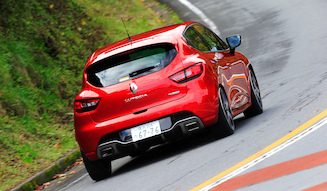
Given this Japanese fondness for "Renault Sport," model selection differs slightly from global standards. In fact, within the "Lutecia" (known as "Clio" overseas) Renault Sport lineup, there are three tiers based on tuning levels: "Chassis Sport," "Chassis Cup," and "Trophy," with tuning becoming progressively more aggressive in that order. While the softer "Sport" model is typically the bestseller in other countries, in Japan, the "Cup" model has overwhelmingly outsold the "Sport" and "Cup" combined in the past. This again reflects the Japanese preference for sports models.
Responding to these market trends, Renault Japon decided to introduce the "Trophy," which is even more potent than the "Cup." The strategy is to offer both the "Sport" and "Trophy" models going forward. Notably, the "Trophy" is usually a limited edition, making its inclusion in the regular catalog a first and a special consideration for the Japanese market. The decision to pair the "Sport" and "Trophy" instead of the "Cup" and "Trophy" was apparently aimed at meeting a wider range of needs by introducing two distinctly characterized models.
Renault Lutecia Renault Sport Trophy
Renault Lutecia Renault Sport Trophy
Test Drive: Renault Lutecia R.S. Trophy
The Pinnacle of Modern Hot Hatches (2)
Engine: +20 hp and +20 Nm compared to "Chassis Sport"
The "Lutecia Renault Sport Trophy," which has now arrived, features several special tuning enhancements befitting its name.
Firstly, by increasing the boost pressure by 0.2 bar to 2.0 bar, the engine achieves 220 hp and 260 Nm, a gain of +20 hp and +20 Nm over the "Sport." The ride height has been lowered by 20 mm at the front and 10 mm at the rear, while the springs have been stiffened by 40 percent. Additionally, it incorporates dedicated features such as launch control and multi-shift down (a function that automatically downshifts according to vehicle speed when the paddle for downshifting is held).
A particularly noteworthy feature, characteristic of Renault Sport's focus on chassis performance, is the system called Hydraulic Compression Control (HCC). Integrated within the dampers, it controls the damping force just before the bump stops are engaged, using a separate damper unit. By progressively controlling the damping force, this device is thought to improve ride comfort in everyday driving while moderating the handling characteristics at the extreme limit, just before the bump stops are reached.
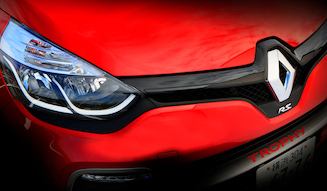
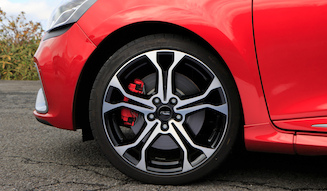
Perhaps due to the effect of the HCC, the "Trophy's" ride comfort is not decisively harsher than the "Sport's." While the stiffness of the springs is certainly noticeable, personally, I found the friction in the suspension, which was present in the initial "Sport" models, to be gone. Instead, the suspension stroke felt solid yet smooth. This resulted in a completely pleasant experience, and I would choose the "Trophy" over the "Sport" even for primarily city driving.
These impressions remained unchanged when moving to winding roads. True to Renault's character, the suspension moves smoothly at low speeds, yet it effectively controls the car's behavior even when picking up the pace through corners, instilling a sense of confidence. Furthermore, even when encountering bumps during hard cornering, the tires maintain contact with the road, and grip is rarely lost momentarily. This also contributes significantly to the driver's sense of security.
Renault Lutecia Renault Sport Trophy
Renault Lutecia Renault Sport Trophy
Test Drive: Renault Lutecia R.S. Trophy
The Pinnacle of Modern Hot Hatches (3)
Few Flaws to Be Found
In contrast, the handling feels significantly more agile compared to its larger sibling, the "Megane Renault Sport," reacting swiftly to steering inputs. Frankly, on the first corner I entered, the initial steering gain was higher than expected, causing an excessive yaw moment and inducing a tail slide. However, the ESC did not intervene even with a slight rear slip, and the car could be easily brought back under control with a small counter-steer. This tuning refinement feels as if engineers who truly understand sporty driving were involved, which is quite satisfying.
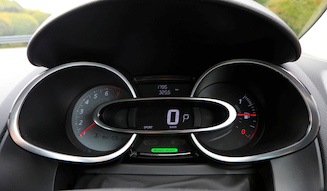
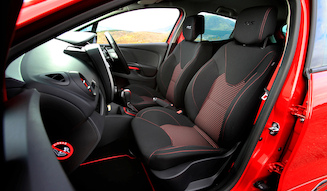
The engine's response, enhanced for more power, is excellent, with no unnatural power delivery steps. The 220 hp output provides more than sufficient performance for the car's 1,290 kg weight. The gearbox, exclusively a 6-speed dual-clutch semi-automatic, reportedly offers 20 percent faster shift speeds, yet it does not induce uncomfortable jolts. More importantly, it frees the driver from the distraction of shifting, unlike a manual gearbox. It seems only a matter of time before the 2-pedal driving, now standard in supercars with over 500 hp, becomes commonplace in the B-segment as well.
In conclusion, during a brief test drive, very few flaws were found in the Lutecia Renault Sport Trophy. If I had to nitpick, I might recall the suspension having more travel and exhibiting greater grip in corners on older Renault Sport models. However, the latest Lutecia is incomparably more agile, responsive, and refined than those of the past. Therefore, rather than a net zero, the current model offers significantly more value. As such, it is a car I can strongly recommend as the pinnacle of modern hot hatches. And at a price of 3,295,000 yen, isn't that simply dreamlike?

Renault Lutecia Renault Sport Trophy
Renault Lutecia Renault Sport Trophy
Body Dimensions | Length 4,105 x Width 1,750 x Height 1,435 mm
Wheelbase | 2,600 mm
Tread Front/Rear | 1,505 / 1,500 mm
Minimum Ground Clearance | 125 mm
Weight | 1,290 kg
Engine | 1,618 cc Inline 4-cylinder Direct Injection DOHC + Turbocharger
Maximum Output | 162 kW (220 ps) / 6,050 rpm
Maximum Torque | 260 Nm (26.5 kgm) / 2,000 rpm
Transmission | 6-speed Dual Clutch
Drivetrain | FF
Tires Front/Rear | 205/40R18
Suspension Front/Rear | MacPherson Strut / Trailing Arm
Brakes Front/Rear | Ventilated Discs / Discs
Price | 3,295,000 yen
Renault Call
0120-676-365 (9:00-18:00, open daily)