Test Drive the New Audi Q7 | Audi
Audi Q7 | The Audi Q7
Test Drive: The New Audi Q7
A Tireless Long-Distance Tourer
The new Audi Q7, slated for introduction in Japan in spring 2016. Ahead of its launch, automotive journalist Fumio Ogawa, who attended the international test drive event in Germany in October 2015, reports on the model's true value.
Text by OGAWA Fumio
A 300kg Weight Reduction Success
It is a premium SUV.The Audi Q7 Has Been RedesignedThe chassis has been completely redesigned. The body is 300kg lighter than the previous model. The engines offer improved efficiency. Furthermore, it features a wealth of driver assistance systems. The quattro system, combined with the spacious body, is also a strong appeal to fans.
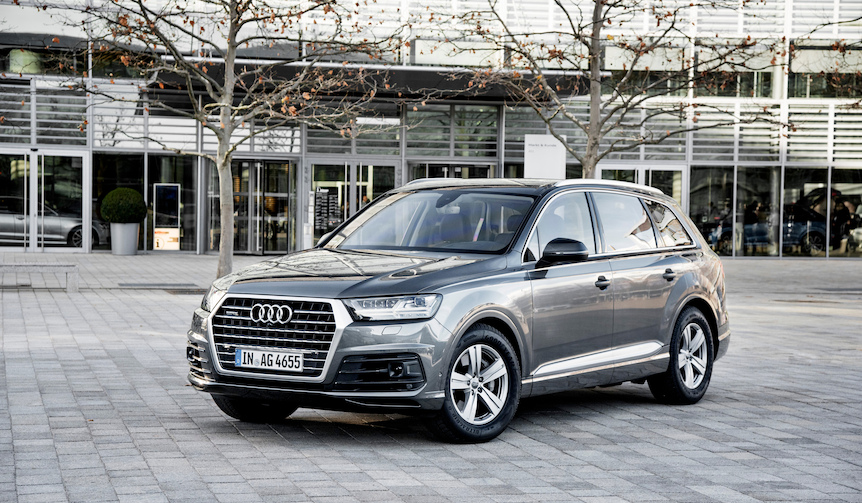
As readers are well aware, Audi's SUV range is named Q. The Q7 is positioned at the pinnacle of this lineup. Its length is 5.05 meters, width 1.97 meters, and height 1.74 meters. Many users in Japan appreciated its imposing presence. After its launch in Japan, the "Pedestrian Protection Law" was enacted, leading to its discontinuation. This is a "re-debut" with the new model, after careful preparation.
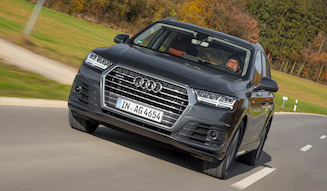
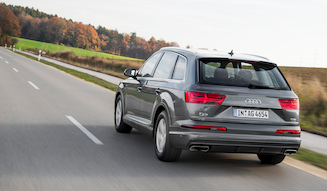
The new Q7 was exhibited as a reference vehicle at the 2015It was a car that garnered attention when it was a reference exhibit at the Tokyo Motor Show.It is already on the roads in Europe. In its home market, diesel engines are the primary focus, with plug-in hybrid variants also available for diesel models. In contrast, Japan will initially introduce the Q7 3.0TFSI quattro with a 3-liter V6 engine and the Q7 2.0TFSI quattro with a 2-liter 4-cylinder engine. Audi Japan expects the launch in the first half of 2016. Following this, the introduction of a 2-liter gasoline engine plug-in hybrid model is planned.
The packaging of the new Q7 is noteworthy. While the overall height is nearly the same as the previous model, the length has been reduced by 35mm and the width by 15mm. Despite this, the space between the front and rear seats has increased by 21mm. Headroom has also increased, by 41mm in the front and 23mm in the rear. The wheelbase is 2.99 meters.
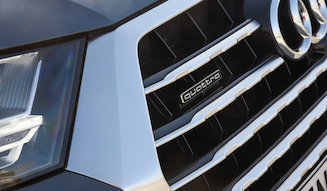
The style effectively retains the characteristics of the previous model, yet feels new. When I first saw the new Q7 at the show, I was struck by its emphasized boxiness. The grille, integrated with the headlights, represented Audi's new design language, making me wonder if Audi design had entered a new era. However, the actual vehicle has well-defined contours on various parts of the body, and a sense of quality conveyed through its taut surfaces and delicate character lines. It also consciously evokes a connection to the classic Audi "quattro."
The drivetrain is, of course, equipped with the quattro system. This full-time 4WD system is paired with an 8-speed automatic transmission. The drive force distribution is typically 40 percent to the front wheels and 60 percent to the rear. Depending on road conditions, the torque distribution can vary between a maximum of 70 percent to the front and 85 percent to the rear. It also features torque vectoring, which uses drive force control of the front and rear wheels via braking to enhance cornering performance. Audi claims that combined with the mechanical center differential, it achieves sporty driving on normal roads.
Significant weight reduction and a new generation of efficient engines. But what about the drive?
Audi Q7 | The Audi Q7
Test Drive: The New Audi Q7
A Tireless Long-Distance Tourer (2)
Packed with "Secret Weapons"
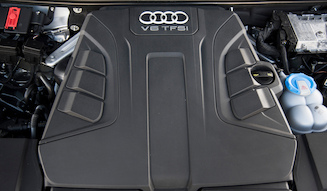
Of the two models scheduled for release in Japan, the one I test drove in Germany was the Q7 3.0TFSI quattro. It boasts a maximum output of 245kW (335ps) and a maximum torque of 444Nm. For reference, the 2-liter 4-cylinder engine delivers a maximum output of 185kW (252ps) and a maximum torque of 370Nm, numbers that are remarkable for a 2-liter engine. The moment I drove the 3-liter model (it felt almost instantaneous), I was surprised by its incredible power.
The 444Nm of torque provides a tangible sense of power, propelling the vehicle forward with strong acceleration. Even with a light touch of the accelerator pedal, the car, over 5 meters long and 1.7 meters high, surges ahead. The acceleration continues without interruption, even at high speeds. Audi has always strived to create driver's cars, and this experience solidifies that belief.
Cornering also feels light and enjoyable, with a responsive feel as you turn. The car's mass is completely unnoticeable as you turn the steering wheel. The body reacts sharply, a testament to Audi's emphasis on lowering the center of gravity. The results are evident.
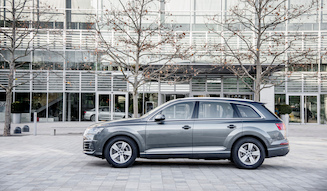
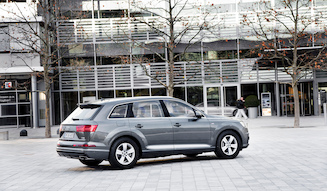
The test drive route took me from Munich Airport to Ingolstadt, where Audi's headquarters are located, covering about 100km on the Autobahn. The virtual cockpit, also featured in the Audi TT in Japan, has a useful function that displays the speed limit for the current section. The limit changed between "100" and "120," and occasionally a "white circle with a lane" indicated a section with no speed limit.
The Q7 3.0TFSI quattro offered a simultaneous experience of instantaneous mid-range acceleration, smooth high-speed acceleration, and remarkable quietness, all unexpected for an SUV. The new generation SUV is packed with "secret weapons." One of these is the "adaptive air suspension." This suspension system uses compressed gas from an electromagnetic pump instead of metal springs and dampers. Its advantage lies in its high computational power to adapt to road surface changes.
Steering is consistently stable. The suspension moves with consistent suppleness. It is a tireless long-distance tourer, making golf courses and snowy mountains equally suitable destinations. Whether on highways, winding mountain roads, or off-road, the suspension excels in its range of motion and shock absorption. However, its adoption in the Japanese specification is "undecided" (according to Audi Japan).
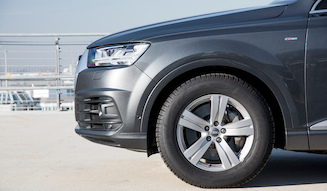
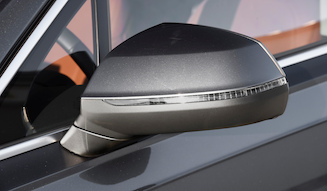
Cornering is sharp in response to steering wheel input. Moreover, it follows a precise line as if on rails. Body roll is well-controlled, and the driving feel can be summarized as sporty. Another "secret weapon" plays a significant role here.
The noteworthy technology in the new Q7 is the "four-wheel steering" (standard equipment). This system steers the rear wheels in conjunction with the front wheels, depending on the driving conditions. At high speeds, the rear wheels turn in the same direction as the front wheels to achieve agile cornering. At low speeds, they turn in the opposite direction to improve maneuverability. The steering angle can be up to 5 degrees.
The standard "Audi drive select" also contributes to clarifying the Q7's character as a driver's car. The redesigned controller, which is now more user-friendly, was immediately impressive. The system itself is even more sophisticated, offering seven driving modes, including Comfort, Sport, and Offroad.
The adaptive air suspension is integrated with drive select. This allows for integrated control of steering, suspension, and engine torque. As a result, it excels as both a family car and a sporty SUV, which is a welcome outcome.
The interior features Audi's latest design theme.
Audi Q7 | The Audi Q7
Test Drive: The New Audi Q7
A Tireless Long-Distance Tourer (3)
A Smaller Body and Expanded Interior Space
The interior of the new Q7 boasts class-leading quietness. The drag coefficient (Cd value) is 0.32, which is quite low. Attention to detail is meticulous. For example, the mounting position of the side mirrors was carefully considered. In addition to their shape, Audi explains that placing them on the shoulder line of the body enhances aerodynamic efficiency.
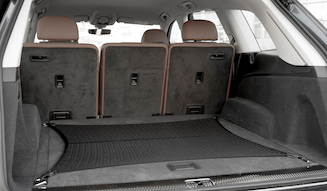
As mentioned earlier, the packaging is a major highlight of this vehicle. While the overall length is shorter than the previous model, the interior space has been expanded. The distance between the first and second rows has increased, and the headroom for occupants has also been enlarged. The second row features three individual seats with adjustable backrest angles and can slide forward and backward up to 110mm. This is a powerful feature for a family car. The third row also has seats, and even with them in the upright position, the luggage capacity is 295 liters. It is a vast 770 liters when the seats are folded down.
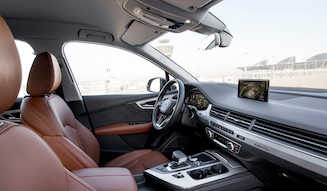
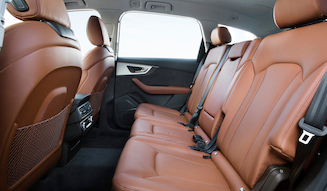
The comfort of the cockpit is also noteworthy. It features a new generation design that is also found in the new "A4," which will soon be launched in Japan. The layered, horizontal dashboard and the high center console create a sense of being enveloped and secure for the driver.
The controls have been completely revamped. The centerpiece is the virtual cockpit, which allows the display to be switched according to the driver's needs. All information can be checked here, significantly reducing the need for the driver to shift their gaze. This can be considered a safety feature in itself.
The operation of the MMI (Multi Media Interface) is also new. The new generation is called "allroad touch" and enables blind touch operation through auditory and tactile (click) feedback. The operating procedures have also been simplified. Once accustomed, you can write on the pad or zoom in and out of the map screen with two fingers. Ideally, for the right-hand drive version, I would prefer a pad for the right hand. Even a small pad in the corner of the dashboard where the right hand can write would greatly improve usability. Is that too much to ask?
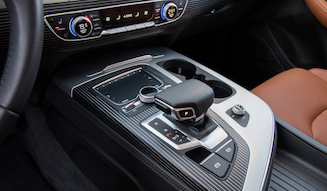
The gear selector has also been redesigned. The knob is more three-dimensional and ergonomic. Additionally, new functional features have been added. The selector button for the parking position is now located at the thumb's natural resting place. This is very convenient. Audi Japan explained that the design will be mirrored for the right-hand drive Japanese specification.
With its high-quality feel, excellent functionality, and comfortable interior, the enhanced new Q7 is even more compelling. I eagerly await its introduction in Japan.