A Test Drive of the Subaru BRZ | SUBARU
SUBARU BRZ | SUBARU BRZ
Test Drive: SUBARU BRZ
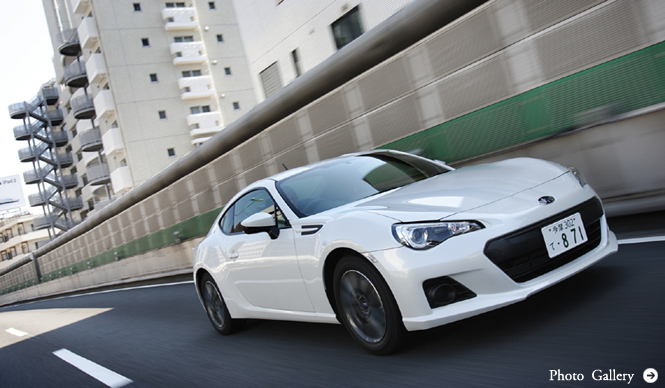
The SUBARU "BRZ," a domestic FR sports car that leverages its low center of gravity, achieved by its specially developed chassis.BRZ" with its sister model, the Toyota "86" is arguably one of the most talked-about Japanese cars right now. OPENERS had the opportunity to test drive this "BRZ." What kind of car is the "BRZ"? Tatsuya Otani analyzes.
Text by OTANI Tatsuya
Photographs by ARAKAWA Masayuki
Beautiful
"It's a car with deep contours."
Gazing at the Subaru BRZ in Satin White Pearl, standing amidst the dappled sunlight of Hakone, I suddenly thought that. It might be natural for a coupe to be beautiful, in a sense. Unlike a sedan, where securing living space is prioritized, a coupe has a lower priority for cabin space, allowing for more room to maneuver in styling.
However, how many Japanese coupes in the past could be described as "beautiful"? While I risk criticism, it seems that many coupes have lacked dynamism, with flat and shallow styling.
But the BRZ is different.
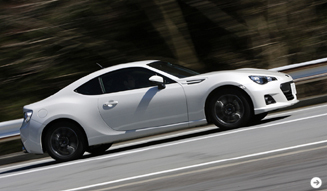
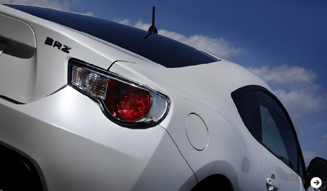
The front and rear fenders bulge powerfully like the muscles of a well-trained athlete, visually conveying the impression that the four wheels are firmly gripping the road.
The straight, horizontal waistline, combined with the side sill that increases in volume towards the rear, gives the car a sense of dynamism as if it's about to move forward. Furthermore, the styling from the C-pillar to the rear end, while a somewhat classical approach for a coupe, embodies sculptural beauty and sensuality, exuding a certain "eroticism."
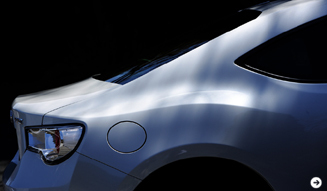
As a result, I believe the BRZ has achieved a highly refined and expressive coupe form. This should be well-received even by sophisticated "adults" interested in fashion and art.
I also appreciated the interior design, which is free of ostentation and kept compact and simple. In particular, the dashboard, with its low basic lines and the design of stacking only essential elements like meters and air vents above them, has a taste reminiscent of Porsche from an era that championed minimalism, further enhancing its sporty impression. It also serves to symbolize the "low" theme that became the development concept for the BRZ.
SUBARU BRZ | SUBARU BRZ
Test Drive: SUBARU BRZ (2)
SUBARU's Car Manufacturing
Here, we would like to recall the circumstances that led to the birth of the Subaru BRZ.
The development plan for the BRZ and its sibling, the Toyota 86, began in 2008, when the strengthening of the relationship between Subaru and Toyota was announced. The two companies agreed to jointly develop a "sports car that newly proposes the joy of driving," with Toyota handling product planning and styling concepts, and Subaru responsible for design, development, and production. However, the division of labor was not so clear-cut; Subaru sometimes participated in work led by Toyota, and Toyota sometimes assisted in areas handled by Subaru. For example, the combination of Toyota's "D-4S" direct injection system with Subaru's signature horizontally opposed engine is a prime example.
The resulting BRZ adopted the ideal basic layout for a compact sports car: a steel monocoque coupe body with four seats, powered by a naturally aspirated 2.0-liter four-cylinder engine mounted at the front and driving the rear wheels.
However, Subaru would not simply settle for a conventional configuration. Subaru's approach to car manufacturing is to thoroughly incorporate the engineers' passion into even conventional layouts. And what the engineers were most passionate about in the development of the BRZ was achieving a low center of gravity and mass concentration, the fundamentals of a sports car.
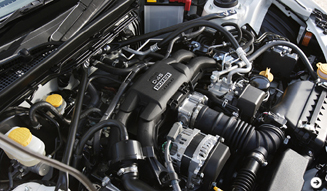
Specifically, the horizontally opposed engine, which already has a low center of gravity, was mounted 60mm lower and moved 240mm rearward compared to the Impreza. By placing the engine, the heaviest component in a car, low and near the center of the vehicle, the moment of inertia is reduced, leading to more agile responses. However, changing the engine's mounting position requires significant structural modifications to the vehicle, incurring enormous costs.
Naturally, car manufacturers hesitate to develop chassis exclusively for sports cars.
Yet, Subaru dared to take on this challenge, aiming for the low center of gravity and mass concentration that only a sports car can achieve. The "low" motif incorporated into the exterior and interior design reflects their sincere commitment and pride in achieving a low center of gravity.
SUBARU BRZ | SUBARU BRZ
Test Drive: SUBARU BRZ (3)
Design That Considers Everyday Usability
The model we tested this time is the "R," the mid-grade of the three available BRZ types. Unlike the top-grade "S," it comes with 16-inch tires, but it's the perfect model to experience the essence of the BRZ at a reasonable price.
The first thing you notice upon getting in is the excellent visibility, despite the low seating position.
Just as the engine mounting position was lowered to reduce the center of gravity, lowering the seat position also helps keep the "driver" component low, contributing to a lower center of gravity. This is a common technique for sports cars.
However, the BRZ ensures a spacious field of vision even from a low seating position by appropriately arranging the front, rear, side windows, and pillars. Notably, the visibility to the rear-right, crucial for merging onto a highway, and the diagonal forward visibility required for safety checks when turning right or left are well secured. This is a design that thoroughly considers everyday usability.
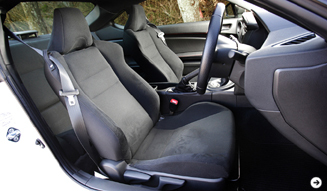
The ride comfort is also pleasant. While the suspension is firm, as expected for a sports car, it doesn't transmit direct shocks from road imperfections, nor does the car's vertical motion repeat on undulating surfaces. In fact, many enthusiasts would likely appreciate the ride comfort, with its well-controlled damping.
Choosing Between the 86 and BRZ—
Although naturally aspirated, the 2-liter engine delivers 100ps per liter, and as an inevitable consequence of its high output, the torque in the low-speed range feels somewhat lacking. However, like the ride comfort, this is not a decisive drawback for a sports car. More appealing is the power characteristic that becomes more powerful the higher you rev it, with its strength undiminished even beyond 7,000rpm.
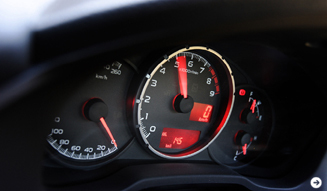
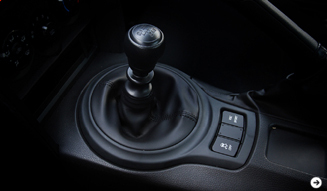
And by operating the crisp-shifting manual gearbox and keeping the engine revs above 4,000rpm, you can enjoy the linear response characteristic of a naturally aspirated engine.
Everything described so far applies not only to the BRZ but also to the Toyota 86.
However, when taken to winding roads, the BRZ began to show a distinctly different character from the 86. I had a faint inkling of this while driving in the city, as the initial steering response felt more subdued than the 86's. But as I picked up the pace in the BRZ, I realized it had a chassis with high stability, where the rear end held its ground well even as it approached its limits.
Compared to the 86 I test-drove previously, the steering response was sharper, and at times even felt a bit unmanageable. Therefore, the BRZ offers greater peace of mind when cornering at high speeds. The Vehicle Dynamics Control (VDC), which prevents oversteer and understeer, also intervenes later in the BRZ, leaving more room for the driver to control the car. Consequently, for those who want to "learn sporty driving seriously from now on," the BRZ is recommended, as it allows you to drive with the VDC, a safety net for unexpected situations, engaged.
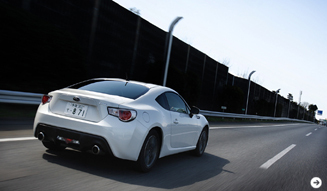
Of course, truly skilled drivers would likely turn off the VDC and VSC to enjoy cornering. In that case, it becomes possible to adopt a driving style that uses the 86's agile steering to initiate turns and controls the rear slide with the throttle.
In other words, the BRZ and 86 should not be compared based on which is superior, but rather chosen based on one's own skill level and preferences.
In any case, it has been a long time since the launch of a new model has sparked such passionate and widespread discussion about "how a car drives."
Furthermore, the BRZ, which captures the essence of a sports car without sacrificing practicality, resonates with many aspects. Therefore, rather than saying "I'm done with sports cars," I want active adults to drive this BRZ.

SUBARU BRZ | SUBARU BRZ
Body Dimensions | Overall Length 4,240 x Overall Width 1,775 x Overall Height 1,300mm (including antenna base. Roof height 1,285mm)
Interior Dimensions | Interior Length 1,615 x Interior Width 1,490 x Interior Height 1,060mm
Wheelbase | 2,570mm
Tread Front/Rear | 1,520/1,540mm
Minimum Ground Clearance | 130mm
Vehicle Weight |
RA 1,190kg (Manual air conditioning equipped: +10kg)
R (6MT) 1,210kg (17-inch Performance Package equipped: +10kg)
R (6AT) 1,230kg (17-inch Performance Package equipped: +10kg)
S (6MT) 1,230kg
S (6AT) 1,250kg
Fuel Economy (JC08 Mode) |
RA 13.4km/ℓ (Manual air conditioning equipped: 13.0km/ℓ)
R (6MT) 13.0km/ℓ (17-inch Performance Package equipped: 12.4km/ℓ)
R (6AT) 12.8km/ℓ (17-inch Performance Package equipped: 12.4km/ℓ)
S (6MT) 12.4km/ℓ
S (6AT) 12.4km/ℓ
Suspension Front/Rear | Strut type independent suspension / Double wishbone type independent suspension
Brakes Front/Rear | Ventilated discs / Discs
(For R and S with 17-inch Performance Package, both front and rear are ventilated discs)
Engine | FA20 Type 1,998cc Horizontally Opposed 4-Cylinder 16-Valve DOHC
Bore x Stroke | 86.0 x 86.0mm
Maximum Output | 147kW (200ps) / 7,000rpm
Maximum Torque | 205Nm / 6,400-6,600rpm