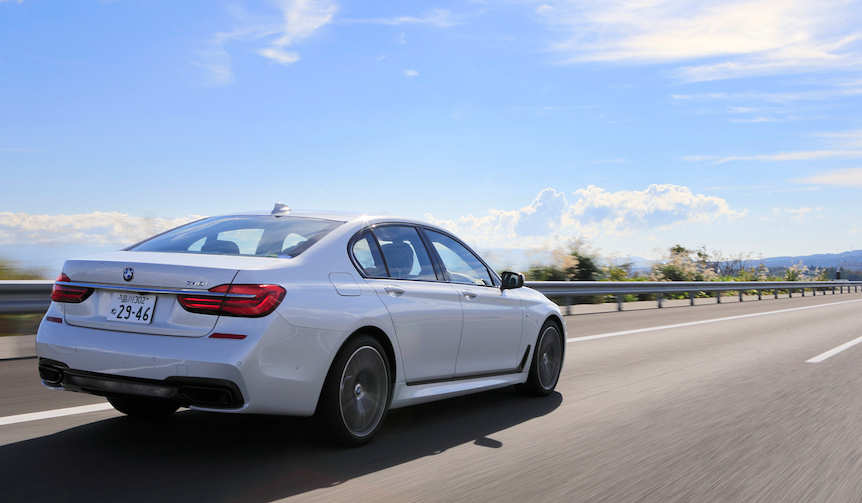
Test Drive: BMW's Latest Flagship, the 7 Series, Arrives in Japan | BMW
BMW 7 Series
First Drive: The New BMW 7 Series Lands in Japan (1)
Completely redesigned for the first time in six years this past June, the "new 7 Series," BMW's latest flagship model, went on sale in Japan on October 29th. Motor journalist Fumio Ogawa was among the first to test drive this model, packed with the latest technology.
Text by OGAWA FumioPhotographs by ARAKAWA Masayuki
The Core Value of a Driver's Car Remains Intact
The "new 7 Series" was released in Japan in October 2015. Befitting BMW's flagship, it exceeds five meters in length. The "L" version, offering even more limousine-like space, was also released simultaneously. However, its true value isn't just its size (though some users will undoubtedly prioritize that). Since the first generation debuted in 1977, the core value of being a driver's car that is enjoyable to drive remains firmly intact in the new model.
The 7 Series is a car that begs to be driven. Part of its appeal lies in the engine. In Japan, the lineup initially includes the "740i" with a newly developed 3-liter inline 6-cylinder engine, and the "750i" with a 4.4-liter V8. In 2016, a hybrid version (known as the "740e" in its home market), combining a 2-liter 4-cylinder engine with an electric motor, is scheduled to join the lineup.
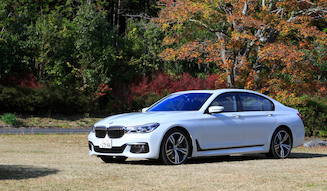
BMW 740i M Sport
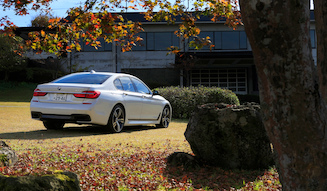
BMW 740i M Sport
Another of the 7 Series' strengths is its styling. While recent generations have presented a more substantial image, this iteration shifts towards a lighter aesthetic. Perhaps this is due to a change in design director? Under the direction of Adrian van Hooydonk, the Dutchman now overseeing BMW design, a sleek, elegant, yet sporty style has been achieved, connecting with the 3 Series. This is a welcome development.
Once you start driving, BMW claims you'll intuitively understand how new the 7 Series is. Take, for example, the weight reduction in the chassis. Dubbed "Carbon Core" by the company, the chassis combines carbon fiber reinforced plastic, aluminum, and ultra-high-strength steel. This offers numerous benefits, including agile handling, improved steering due to a lower center of gravity, and enhanced fuel efficiency.
The air suspension, combined with the "Executive Pro" system, is another noteworthy technology. Using two stereo cameras, it reads the road surface ahead. Based on this data, it instantaneously controls the air suspension's response.
The sporty impression is not betrayed when you're actually driving.
BMW 7 Series
First Drive: The New BMW 7 Series Lands in Japan (2)
An Engine That Meets Expectations
The model tested was the 740i "M Sport." This is a sporty grade featuring M's specialized equipment, including a quick-shifting sport automatic transmission, aerodynamic parts, and a unique interior. Apparently, about 30% of 7 Series buyers in Japan opt for the M Sport. While the 7 Series is also known as a chauffeur-driven car, those who choose the inline 6-cylinder model likely understand that the driver's seat is the superior place to be, rather than the rear.
BMW's new modular engine family is built using 500cc cylinder units to create 1.5-liter 3-cylinder and 2-liter 4-cylinder engines. The 3-liter 6-cylinder version was previously introduced in Japan in the "340i," but this is the first time I've had the chance to test it. It is indeed a fine engine. It doesn't disappoint. It delivers strong torque from low RPMs and spins up beautifully and smoothly to the redline. It produces 450 Nm of torque starting from just 1380 rpm. This engine makes even this 1.9-ton vehicle feel agile.
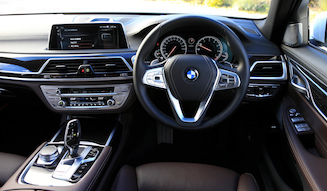
BMW 740i M Sport
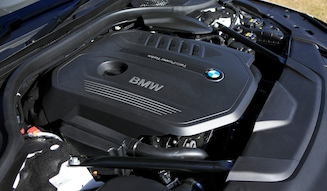
The handling, much like the engine's performance, is sporty. The car reacts sensitively to the steering, which feels perhaps a bit too light. It precisely follows the intended line with satisfying accuracy. While the Mercedes-Benz S-Class, for example, is also exceptionally well-engineered, the 7 Series stands out with its emphasis on sharp responsiveness.
A 3-liter engine like this would have been considered for a mid-size sedan of a lower class not long ago. However, with 1-liter engines becoming the standard for economy cars, engine technology is advancing rapidly. For the 740i, the 3-liter 6-cylinder offers ample power and a refined feel. The 8-speed automatic transmission is also a superb match. In "Eco" mode, prioritizing fuel efficiency, it utilizes higher gears to achieve 12.2 km/ℓ (JC08 mode). Conversely, in "Sport" mode, it focuses on torque. A light press of the accelerator pedal delivers impressively strong acceleration.
Another feature that defines the character of the new 7 Series is the "Adaptive" mode.
BMW 7 Series
First Drive: The New BMW 7 Series Lands in Japan (3)
The 740i Embodies the Strengths of the New 7 Series
The new 7 Series is equipped with "Driving Dynamics Control." This system allows drivers to manually select steering, suspension, and engine response characteristics. The "Adaptive" mode has now been added to this. Cornering on a highway and navigating a city street both involve turning, but the vehicle's behavior differs. The onboard computer determines the nature of the cornering. It's a system that instantaneously adjusts the air suspension's stiffness to maintain stability and, when appropriate, comfort, optimizing both ride quality and handling.
Typically, it offers a smooth and supple ride, but the suspension firms up appropriately when driven spiritedly. This was also impressive.
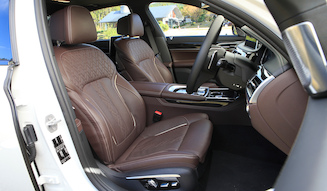
BMW 740i M Sport
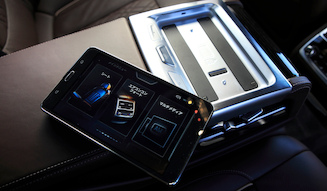
BMW 740i M Sport
On the highway, despite some wind noise, sounds from the road and engine bay are almost perfectly suppressed, making for a quiet cabin. You can ride in a relaxed state. While the sound of the straight-six isn't very prominent, the 7 Series is expected to offer quietness above all else. This is a compromise one must accept.
Safety and comfort features are, as expected for a top-tier sedan, comprehensive. These include "Steering & Lane Control Assist" for automatic steering adjustments, "Laserlight" headlamps that reach twice the distance of LEDs, "Night Vision" to detect pedestrians and animals at night using infrared, and "Active Side Collision Protection" which automatically steers to avoid collisions if a car in an adjacent lane suddenly changes into your lane. While some of these are optional depending on the vehicle, they aim to improve safety and fuel efficiency through automated driving.
Features like "ConnectedDrive," which includes "Remote Services" allowing you to check your car's location and operate the air conditioning via a smartphone app, are also present. Furthermore, "Touch Command" provides a tablet for rear-seat passengers to control entertainment, navigation, and more. Many of these features offer practical convenience for daily use.
The 740i measures 5150mm in length, 1900mm in width, and 1480mm in height, with a wheelbase of 3070mm. While this offers ample space, the 740Li extends the wheelbase to 3210mm, with overall dimensions increasing to 5250mm in length and 1485mm in height (width remains the same). The increase in weight by 80kg feels more significant than the number suggests when driving.
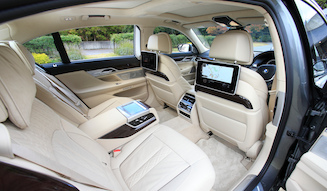
BMW 740Li
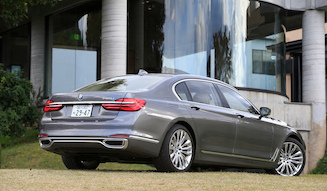
BMW 740Li
If you appreciate BMW's slogan, "The Ultimate Driving Machine," I recommend the standard wheelbase. While I haven't yet driven the 750i with its 4.4-liter V8 engine producing 330kW (450ps) and 650Nm, I believe the 740i encapsulates the best aspects of the new 7 Series. You won't regret purchasing it for the straight-six engine alone.

BMW 740i M Sport
Body Dimensions | Length 5,110 x Width 1,900 x Height 1,480 mm
Wheelbase | 3,070 mm
Tread Front/Rear | 1,620 / 1,620 mm
Weight | 1,900 kg
Minimum Ground Clearance | 135 mm
Engine | 2,979 cc Inline 6-cylinder Direct Injection DOHC Turbo
Maximum Output | 240 kW (326 ps) / 5,500 rpm
Maximum Torque | 450 Nm (45.9kgm) / 1,380-5,000 rpm
Transmission | 8-speed Automatic
Drivetrain | FR
Tires Front/Rear | 245/45R19 / 275/40R19
Fuel Economy (JC08 mode) | 12.2 km/ℓ
Trunk Capacity | 515 Liters
Price | 12.88 million yen
BMW 740Li
Body Dimensions | Length 5,250 x Width 1,900 x Height 1,485 mm
Wheelbase | 3,210 mm
Tread Front/Rear | 1,610 / 1,640 mm
Weight | 1,980 kg
Minimum Ground Clearance | 135 mm
Engine | 2,979 cc Inline 6-cylinder Direct Injection DOHC Turbo
Maximum Output | 240 kW (326 ps) / 5,500 rpm
Maximum Torque | 450 Nm (45.9kgm) / 1,380-5,000 rpm
Transmission | 8-speed Automatic
Drivetrain | FR
Tires Front/Rear | 245/50R18
Fuel Economy (JC08 mode) | 12.2 km/ℓ
Trunk Capacity | 515 Liters
Price | 13.46 million yen
BMW Customer Instruction Center
Toll-free number0120-269-437 (Weekdays 9:00-19:00, Weekends and Holidays 9:00-18:00)