December 16, 2014
Test Drive of the Ferrari FF on an Ice Circuit
Ferrari FF
Ferrari's First All-Wheel Drive Model
Test Drive of the FF on an Ice Circuit
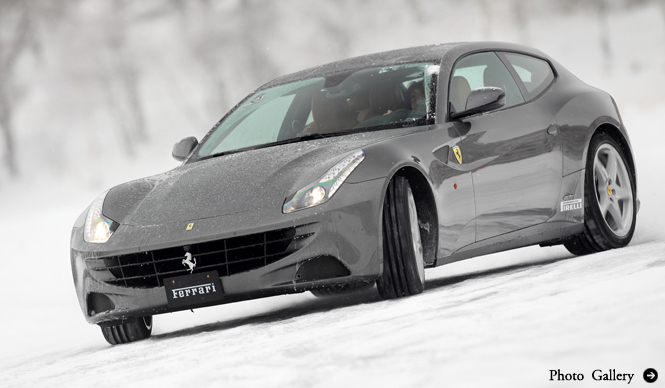
The new flagship Ferrari, the "FF," named after "Ferrari Four." As the company's first all-wheel drive model, and with a shooting brake-style body that offers ample space for four adults, it has garnered significant attention. We had the opportunity to test drive this model on a specially constructed ice circuit.
Text by Yoshiyuki Aoki
Photographs by Hirohiko Mochizuki
"FF" Stands for "4 Seater + 4WD"
News of Ferrari's latest model must have brought a smile to the face of any British gentleman. A shooting brake from the Prancing Horse! And its name is FF!!
A shooting brake is a high-end sports car modified under the guise of being "for hunting." It's a specialty of British cars, with those from Aston Martin, crafted by Harold Radford or AML, being well-known examples. A status symbol, an ultra-luxury touring wagon. The idea was that if hunting rifles and ammunition could fit, it was sufficient; larger luggage would be carried by a footman's Land Rover, so the size of the luggage compartment wasn't a primary concern. Furthermore, to avoid compromising the original performance, they featured a sporty, low, and long roofline. However, looking at the DB5 and V8 shooting brakes, they can be objectively described as cars for the connoisseur. Personally, I suspect it's an expression of the British upper class's particularly concentrated affection for "peculiar shapes."
Writing "FF" to mean "Full Time Four Wheel Drive" was a trick previously used by the British automaker Jensen for the 4WD version of their Interceptor. It shares a certain British sensibility, akin to calling a V12 engine a "Double Six." However, the FF in Ferrari FF is said to represent "4 Seater + 4WD."
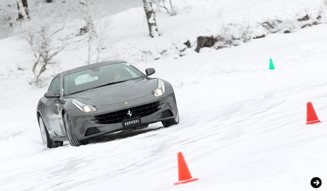
After a rather lengthy preamble, a test drive event for Italy's super-exclusive two-door wagon was held at Lake Megami in Shirakaba Kogen, Nagano Prefecture.
Ferrari FF
Ferrari's First All-Wheel Drive Model
Test Drive of the FF on an Ice Circuit (2)
Large Enough to Fit a Toyota Alphard
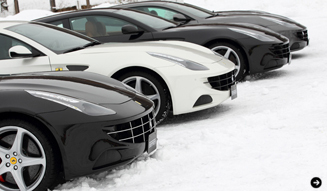
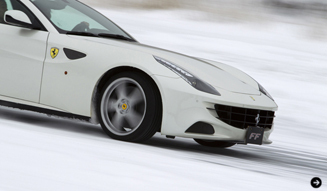
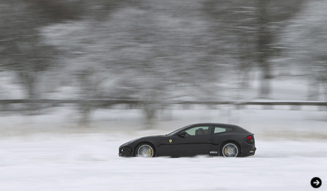
Five Ferrari FF models were lined up on the ice, lightly dusted with snow. The headlights echoed the design of the 458 Italia. The LED lamps arranged along the long hood and over the fenders added a touch of flair. Even on the frozen lake, with few points of comparison, they exuded a strong presence.
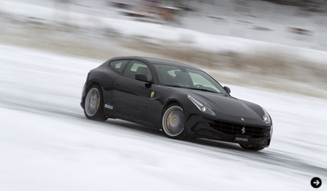
The body dimensions are 4,907mm in length, 1,953mm in width, and 1,379mm in height. While it might seem like an odd comparison, in terms of road footprint, it's large enough to completely contain a Toyota Alphard (4865 x 1840mm). Moreover, even with its low height, the touring wagon shape implies a significant mass. Despite knowing it might be unfounded, I couldn't help but wonder with a mix of apprehension and curiosity, "Will it actually drive on ice?" The curb weight is a listed 1,880kg.
The Strength of the Red Constructor
The body, mounted on a 2,990mm wheelbase, utilizes a variety of alloys, primarily aluminum. It employs a spaceframe structure where aluminum panels are attached to a framework joined by cast components at key points. Compared to previous generations, it is said to be 10% lighter with a 6% increase in torsional rigidity. The styling, of course, was handled by Pininfarina.
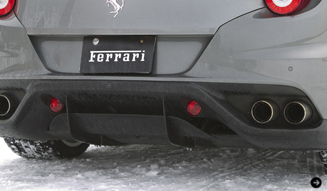
As a high-speed cruiser boasting 0-100 km/h acceleration in 3.7 seconds and a top speed of 335 km/h, aerodynamic considerations are paramount. The outlets on the front fenders are not merely decorative; they release heat from the engine bay and help direct airflow along the sides of the body. The wagon body, with its large rear cross-section, is particularly prone to turbulent airflow directly behind the tail, but comprehensive measures have been taken. The air vents next to the taillights relieve pressure in the wheel arches and, in conjunction with the double diffuser at the underside of the rear, expel turbulent air from the vehicle's rear. The ability to unashamedly use phrases like "derived from F1 technology, where aerodynamic competition is at its peak..." is the strength of the red constructor.
Ferrari FF
Ferrari's First All-Wheel Drive Model
Test Drive of the FF on an Ice Circuit (3)
The FF's Highlight: The "PTU (Power Transfer Unit)"
The 12-cylinder engine mounted at the front has the largest displacement in the current lineup: 6,262cc. With a bore and stroke of 94.0 x 75.2mm, it produces a maximum output of 486kW (651ps) at 8000rpm and a peak torque of 683Nm (69.7kgm) at 6000rpm. While slightly less powerful than the 670ps 599 GTO, it surpasses the 620ps "standard" 599 and overwhelms both in torque. However, what's noteworthy is the pursuit of efficiency; thanks to direct injection and precise control, the compression ratio has been raised to 12.3. Furthermore, it features an idling stop function! The catalog lists fuel consumption at 15.4 liters per 100km under European standards, or 6.5 km/liter by Japanese standards.
Paired with this high-tech unit, which produces 104ps per liter, is a two-pedal 7-speed manual transmission. This "F1 dual-clutch gearbox," which transmits power alternately through two clutches, is claimed by Ferrari to "balance enjoyment and comfort." It's manufactured by Getrag. While the mechanism itself isn't novel, its placement is impressive. Integrated with the rear differential, it employs a transaxle layout to optimize front-to-rear weight distribution. The result is an excellent front-to-rear ratio of 47:53.
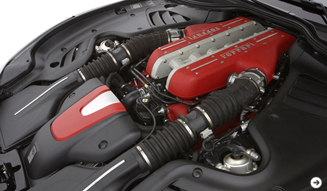
Let's take a look at the V12 by opening the hood. The engine, with its red-crystallized heads, appears to be deeply embedded within the front bulkhead, mounted as far back as possible within the engine bay. It's a textbook front-midship layout, with the two banks of six cylinders positioned entirely behind the front axle. And above the front axle, in front of the V12, is a unit with repeated red crystallization: the "PTU (Power Transfer Unit)," the highlight of the Ferrari FF.
Ferrari FF
Ferrari's First All-Wheel Drive Model
Test Drive of the FF on an Ice Circuit (4)
A System "Permitted" Only by Ferrari
Ferrari's 4WD system, named 4RM, fundamentally differs from existing all-wheel drive systems and can truly be called a system "permitted" only by Ferrari. Power from the engine's crankshaft is sent both forward and backward. Torque sent rearward travels via the propeller shaft to the 7-speed gearbox, rear differential, and then to the left and right rear wheels. This is no different from a conventional FR car (employing a transaxle system). Meanwhile, torque sent forward is distributed to the left and right front wheels via the PTU.
The PTU, located in front of the engine, appears large due to its substantial cover, but it is actually a device only 170mm in length. In principle, it can be thought of as a front-mounted version of the rear E-Diff. In other words, it's a device that transmits driving force to each of the left and right wheels via an electronically controlled wet multi-plate clutch.
The Pragmatism of a Racing Pedigree
What's interesting is that the PTU has two gears. The main gearbox (if you can call it that), the F1 dual-clutch, has seven speeds. The rotational difference between the front and rear wheels is absorbed by repeatedly engaging and disengaging the multi-plate clutch. However, since there are limits to its capacity, the PTU covers the main 1st to 2nd gears with its low range and 3rd to 4th gears with its high range; it does not engage for 5th gear and above! In other words, the Ferrari FF is not a "Full Time Four Wheel Drive" but rather an on-demand 4WD system limited to 1st to 4th gear. The reasoning is: if you can engage 5th gear, the conditions are not those of a slippery "low-grip surface." Therefore, 4WD is unnecessary. This is the kind of pragmatic decision-making unique to a racing heritage! It's a "crude" solution that would likely be rejected by any automaker other than Ferrari.
The Ferrari FF is fundamentally an FR car. On normal roads, torque is unlikely to be sent to the front wheels at all. The compact and lightweight PTU was developed to meet the demands for increased engine output and versatility across various road conditions required by affluent, yet not necessarily expert, users, without compromising the authentic driving feel of a Ferrari road car. It achieves all-weather capability, essential for a top-tier multi-purpose model, with minimal weight increase.
Ferrari FF
Ferrari's First All-Wheel Drive Model
Test Drive of the FF on an Ice Circuit (5)
A Drive System That Achieved a Copernican Revolution
While it might sound a bit grandiose, the Ferrari 4RM system can be described as a drive system that has achieved a Copernican revolution. It's a system that has materialized a paradigm shift in thinking, utilizing electronic control in the positive direction of acceleration, rather than the negative direction of deceleration.
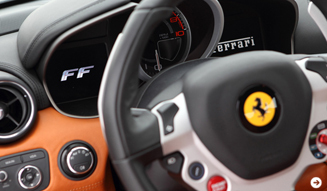
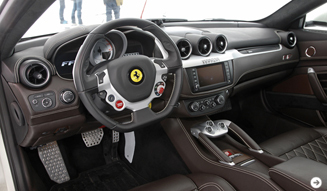
Walking across the ice, which was far beyond merely slippery and excessively slick, I approached the designated test car. The course set up on the frozen lake had developed patches of black ice from previous use. I pressed the red starter button on the steering wheel. To my right was the Manettino, a dynamic control system inherited from F1 cars, allowing selection of driving modes via a small lever. For the FF, options included "WET" and "ICE-SNOW," in addition to the circuit-oriented "ESC OFF," "SPORT," and "COMFORT."
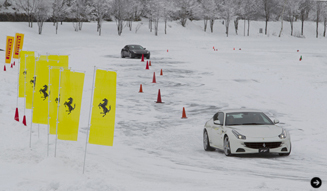
As Relaxing as Driving a Mazda Roadster on Ice
First, I took it for a gentle drive in "ICE-SNOW" mode. The engine didn't rev, and the car moved quietly, mirroring the driver's hesitant state. I applied the brakes well before a left turn, but the car didn't stop. In fact, the Ferrari, carrying the instructor and staff, continued to slide. The brakes seemed to be controlled by pedal pressure rather than stroke, with a firm feel that made you think you were resting your foot. What was appreciated was that the precise control of each wheel's brakes likely kept the nose pointed straight ahead as it slid, preventing any unwanted yaw.
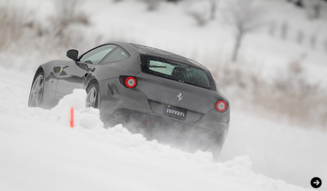
With the "WET" mode, the FF and driver regained some composure, and we moved on to try the normal mode, "COMFORT." I almost forgot I was in a luxurious, large sports car and began to enjoy the icy conditions. As I applied the throttle, the engine note immediately rose, the rear tires spun, and at times, even at low speeds, I could apply counter-steer, giving me the sensation of "doing it right." It felt as carefree and accessible as driving a Mazda Roadster on an ice circuit. It was hard to believe I was piloting a monster weighing over two tons with nearly 700Nm of torque. The engine output, shift timing, suspension, traction control, VDC (individual wheel brake control), and the PTU all worked in concert, seamlessly compensating for the driver's shortcomings without me even realizing it. I truly understood this when I switched the Manettino lever to "SPORT."
Ferrari FF
Ferrari's First All-Wheel Drive Model
Test Drive of the FF on an Ice Circuit (6)
The Launch Control Was Astonishing
The V12's response was ferocious. Navigating the first corner with the more aggressive FF, then again, and again... As I approached the spot warned about as being completely black ice, I carefully maneuvered. Suddenly, I spun out. This was likely because the safety margin of the VSC had been reduced, placing more reliance on the driver's skill. Blushing, I returned to the course. On the next lap, approaching the same spot with extreme caution... I spun out again! Even the dynamic control system couldn't compensate for my lack of learning ability.
What was truly astonishing was when the instructor prompted me to try the launch control (racing start) in "SPORT" mode. I pressed and held the LAUNCH button, then depressed the brake pedal. I opened the throttle, raised the RPMs, and then released the brake!
Despite the apprehension that "the nose might go wild and go anywhere," the Ferrari FF dug into the ice with all four wheels, moving forward in a straight line with fierce determination. Feeling the vibrations from beneath the car, the driver simply held the steering wheel. I imagined what kind of rocket-like start could be achieved on a normal surface where the tires wouldn't spin.
The Ferrari FF's 4RM system is designed with the concept of not just absorbing front-rear and left-right differentials using four multi-plate clutches, but rather actively applying driving force. It's as if each of the four wheels has a small engine, adjusting its output according to instructions from a central CPU. It's a departure from the stability control philosophy of reducing excess drive force to stabilize the vehicle; it's the "pushing" drive system, reminiscent of the Audi Quattro of yesteryear, revived through 21st-century electronic control.
Too Practical to Be Called a Shooting Brake!?
I handed the steering wheel over to a staff member and sat in the rear seat. While the seating position is slightly low, there is ample practical space for both knee room and headroom. It's said to accommodate 95% of adults up to 185cm tall. The rear seats are shaped to provide good support, allowing passengers to comfortably watch the driver struggle on the icy surface from the front seats, a testament to the FF's full four-seater configuration.
The luggage capacity is 450 liters, enough to fit two golf bags and four trolley cases. The center section of the rear seatback can be folded down to accommodate long items like skis. Alternatively, the split rear seatbacks can be folded down, allowing for travel with two people. The Ferrari FF is perhaps too practical to be called a shooting brake. Prices start from 32 million yen.