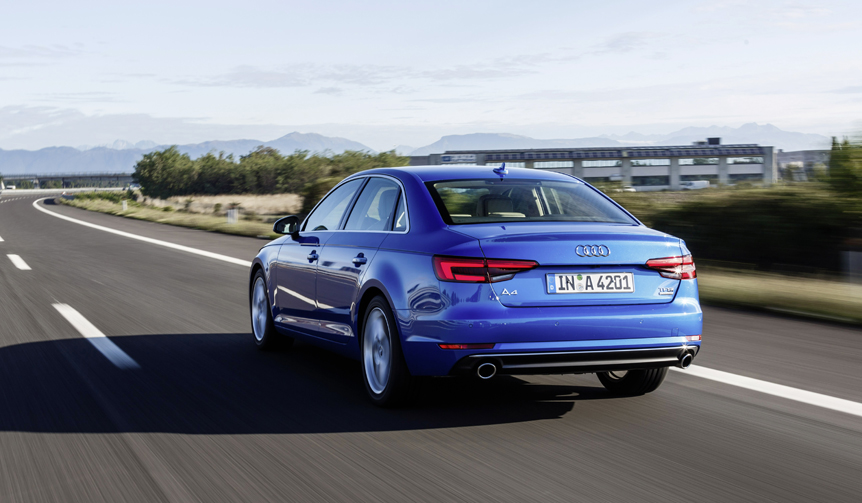
Test Driving the New Audi A4
Audi A4 | The New Audi A4
Test Drive the New Audi A4
In July, the Audi A4 underwent a full model change for the first time in seven years. Fumio Ogawa took it for a spin. In a segment crowded with rivals like the Mercedes-Benz C-Class and BMW 3 Series, what answer did Audi arrive at? A report from Venice, Italy.
Text by OGAWA Fumio
A Full Model Change After Seven Years
The Audi A4 has undergone a full model change, and a test drive event was held near Venice, Italy. The A4 is Audi's most important model, a bestseller that competes fiercely with the Mercedes-Benz C-Class and BMW 3 Series in Europe, particularly in Germany. Therefore, this ninth generation has garnered significant attention.
If we had to summarize the features of the Audi A4, which has undergone a full model change for the first time in seven years, it would be its improved environmental performance. A combination of a lightweight body and a newly developed, fuel-efficient engine. At the same time, comfort aspects such as quietness and ride quality have also been enhanced. The front-wheel-drive models are the main focus, with some engines paired with the quattro full-time four-wheel-drive system. It's said to offer lighter handling and improved responsiveness, with a visibly greater driving enjoyment.
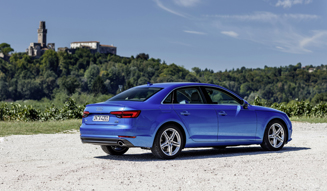
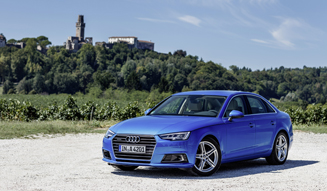
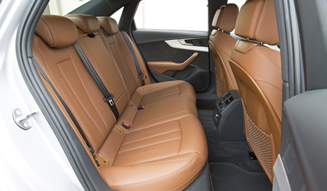
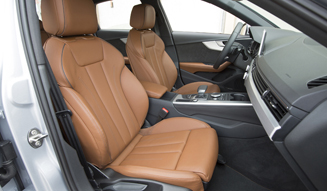
"We've clearly made the exterior recognizable as part of the A4 family. Yet, we've emphasized horizontal lines to create a sense of lightness. Meanwhile, we've increased headroom by 24mm and rear legroom by 23mm," said a development representative we met at the event, stressing the newness of the interior. In terms of dimensions, the overall length is 4,726mm (+25mm over the previous model), the width is 1,842mm (+16mm), and the height is 1,427mm (unchanged). The wheelbase is 2,820mm, an increase of 12mm.
"Although the dimensions have increased, the weight is up to 120kg lighter than the previous model." As an Audi technician emphasized, a key feature of the new A4 is the use of lightweight materials, including suspension components and some structural elements like the frame.
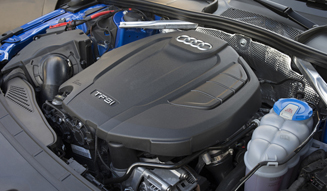
The engine lineup includes a 1.4-liter four-cylinder and two versions of a 2.0-liter four-cylinder. Diesel options are a 2.0-liter four-cylinder and a 3.0-liter V6.
While front-wheel drive is the primary configuration, the 185kW (245ps) 2.0 TFSI (gasoline) and the 2.0 TDI (diesel) with 140kW (190ps) or more are available with the quattro full-time four-wheel-drive system.
Initially, two types of 2.0 TFSI (likely one with quattro) will be introduced in Japan. A notable change is the transmission, which replaces the previous continuously variable Multitronic with a 7-speed S tronic featuring a dual-clutch system.
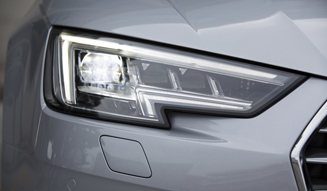
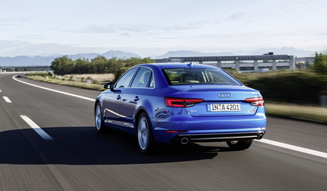
The Singleframe grille is wider, and combined with the shape of the headlamps and air dams, it has gained a certain aggressiveness. However, the overall appearance is surprisingly understated, which is my honest impression. On the other hand, the driving performance has improved remarkably.
Audi A4 | The New Audi A4
Test Drive the New Audi A4 (2)
The Excellence of the Newly Developed 2.0-Liter Unit
The setting for the new A4 test drive was Venice. However, since cars cannot enter the islands that "float" in the Adriatic Sea, the designated course involved driving on mountain roads and autostradas on the mainland, including areas around the airport. Audi models are quite popular in Northern Italy, so we saw various models, both large and small. Owners quickly recognized the new A4 and showed keen interest with smiles.
We were able to drive two gasoline engine variants planned for introduction in Japan: the 140kW and 185kW 2.0 TFSI. The 2.0 TFSI with a maximum output of 140kW and 320Nm of torque was a front-wheel-drive model, while the 185kW, 370Nm 2.0 TFSI was the quattro version.
To put it simply, both left an excellent impression. Although the full model change appeared understated visually, the moment I took the wheel and drove a short distance, it felt as if the cloudy sky suddenly cleared.
One reason for this positive impression is the superb quality of the newly developed 2.0-liter unit. A notable point is the use of the Miller cycle, rather than the conventional (and common) Otto cycle. It shortens the compression stroke to cover the mid-load range, while controlling intake timing allows for optimal power delivery via turbocharging under high loads.
The reason cited for adopting the Miller cycle is to achieve the same efficiency as a smaller displacement engine while retaining the benefits of a larger one. Audi is newly promoting the concept of "right-sizing" (meaning appropriate displacement), emphasizing that they have moved beyond simply reducing displacement to the next step, faster than any other manufacturer.
According to Audi, while the previous 1.4-liter engine consumed 4.9 liters per 100km, the new 2.0-liter engine consumes only 4.8 liters. This overturns the common notion that smaller displacement means better fuel economy. In Japanese terms, this is close to 21km per liter. It's truly astonishing.
To describe the experience of the new engine in one word: it revs wonderfully smoothly. Simultaneously, the car's response to steering inputs is quick, demonstrating the excellence of the improved "MLB Evo" platform, which Audi calls its longitudinal engine platform. The power steering feels light, which is a personal preference. The immediate response of the car from the initial turn of the wheel conveys Audi's rich experience in producing front-wheel-drive models for many years. It's even sporty, and its lightness, distinct from the rear-wheel-drive rivals like Mercedes and BMW, is so good that I'd recommend it to anyone.
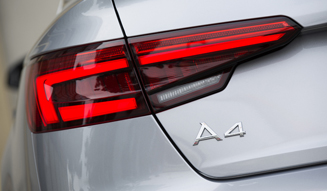
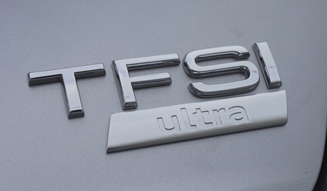
The A4 also features an "ultra" lightweight body model. Fans of the World Endurance Championship might recall a similar sub-name for Audi's racing machine, the R18. It refers to the most fuel-efficient version. "Compared to the standard model, the gear ratios, body parts, and suspension are partially modified, and the tires are designed to reduce rolling resistance," Audi states. While its introduction to Japan is unconfirmed, it offers a delightfully light driving impression.
While the A4 offers a quite sporty drive, the more powerful quattro version takes it a step further.
Audi A4 | The New Audi A4
Test Drive the New Audi A4 (3)
Is the S4 Unnecessary?
The Audi test drive route included winding mountain roads that stretched on endlessly. Occasionally, the Adriatic Sea sparkled beyond the trees, but the winding, undulating roads through the forest were not coastal drives. However, they were enjoyable in their own way with the A4. Driving the 2.0 TFSI quattro (though the front-wheel-drive 2.0 TFSI was also satisfactory) made me grateful for such roads, allowing me to enjoy driving to the fullest.
The quattro's power unit features flat torque, with maximum torque of 370Nm available from 1,600rpm, but it felt like an exhilarating acceleration. While the torque distribution is typically 40% front and 60% rear, there are no negative aspects of front-wheel drive felt during driving. This might also be due to the optional dynamic steering (variable gear ratio) equipped on the test car; with just a slight turn of the wheel, the car changes direction instantly.
The sense of the driver and car becoming one, experienced even in a regular A4 with a high-power variant, makes this model a bargain. Perhaps thanks to the Miller cycle, there's no turbo lag, and the engine revs effortlessly towards the red zone, providing a truly satisfying experience. The engine's performance is truly pleasing.
Perhaps due to the 185kW high-power version, which accelerates from 0 to 100km/h in 5.8 seconds, the suspension is slightly "stiffened." While some road imperfections are transmitted, it doesn't feel uncomfortable. The new quattro signifies agile sportiness. It's impressive how it presents such new value.
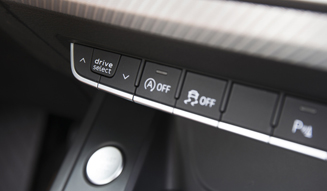
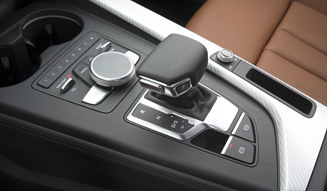
With Audi Drive Select, you can adjust the steering gear ratio, engine response according to throttle input, shift timing, cruise control, and (depending on options) the control maps for the suspension with variable damping, as well as the automatic climate control. There are five modes: Comfort, Dynamic, Efficiency, Auto, and Individual.
After just a brief spirited drive, I found myself thinking, "Is the high-performance S4, announced at the Frankfurt Motor Show, even necessary?" The sportiness you can experience is that profound.
Overall, the quietness is also high. This is likely due to thicker windshield glass, revised door seals, and effective suppression of noise transmitted from the gearbox and engine. The drag coefficient is an extremely low Cd=0.23. "On par with the A8," an Audi engineer proudly stated, and it's not an exaggeration. I agree that the quiet and comfortable cabin is also a point of pride for the A4.
Audi A4 | The New Audi A4
Test Drive the New Audi A4 (4)
The Latest Technology Equipped in the A4
Even autonomous driving has been updated in the A4, reaching a high level. Among these, the Traffic Jam Control is a particularly interesting system.
Intelligence. This was a word that repeatedly appeared when Audi technicians explained the A4 at the test drive event. It refers to the full adoption of autonomous driving technology, also known as driver assistance systems. The goal is to enhance both safety and environmental performance using radar, ultrasonic sensors, and cameras.
Particularly noteworthy is the Adaptive Cruise Control. With its function to follow the vehicle ahead, it can also automatically stop and restart. It can operate within a speed range of 0-250km/h. Using the traffic sign recognition function, it's possible to set the system to automatically apply the brakes if you exceed the detected speed limit (this function is not planned for introduction in Japan).
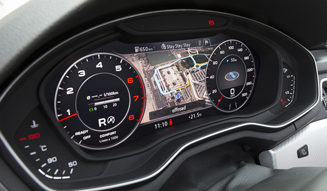
Furthermore, this model includes a function called Traffic Jam Assist. When activated in traffic jams, the aforementioned autonomous driving system operates, and steering assistance is also provided automatically.
"Fuel economy is significantly improved with Adaptive Cruise Control, including Traffic Jam Assist," said an Audi technician. Anyone who has ever compared the fuel economy of Adaptive Cruise Control with human driving will know about the excellent fuel efficiency when entrusting acceleration and deceleration to a computer. Traffic Jam Assist, which operates below 65km/h, is not only a collision avoidance technology but also a fuel-saving technology. The fact that these two are inseparable is what makes cutting-edge automotive technology so fascinating.
Introduction to the Japanese market is scheduled for early 2016. First, the sedan will arrive, followed later by the station wagon version, known as the Avant. As mentioned earlier, the S4 has also been announced, so it's likely to land in Japan in the not-too-distant future. The new A4, packed with Audi's latest technology, is a model well worth waiting for.

Audi A4 2.0 TFSI ultra S tronic
Body Dimensions | Length 4,726 × Width 1,842 × Height 1,427 mm
Wheelbase | 2,820 mm
Tread Front/Rear | 1,572 / 1,555 mm
Weight | 1,405 kg
Engine | 1,984cc Inline 4-cylinder Turbo
Bore x Stroke | 82.5 × 92.8 mm
Max. Output | 140 kW (190 ps) / 4,200 - 6,000 rpm
Max. Torque | 320 Nm / 1,450 - 4,200 rpm
Transmission | 7-speed AT (S tronic)
Drivetrain | FF
Suspension Front | 5-link
Suspension Rear | 5-link
Brakes Front | Ventilated discs
Brakes Rear | Ventilated discs
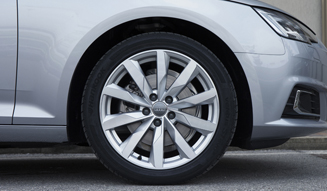
Tires Front/Rear | 205/60R16
0-100km/h Acceleration | 7.3 seconds
Top Speed | 210 km/h
Fuel Consumption (NEDC combined) | 4.8 ℓ/100km (approx. 20.8 km/ℓ)
Trunk Capacity | 480 - 965 liters
CO2 Emissions (combined) | 109 g/km
Audi A4 2.0 TFSI quattro S tronic
Wheelbase | 2,820 mm
Tread Front/Rear | 1,572 / 1,555 mm
Weight | 1,510 kg
Engine | 1,984cc Inline 4-cylinder Turbo
Bore x Stroke | 82.5 × 92.8 mm
Max. Output | 185 kW (252 ps) / 5,000 - 6,000 rpm
Max. Torque | 370 Nm / 1,600 - 4,500 rpm
Transmission | 7-speed AT (S tronic)
Drivetrain | 4WD (quattro)
Suspension Front | 5-link
Suspension Rear | 5-link
Brakes Front | Ventilated discs
Brakes Rear | Ventilated discs
Tires Front/Rear | 225/50R17
0-100km/h Acceleration | 5.8 seconds
Top Speed | 250 km/h
Fuel Consumption (NEDC combined) | 5.9 ℓ/100km (approx. 16.9 km/ℓ)
Trunk Capacity | 480 - 965 liters
CO2 Emissions (combined) | 136 g/km