May 18, 2015
NISSAN GT-R 2012 Model Review
NISSAN GT-R
Model 2012, More Elaborated GT-R (1)
The Nissan GT-R 2012 is not simply the latest iteration of the GT-R. With an additional 20ps of power and an asymmetric suspension, the GT-R 2012 represents a significant evolution. A detailed review by Toshifumi Watanabe.
Original text in Japanese by Toshifumi WatanabePhotos by Masayuki Arakawa

Perfection
“Automobile manufacturers often proudly announce, ‘Our new car utilizes groundbreaking technology for the first time in the world!’ I dislike that kind of statement,” began Mr. Kazutoshi Mizuno, the engineer responsible for the GT-R’s development. “I believe such claims are unnecessary because they don’t matter to the customer. What manufacturers must do is dedicate themselves to meeting customer needs.”
Throughout the presentation, this eloquent engineer passionately, and at times reservedly, articulated his philosophy. He concluded modestly, “Perhaps I’ve been a bit too arrogant…” As usual, his meticulously prepared PowerPoint slides were largely set aside. Instead, he used a whiteboard to sketch and explain his points. This is his characteristic presentation style, unconventional for an automotive engineer, yet I find it compelling.
“Are you suggesting that the GT-R’s engineering is conventional?” I inquired.
“Of course it is! The GT-R does not employ uncertain ‘new technologies’ because they are not sufficiently reliable for a high-speed car like the GT-R. Listen, Mr. Watanabe, for four years since the GT-R’s inception, I have devoted myself to developing and perfecting its products. That is all I have done until today.”
New technology holds little interest for him; perfection does. This philosophy transforms the GT-R into a mass-produced artisanal automobile.
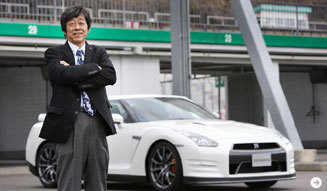
Kazutoshi Mizuno, responsible for the development of the GT-R
This marks the GT-R's fifth year. Its rivals have now adopted new technologies that did not exist four years ago. Yet, the GT-R has never embraced such innovations. When I first drove the prototype GT-R in Germany, I perceived it as a monster of the digital age. However, my impression of this car has since evolved, even though the GT-R team has maintained their production philosophy for the past four years.
NISSAN GT-R
Model 2012, More Elaborated GT-R (2)
Acceleration Performance Rivals the Bugatti Veyron
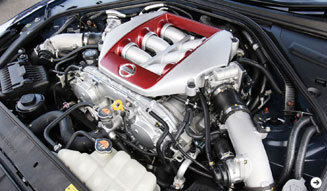
The GT-R 2012’s maximum engine power output has reached 550ps, an increase of 20ps over the 2011 model. Broadly speaking, to achieve this power increase, the GT-R’s air intake and exhaust efficiency were improved, and the cooling system was optimized. Although this marks the first engine modification by the GT-R team, the change was a very simple refinement. In reality, an average driver like myself would not perceive this power increase. Furthermore, the GT-R’s speed is not heavily reliant on engine power.
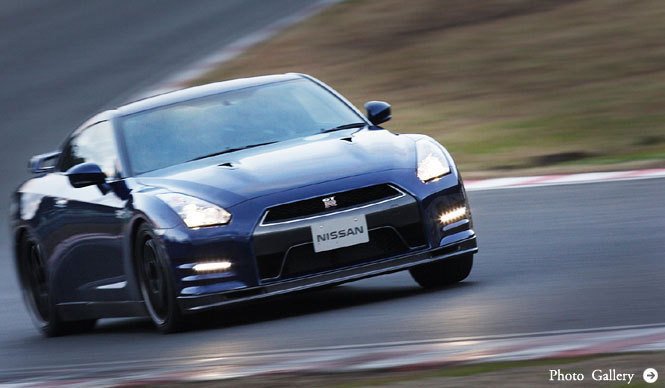
The GT-R’s speed stems more from its exceptional traction; the car efficiently utilizes its engine power. The GT-R 2012 now accelerates from 0 to 100 km/h in 2.84 seconds. No other mass-produced car, except the Bugatti Veyron, precedes it.
It was astonishing to witness a massive 1,730kg vehicle accelerate without any tire squeal or smoke. I felt as though I had entered a realm where the laws of physics no longer applied. I am now convinced that the new GT-R resides in truly uncharted territory.
Four Wheels, Four Distinct Suspensions
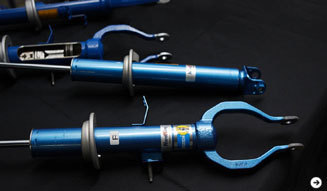
One of the most intriguing features of the new GT-R is its suspension, which has been set asymmetrically for the left and right sides. This is to achieve horizontal balance when the driver's weight is added to the right side in a right-hand drive configuration.
Because the GT-R's propeller shaft is positioned on the right side of the vehicle, the right side of the GT-R is 50kg heavier than its left side. While the driver's weight stabilizes a left-hand drive vehicle, in a right-hand drive, this weight imbalance can induce understeer.
Consequently, the new GT-R features a stiffer spring rate suspension on the front left. For the rear, the suspension arm is installed upward on the left side and downward on the right. In essence, each wheel of the right-hand drive GT-R has its own unique suspension setting. This is highly unusual for a commercial vehicle.
The "Track Pack" Option Replaces the Spec V
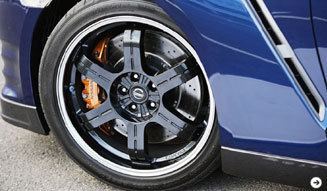
Minor adjustments to the gearbox, new differential oil, more rigorous shaking tests, a more rigid scuttle, a uniquely integrated BOSE® sound system woofer, and new speedometer illumination are just some of the detailed improvements made by the GT-R team in just one year. This time, customers can opt for a custom package called "Track Pack" for 1,470,000 Japanese yen. While minimally sacrificing the GT-R's daily usability, this option provides drivers who intend to race the car with a "ready to race" GT-R. Similar to the Spec V, the GT-R with the Track Pack features two seats, a front aerodynamic spoiler designed to direct air to the brakes, and lightweight forged wheels. Specially designed variable control suspension and high-friction seats are new additions.
NISSAN GT-R
Model 2012, More Elaborated GT-R (3)
More Spontaneous Handling
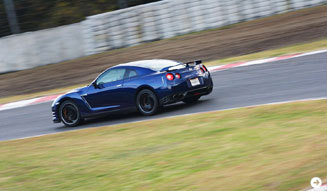
Nissan seemingly intended to highlight the GT-R 2012's advancements over the 2011 model by selecting the SUGO sports land circuit in Sendai, Japan, as the venue for the test ride event. Initially, to discern the performance differences between the 2012 and 2011 models on public roads, I drove both at slow speeds. Compared to the 2011, the 2012 felt slightly quieter and moved more smoothly.
However, what truly impressed me each time I steered the GT-R 2012 left and right was a sense of "warmth" or a "creature-like" feel that the 2011 model lacked. At low speeds, the GT-R 2011 felt somewhat detached, as if I were merely operating controls. In contrast, with the 2012, I could sense the camber angle changes and the friction of the tires during cornering. While the GT-R's run-flat tires are remarkably durable and would not be worn by low-speed cornering, I experienced a direct connection to the road, as if the GT-R were equipped with soft radial tires. The handling was deeply satisfying.
Interaction Between Car and Driver
“I never imagined this monster of the digital era could evolve into such an emotional being!” Even at high speeds, my impression of the GT-R 2012 remained unchanged. Thanks to the asymmetric suspension, the GT-R 2012 controlled understeer far better than the 2011 model, and the difference in feel between right and left turns was less pronounced. Furthermore, what truly surprised me was the sense of enjoyment this car imparts to its driver. Even an average driver like myself can perceive the car leaning forward under braking, the tires gripping the road during cornering, and the engine unleashing its power when the accelerator is pressed. You will never feel panicked at high velocities because the car remains under your control, allowing you to steer at any angle you desire. If I were to compare the GT-R to audio equipment, its dynamic range has widened, and its sound has become more analog-like. You will enjoy excellent sound at any volume level. Just as we no longer debate whether analog or digital sound is superior with high-end modern audio equipment, anyone driving the GT-R will enjoy it, feeling that the car is completely under their command. The GT-R no longer drives itself; it is your turn to drive the GT-R.
Expected Nürburgring Lap Time: 7 minutes 10 seconds?
It is undeniable that the GT-R's performance progresses year by year. A straightforward indicator of its performance advancement is its lap time at the Nürburgring: Nissan estimates the GT-R 2012's time to be around 7 minutes and 10 seconds.
However, for us, this data is merely data, as we are well aware that only a select few professional drivers can extract the maximum performance from the GT-R.
Even so, I cannot help but feel excited by this figure. Perhaps I am seeing within it the pinnacle that Japanese engineering has ever achieved. As Mr. Mizuno stated, "The GT-R progresses as much as craftsmen progress." In the Tochigi factory, the same original staff continues to build the GT-R today.

NISSAN GT-R Pure edition
Dimensions: Length 4,670 x Width 1,895 x Height 1,370mm
Wheelbase: 2,780mm
Curb Weight: 1,730kg
Engine: 3.8L V6
Transmission: 6-speed dual-clutch transmission
Maximum Output: 404kW (550ps) / 5,400rpm
Maximum Torque: 632Nm (64.5kgm) / 3,200-5,800rpm
Fuel Economy (JC08 mode): 8.7km/L
CO2 Emission: 267g/km
Price: 8,694,000 JPY