February 23, 2018
Test Driving the Ferrari 458 Speciale | Ferrari
Ferrari 458 Speciale
A Pure Sports Ferrari with a Naturally Aspirated V8 Engine
Test Driving the Ferrari 458 Speciale
Following the "360 Modena," Ferrari has consistently offered high-performance models to cap off its series, such as the "Challenge Stradale" and "430 Scuderia." The "458 Italia" is no exception, with Maranello releasing the "458 Speciale" as its ultimate weapon. We deliver the traditional driving experience of a naturally aspirated V8 engine, which has disappeared with the new "488 GTB," along with an impression from Tatsuya Otani.
Text by OTANI TatsuyaPhotographs by ARAKAWA Masayuki
Efforts in Weight Reduction Akin to Racing Cars
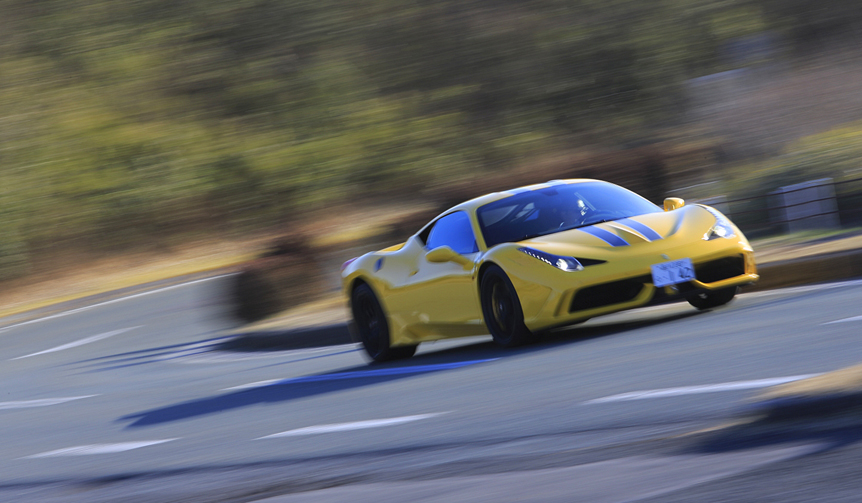
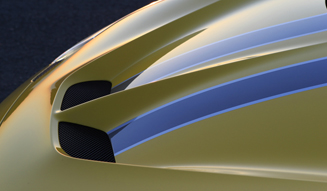
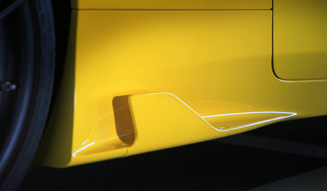
I must confess, when I first saw the Ferrari "458 Speciale" in an underground car park, I couldn't quite discern the difference from the standard "458 Italia." While its appearance exuded an undeniable intensity, it was unclear what contributed to it. I did notice the vertically oriented aerodynamic fins just before the rear wheels, but I couldn't pinpoint any other specific features.
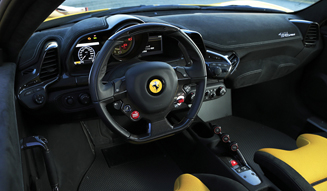
However, once I settled into the cockpit, the reasons for this "Speciale" Ferrari's special nature began to reveal themselves. In a word, its defining characteristic is the pervasive effort in weight reduction, reminiscent of racing cars.
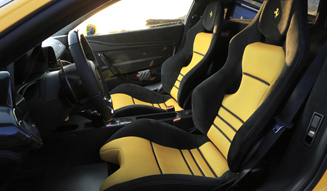
For instance, the seats are of a simple sports design, with all adjustments for recline and slide being manual. Yet, despite the not-so-thick cushioning, they are comfortable, and while the side bolsters are quite deep, ingress and egress are excellent – a testament to their well-thought-out design despite their simple appearance.
Looking towards the passenger side, there is no glove box; instead, a large knee pad is installed for the passenger. Furthermore, the floor, which is not carpeted, features a substantial footrest at the front. Both are thoughtful additions to enhance passenger comfort under immense acceleration G-forces, evoking the feeling of a classic rally car and heightening the excitement.
Moreover, while the dashboard's basic design is shared with the 458 Speciale, the extensive use of carbon fiber makes it appear exceptionally lightweight. The center console is remarkably minimalist, prompting a "Was it always this simple?" reaction. These elements significantly contribute to the racing car-like ambiance within the cabin.
Ferrari 458 Speciale
A Pure Sports Ferrari with a Naturally Aspirated V8 Engine
Test Driving the Ferrari 458 Speciale (2)
A Masculine Setup
The difference from the standard 458 Italia becomes even more pronounced when the engine is started. At idle, the engine occasionally shudders with a "burble." This is a characteristic often found in high-performance cars from the carburetor era, and Ferrari has likely incorporated this deliberate touch to convey to the driver just how special this car is.
Selecting first gear and gently pressing the throttle, the 458 Speciale exhibits an exceptionally nimble response, as if it has lifted off the ground. After a few meters, with just a slight increase in pressure from the ball of my right foot, the car accelerates instantaneously, as if freed from the Earth's gravity.
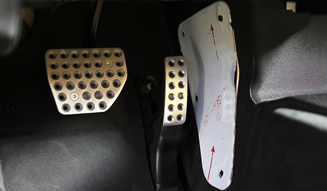
In a word, the response is sharp, but it's not the sensation of a heavy car being propelled by immense power; rather, it's an acceleration akin to that of a racing kart or a Formula car. The keyword here, once again, is "lightness."
The source of this sensation lies not only in the body's lightness but also in the short gear ratios. Fifth gear can be engaged from 40 km/h, sixth gear at 50 km/h, and seventh at 70 km/h. At 100 km/h in seventh gear, the engine speed is around 2,700 rpm. What's more, while driving in automatic mode on the Tokyo Metropolitan Expressway, I was greatly surprised when the car downshifted to fifth gear during a traffic jam.
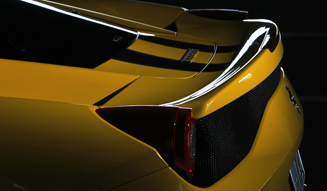
Thanks to this, you can effortlessly extract the engine's "sweet spot" even on Japanese public roads. It's a truly masculine setup, defiantly turning its back on the trend of modern high-performance cars that prioritize fuel economy with tall gearing and lower engine speeds.
When I pressed the throttle pedal firmly from a slow crawl on the Tokyo Metropolitan Expressway, the car exhibited a jerky response again.
Of course, smooth acceleration is possible with careful operation, but it's clear that this behavior is intentionally programmed. Conversely, when you can drive smoothly, the driver will likely feel a sense of satisfaction, as if they have truly mastered this special Ferrari.
Ferrari 458 Speciale
A Pure Sports Ferrari with a Naturally Aspirated V8 Engine
Test Driving the Ferrari 458 Speciale (3)
Reaching 9,000 rpm in an Instant
And what about the engine sound? As a supercar born in Maranello, its sound is bound to be exceptional, but its tone is fundamentally different from that of the 458 Italia. The latter produces a smooth and beautiful tone, like a well-trained string quartet, without any hint of the eight cylinders firing.
In contrast, the 458 Speciale has a more granular sound. While it shares the clarity of tone, free from extraneous noise, with the 458 Italia, its timbre is closer to an electric guitar with a slight overdrive from a vacuum tube amplifier, rather than a violin. Yet, it is in no way crude; the volume itself is rather subdued, making for a truly pleasant sound.
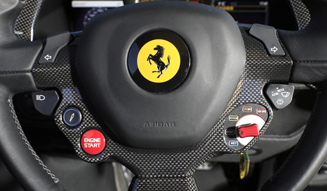
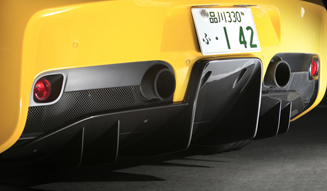
Listening to such exhaust notes, I intermittently press and release the throttle pedal. When I apply force to my right foot, the tachometer needle instantly reaches the 9,000 rpm redline. The sensation felt is one of pure lightness. This is another characteristic shared with racing engines, but the complete absence of any harshness is quintessentially modern Ferrari.
Speaking of lightness, the steering effort is also on the lighter side. A smooth turn of the steering wheel results in the nose immediately pointing in that direction without any delay. I'm not suggesting the 458 Italia had sluggish handling, but once you experience the 458 Speciale, the memory of the 458 Italia's feel starts to seem like that of a luxury sedan, which is quite remarkable.
The ride quality is similar. Although the 458 Speciale's suspension is decidedly firm, the rigidity of the control arms and their mounting points is astonishingly high, and they move so smoothly without any hint of friction that the ride quality feels incredibly fluid and entirely free of discomfort.
This, too, is a sensation akin to that of a racing car. Once you experience this, the 458 Italia will again seem like a luxury sedan.
Ferrari 458 Speciale
A Pure Sports Ferrari with a Naturally Aspirated V8 Engine
Test Driving the Ferrari 458 Speciale (4)
Superb Traction Control Settings
It goes without saying that driving such a bundle of lightness on winding roads would be immensely enjoyable. I had initially worried that the car's 1,951mm width might be cumbersome on Hakone's narrow roads, but the ability to control the driving line with millimeter precision meant that the car's size was not a concern at all.
As I picked up the pace, aided by this handling, the traction control warning light began to flash on tight corners. With 605 horsepower being delivered solely to the rear wheels, this is to be expected. However, the traction control system is so brilliantly calibrated that it minimizes engine power reduction to the absolute minimum.
In other words, it feels less like a system to prevent the rear wheels from skidding and more like one that actively enhances traction by ensuring grip. You might say, "That's obvious," but it's rare to find traction control settings this finely tuned. This allows for a strong sense of control over the car, even at high speeds, and prevents frustration.
Meanwhile, the lightness of the nose is palpable with every turn of the steering wheel. Its sharp response, to reiterate, is comparable to that of a racing kart or a Formula car. Yet, it is completely manageable and can be controlled exactly as envisioned, allowing you to fully exploit the lateral G-forces generated by the Michelin Pilot Sport Cup 2 tires (front: 245/35R20, rear: 305/30R20).
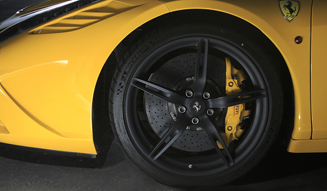
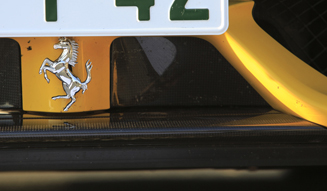
Well, my skills aren't advanced enough to casually speak of such feats. Nevertheless, the 458 Speciale truly allows you to utilize the tires' limits. For those who believe that "supercars are fun to look at but only stressful to drive on public roads in Japan," I strongly recommend experiencing the 458 Speciale.
Ferrari 458 Speciale
A Pure Sports Ferrari with a Naturally Aspirated V8 Engine
Test Driving the Ferrari 458 Speciale (5)
What Matters to a Ferrarista
Furthermore, another characteristic of the 458 Speciale is the deepening sense of unity with the car the more you drive it. As I increased the pace, on exiting a tight corner in second gear, a deep press of the throttle pedal resulted in a beautiful, four-wheel drift without any loss of balance. In that moment, I felt as though I had complete mastery of the 458 Speciale, filled with profound satisfaction.
The characteristic of a supercar that allows you to push its limits was something I also experienced in the Lamborghini "Aventador SV," and it was clearly felt in the McLaren "650S," which was introduced with the slogan "Driftability."
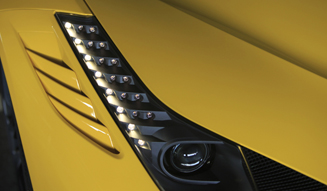
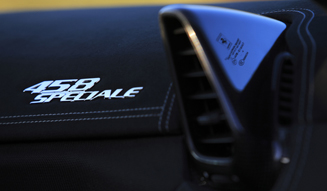
While it would be pointless to debate which of these two cars is superior to the 458 Speciale, one crucial point for a Ferrarista is that this is likely to be the last pure sports Ferrari with a naturally aspirated V8 engine.
As you know, the mainstream for V8 Ferraris is shifting towards turbocharged engines, such as in the "California T" and the "488 GTB." While I don't intend to dismiss those, it's no coincidence that a special model capable of truly enjoying sports driving has emerged at a time when the naturally aspirated V8 Ferrari, with its long history, is fading away.
This 458 Speciale, a veritable historical monument, is so easy to handle that you never tire of driving it, no matter the distance. Yet, it is also a precious model that you'll want to cherish and drive only on special occasions.
Ferrari 458 Speciale
Body Dimensions | Length 4,571 x Width 1,951 x Height 1,203 mm
Wheelbase | 2,650 mm
Tread Front/Rear | 1,679 / 1,632 mm
Weight | 1,430 kg
Engine | 4,499cc V8
Max. Output | 605ps / 9,000 rpm
Max. Torque | 540Nm / 6,000 rpm
Transmission | 7-speed Dual-Clutch
Drivetrain | MR
Tires Front/Rear | 245/35ZR20J9 / 305/30ZR20
Brakes | Carbon-Ceramic (CCM3)
Top Speed | 325 km/h
0-100km/h Acceleration | 3.0 seconds
0-200km/h Acceleration | 9.1 seconds
0-400m Acceleration | 10.7 seconds
Fiorano Lap Time | 1:23.5
Fuel Consumption | 11.8 L/100km
CO2 Emissions | 275 g/km
Fuel Tank Capacity | 86 L
Reference Price | ¥32.9 million (Sales ended)