Driving Across Hokkaido's Landscapes in the Mazda CX-3 | Mazda
Mazda CX-3
A Stylish B-Segment SUV
Driving the Mazda CX-3 Through Early Summer Hokkaido
The Mazda CX-3 is a global model that had its world premiere at the Los Angeles Auto Show in November 2014. It's an SUV developed based on the B-segment model "Demio," which was released earlier, and is exclusively powered by a diesel turbo engine. Mazda is currently pouring its greatest efforts into diesel engines, and it can be said that Mazda is the sole contender in Japan pushing diesel engines into the spotlight. This time, we set our stage in the heart of summer in Hokkaido for a long-distance drive, aiming to explore the CX-3's capabilities through extended travel.
Text by Kenichi Sakurai
The CX-3's Presence
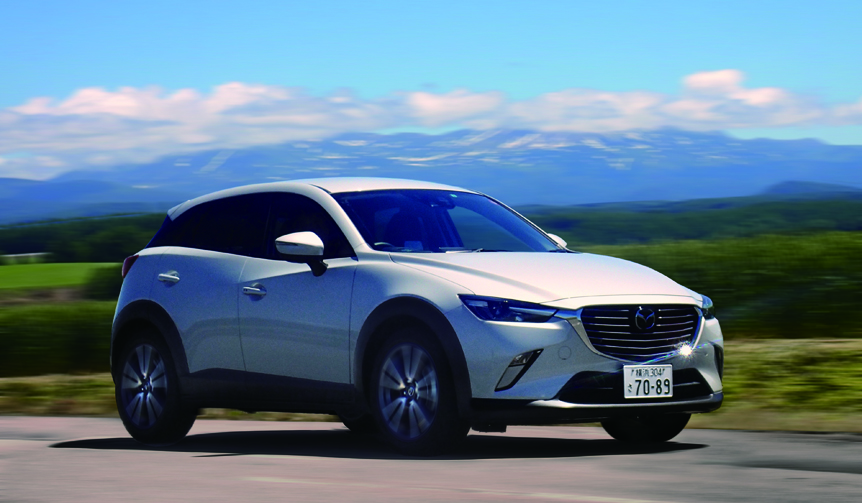
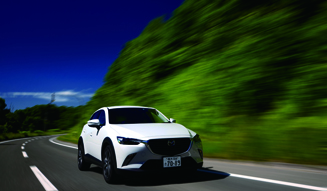
Starting from Asahikawa Airport, the destination, Risonare Tomamu in Shimukappu Village, is approximately 190 km away. We chose a route for the CX-3 test drive that included winding roads at the foot of Mount Tokachi and public roads in Kamifurano, featuring the long, straight stretches unique to Hokkaido. The northern land we landed in was characterized by a clear blue sky with low humidity. While Hokkaido's climate necessitates vehicles with good winter usability, leading to a surprisingly large number of SUVs capable of handling snow and off-road conditions, the CX-3 still commands a significant presence among them.
The body design, with its solid feel as if carved from a single block of metal, and its appearance, with large tires placed at the four corners to evoke SUV-like strength, are undeniably stylish. The short front and rear overhangs give the impression of a car that's "ready to run." This design theme, which began with the "Kodo" concept car, is now applied to all current models released since the CX-5.
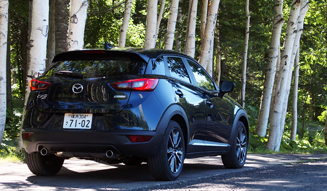
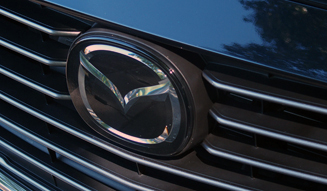
Of course, the large, shield-shaped front grille silently asserts its Mazda identity, but the headlight designs vary by model, subtly differentiating their expressions. The CX-3, in particular, features slim, sharp headlights. Combined with the aforementioned large tires and wheels and the voluminous body lines, this creates a dignified and sporty impression.
Diesel engines were once notoriously associated with being "noisy, smelly, and slow" – a set of negative traits prevalent up until the 1990s. In 1999, nitrogen oxide emissions became a concern highlighted by the Governor of Tokyo, and by the 2000s, passenger cars with diesel engines gradually disappeared from the market.

We drove the Mazda CX-3 for a total of 300 km, from Biei, known as "Japan's most beautiful town," to the natural wonderland of Tomamu.
The repeated news footage of someone shaking a 500ml PET bottle filled with black powder was quite impactful. At the time, it was estimated that 120,000 such bottles were being discharged into the atmosphere daily.
Partly due to these factors, Japan experienced a period of about 6-7 years without diesel engines in passenger cars until Mercedes-Benz introduced clean diesel technology to the Japanese market. Amidst this headwind, Mazda was the only domestic manufacturer to boldly challenge the diesel engine.
Four years have passed since Mazda launched its clean diesel vehicles. This year, data shows that 80 percent of passenger car clean diesel engines sold in the market are from Mazda, making "clean diesel" virtually synonymous with Mazda.
Mazda CX-3
A Stylish B-Segment SUV
Driving the Mazda CX-3 Through Early Summer Hokkaido (2)
The CX-3 Lineup: Choose from 12 Models
During this test drive, our objective was to spend as much time as possible in the CX-3, blending in with the general flow of traffic in Hokkaido. We explored its merits through typical usage scenarios, such as parking at tourist spots or experiencing overtakes on public roads – something we've almost forgotten how to do on Japanese roads, but is feasible on Hokkaido's long, straight stretches of single-lane roads. This approach allowed us to discover the CX-3's strengths in everyday driving.
While classified as an SUV, the CX-3 is not an off-road type but rather an urban SUV that perfectly embodies sophistication. It is available in both front-wheel drive (FF) and all-wheel drive (AWD) configurations, with a uniform height of 1,550mm, allowing it to fit into most standard mechanical parking garages commonly found in cities. This is another factor contributing to its urban appeal.
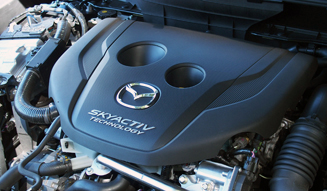
The body dimensions are 4,275mm in length, 1,765mm in width, and 1,550mm in height, with a wheelbase of 2,570mm, identical to the base Demio. Although the length is extended by 215mm compared to the Demio, and the vehicle height is also greater, making it appear a size larger, Mazda positions it as a B-segment model based on this wheelbase.
As mentioned earlier, the sole engine option is a 1.5-liter inline 4-cylinder diesel turbo, producing a maximum output of 77 kW (105 ps) at 4,000 rpm and a peak torque of 270 Nm (27.5 kgm) between 1,600 and 2,500 rpm. Both a 6-speed manual (6MT) and a 6-speed automatic transmission (6AT) are available. Some grades feature manual shift switches on the steering wheel.
Both FF and AWD drivetrains are offered across all grades, and regardless of the drivetrain, a 6-speed manual or 6-speed automatic transmission can be selected. This means the CX-3 is available in a total of 12 variations, combining three equipment grades with two drivetrain options and two transmission types.
Mazda CX-3
A Stylish B-Segment SUV
Driving the Mazda CX-3 Through Early Summer Hokkaido (3)
The Reason for its European Orientation
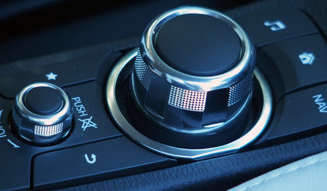
The interior, which largely shares parts with the Demio, is exceptionally distinctive and high-quality, defying expectations for a B-segment design. Most operations are intuitive, even for complex functions. This is a consistent trait across Mazda vehicles, showcasing their world view not only in the exterior but also in the interior.
Such attention to detail is crucial, much like the approach taken by European premium brands such as Mercedes-Benz, BMW, and Audi. This is precisely why Mazda is often described as having a European orientation.
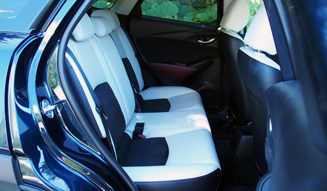
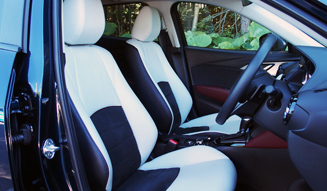
The front seats, designed with thicker cushioning than those in the Demio, are comfortable even on long drives, making them suitable for journeys covering several hundred kilometers in one go. Combined with the steering wheel's adjustability in both tilt and telescopic directions, the driving position can be perfectly set. The flexibility in adjustment allows even smaller drivers to secure good visibility. This naturally achieved position fosters a sense of unity between the driver and the car the more you drive.
However, the rear seat cushion is short, forcing a posture where the back of the knees is unsupported, which could lead to fatigue on long journeys. This, along with the slightly narrow rear door opening, suggests that the CX-3 is primarily intended for two occupants, with the rear seats used for children or as secondary seating. The packaging is not designed for regular use by four adults (or older children).
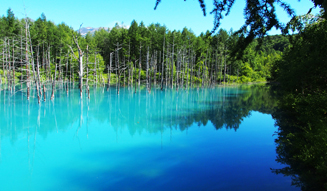
We made a short stop at the "Blue Pond," a tourist spot in Biei at the foot of Mount Tokachi.
While not excessively cramped, the physical dimensions of a B-segment model mean that four adults cannot comfortably fit, despite its seemingly larger appearance. For those prioritizing spaciousness in an SUV, a higher class of vehicle would offer greater satisfaction. This is a compromise inherent to a B-segment SUV. Naturally, for our journey with two adult males, the rear seats were used solely for luggage, so there were no complaints about cabin comfort or space.
Mazda CX-3
A Stylish B-Segment SUV
Driving the Mazda CX-3 Through Early Summer Hokkaido (4)
Mazda's Strong Commitment
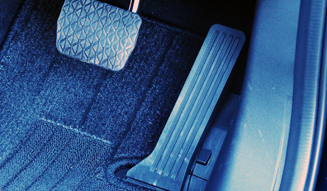
The organ-type accelerator pedal, a feature uncommon in Japanese cars but typical of German vehicles, has a satisfying resistance that is surprisingly comfortable on long drives. Mazda consistently favors this organ-type pedal, and this, along with the pedal's design and position, as well as the seat and steering wheel settings, reflects Mazda's strong commitment to detail.
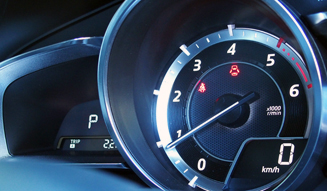
The steering wheel is slightly small but appropriate for the interior design. While its operation is light, the tuning ensures that the driver reliably receives feedback on road conditions, such as load changes during cornering, through the tires and the road surface.
Overall, the ride comfort is good, though there are slight differences between FF and AWD. For instance, on roads with continuous undulations, the FF exhibits a slight lack of rear stability, with a noticeable tendency for the rear wheels to bounce. The AWD, however, shows almost none of this tendency, suggesting that the difference is due to the presence or absence of the rear drive system and weight distribution.
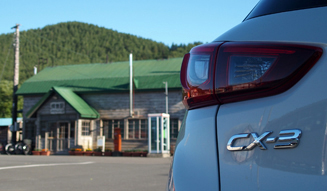
We made an impromptu stop at Ikutora Station, whose station building remains as it was in the movie "Poppoya." It was used as Horoma Station in the film.
For users who primarily drive alone or with one passenger, as is typical for Mazda's target demographic, choosing the AWD model will undoubtedly lead to higher satisfaction with ride comfort.
The engine maintains a consistent quietness, even during high-speed cruising, effectively dispelling any preconceived notions about diesel engines being noisy. This is partly due to the unit being equipped with a "Natural Sound Smoother" (which incorporates a damper in the piston pin to cancel vibrations).
Standing outside the car, one can faintly detect the characteristic rattling sound of a diesel engine. However, from within the cabin – when actually driving – the environment is akin to that of a gasoline-powered car, making it comfortable without question.
Mazda CX-3
A Stylish B-Segment SUV
Driving the Mazda CX-3 Through Early Summer Hokkaido (5)
Impressively Good Real-World Fuel Economy
The engine pairs well with the automatic transmission, and the CX-3's strengths include the fact that there were very few situations where we felt stressed due to the diesel engine. While the initial response when lightly pressing the accelerator is not quite as immediate as a naturally aspirated gasoline engine, the desired torque can be delivered with minimal lag, making overall driving feel effortless.
Despite its high ground clearance, the car corners well without feeling unstable. Utilizing the manual shift switches on the steering wheel allows for sporty driving, creating an overall impression of driving enjoyment.

Fields of canola flowers in full bloom spread across Biei.
However, in situations where we maintained a speed of 60 km/h, adhering to the speed limit, the transmission inexplicably remained in fourth gear, keeping the engine RPM slightly elevated. While the engine noise wasn't overly bothersome, inquiring with technical staff revealed that "the programming selects 4th gear in this speed range for optimal combustion efficiency and emissions." Although it might seem unnecessary, allowing for a higher gear selection at a certain throttle opening could potentially lead to even better fuel economy.
Speaking of fuel economy, over the two days and more than 300 km driven, the onboard computer displayed an average of 17.7 km per liter. This result was achieved while generally keeping pace with local traffic and, at times, aggressively (and enjoyably) tackling the winding roads around Mount Tokachi.
Naturally, we weren't consciously trying to achieve excellent fuel economy figures; this was the result of driving freely. The JC08 mode (Ministry of Land, Infrastructure, Transport and Tourism standard) fuel economy for the higher-grade XD Touring L Package with the 6-speed AT is 21.0 km per liter, so considering our driving style, this figure is certainly acceptable.

Mazda CX-3
Body Dimensions | Length 4,275 × Width 1,765 × Height 1,550 mm
Wheelbase | 2,570 mm
Tread Front/Rear | 1,525 / 1,520 mm
Weight | 1,260 - 1,340 kg
Engine | 1,498 cc Inline 4-cylinder Turbo Diesel "SKYACTIV-D 1.5"
Bore x Stroke | 76.0 x 82.6 mm
Max. Output | 77 kW (105 ps) / 4,000 rpm
Max. Torque | 270 Nm (27.5 kgm) / 1,600-2,500 rpm
Transmission | 6-speed AT or 6-speed MT
Drivetrain | FF or 4WD
Suspension Front | MacPherson Strut
Suspension Rear | Torsion Beam
Brakes Front/Rear | Ventilated Disc / Disc
Fuel Economy (JC08) | 21.0km/ℓ - 25.0km/ℓ
Trunk Capacity (DIN) | 350ℓ
Price | ¥2,376,000 - ¥3,024,000
Mazda Call Center
0120-386-919