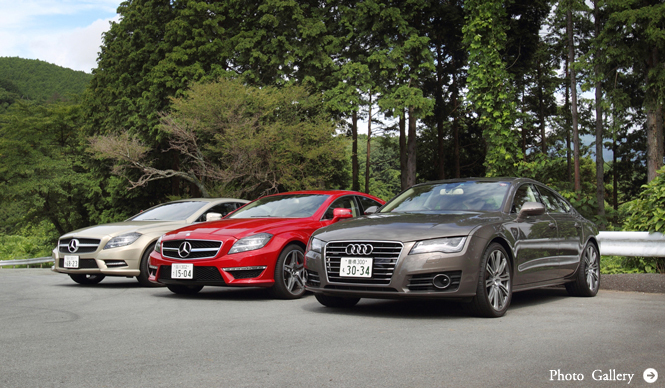
A Comparative Test Drive of Three Four-Door Specialties
Audi A7
Mercedes-Benz CLS 350 BlueEFFICIENCY
Mercedes-Benz CLS 350 BlueEFFICIENCY
Mercedes-Benz CLS 63 AMG
A Big Comparison of Three 4-Door Specialties (1)
The first generation of the "Mercedes-Benz CLS-Class," which can be said to have ignited the four-door coupe boom, was born in 2005. In February 2011, the second generation arrived, followed in May by the Audi A7 Sportback, considered a direct rival to the CLS, making its debut in Japan. Recently, we test-drove these three cars and shared an in-car report movie by Toru Watanabe, who served as the driver that day. This is the full version. What is the true value of each model? We hope you will refer to it alongside the movie.
Text by Toru WatanabePhotos by Masayuki Arakawa
Click here for the in-car report movie!
Three Cars Merging Practicality, Formal Presence, and Driving Performance
The E-segment is fundamentally a segment where core models from premium manufacturers, such as the E-Class from Mercedes, the 5 Series from BMW,and the A6 from Audi,are densely packed. In the EU, about half of the demand is supported by fleets, meaning corporate clients. It is customary for European companies to provide company cars for commuting and travel as part of their compensation, and the E-segment is often chosen for these vehicles.
Therefore, for those using E-segment cars as personal vehicles, there has been a desire for a more personalized configuration. However, coupes offer low practicality, and wagons or SUVs lack a formal presence. In this context, the concept of the four-door specialty car, which is nostalgic for Japanese consumers, naturally comes to the forefront. Mercedes' first CLS was quick to embrace this trend, and since its launch in 2005, it has achieved a certain level of success, leading to a gradual increase in choices. Recently, rumors of BMW's entry have also surfaced, making this a very hot category right now.
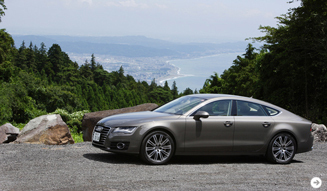
Audi A7 Sportback
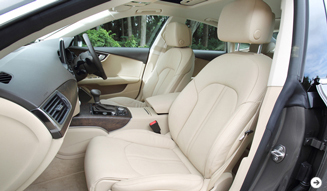
The First: A7, Combining Flowing Lines and Utility
The Audi A7, which has positioned itself as a direct rival to the CLS,Audi A7,adopts a body style they call a Sportback. While possessing a fastback coupe silhouette that slants in a straight line from the rear window to the notch, it is a frameless four-door sedan in terms of utility, utilizing a hatch gate for access to the luggage compartment. This approach mirrors the method they employed with the earlier A5 Sportback.
The low side windows might suggest a cave-like interior, but the A7's cabin space is surprisingly not bad. The front seats, set at a low seating position, offer good visibility with well-considered pillar angles, allowing the driver to grip the steering wheel with a posture only slightly lower than in a sedan. The rear seats have a low seating position and limited forward visibility, but this is also true for the CLS and should be acceptable in this category. The headroom for occupants around 180cm is just enough to avoid touching the roof, making it usable as a chauffeur-driven car. However, the rear side window opening is limited due to the priority given to the elegant, frameless design.
Audi A7
Mercedes-Benz CLS 350 BlueEFFICIENCY
Mercedes-Benz CLS 350 BlueEFFICIENCY
Mercedes-Benz CLS 63 AMG
A Big Comparison of Three 4-Door Specialties (2)
A 3-liter V6 Delivering Ample Torque from Low RPMs
The A7 Sportback utilizes much of the platform and mechanical components from the new A6, which recently debuted in Japan. It's an FF-based AWD system, with the engine positioned further back to optimize weight distribution and extensive use of aluminum to reduce vehicle weight. The Quattro all-wheel-drive system with variable torque distribution has a basic front-to-rear split of 40:60 and is set up for agile cornering. Furthermore, a new center differential using a crown gear and the adoption of a brake vectoring system ensure agility... these are elements that will also be inherited by the new A6. The engine is a 3.0-liter V6 with a supercharger, boasting not only a maximum output of 300ps but also a torque of 44.9kgm from 2,900rpm, with a focus on its user-friendly characteristic of providing robust torque even at lower RPMs.
In actual driving, the power performance of this engine is more than sufficient for the vehicle's 1,900kg weight. Particularly in the 0-100km/h range, the low-end torque unique to the supercharger, combined with the traction of the Quattro system, delivers a response comparable to a 4-liter V8 engine. On the other hand, this engine also revs smoothly beyond 6,000rpm without losing power, complementing the A7's sporty image. Meanwhile, in city driving, the start-stop system, which restarts smoothly, contributes not only to fuel efficiency but also to quietness, demonstrating a drivetrain sophistication befitting its class.
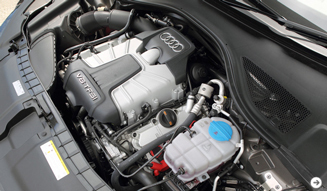
The 3.0-liter V6 engine mounted in the Audi A7 Sportback
The Ride Quality Audi Aspires To
However, the A7 Sportback's strength lies in its refined suspension, which clearly defines its character. The challenge is to convey Audi's signature rich road contact feel, inherent in its Quattro system, to the driver with clarity and lightness, without compromising a sense of security. Personally, I feel that recent Audis, especially in the larger classes, have been exploring this direction. While the current A6, for example, has shown this exploration as a certain ambiguity in driving feedback,the new A8,and this A7 Sportback, show significant progress in terms of steering feel, pedal response, and the clarity of information transmitted to the driver, while keeping the wheels firmly planted on the road and propelling the car forward.
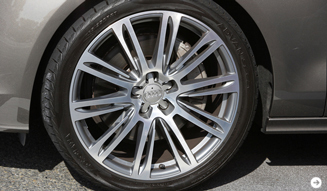
The Audi A7 was equipped with optional 10-parallel-spoke alloy wheels on this occasion.
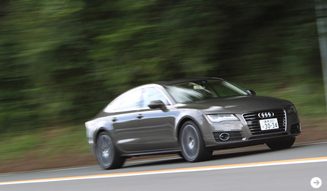
Simply put, the alignment of the operational feel has enhanced the sense of unity, or perhaps all the tuning has begun to point in the same direction. Beyond that, it can be said that the ride quality, distinct from Mercedes and BMW, which high-class Audis should aspire to, has been firmly grasped.
Although it is an E-segment car, the A7, with its class approaching the higher end, is a car that can be driven with confidence even on unfamiliar winding roads. Conversely, at slower speeds, supported by its supple ride, it is also a car that allows one to savor its refined interior.
Audi A7
Mercedes-Benz CLS 350 BlueEFFICIENCY
Mercedes-Benz CLS 350 BlueEFFICIENCY
Mercedes-Benz CLS 63 AMG
A Big Comparison of Three 4-Door Specialties (3)
The CLS: Possessing the Lineup's Most Striking Proportions
In Mercedes' model designation system, the letter 'C' at the beginning indicates a coupe. Similarly, 'W' is assigned to sedans and 'S' to wagons. Incidentally, the designation for the second-generation CLS is C218. This means that even though it can be said to have pioneered the modern four-door specialty car category, it is not classified as a pure sedan by Mercedes.
Precisely because of this meticulousness, the CLS has been given a bold design that sets it apart from sedans, reflecting its distinct classification. The second generation continues this tradition, maintaining a low profile and a slender cabin, with proportions vastly different from the E-Class.
Furthermore, with design elements reminiscent of the kicked-up fenders of classic roadsters and more catchy details than the first generation, its design daringness can be considered among the most striking in Mercedes' lineup.
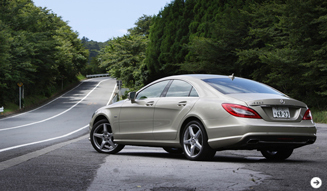
Mercedes-Benz CLS 350 BlueEFFICIENCY
Strengths and Weaknesses Compared to the A7
In contrast, the interior space is more conventional than one might expect, a trait inherited from the first generation. The seating position in the rear, with the backrest slightly reclined, is similar to the A7 Sportback, but the ease of entry, the sense of openness in headroom and shoulder room, and the size and shape of the window openings are better refined here.
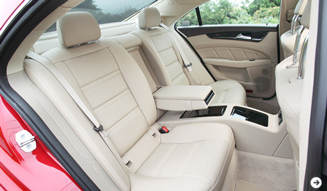
Mercedes-Benz CLS 63 AMG
However, as this is a four-door with a separate trunk, it falls short in terms of luggage capacity and practicality. As direct rivals, they are likely well aware of each other's strengths and weaknesses.
Speaking of strengths and weaknesses, while Audi has consistently excelled in static quality, the new CLS has also put considerable effort into this area. As a result, it does not significantly lag behind the A7 Sportback. Furthermore, it leads the category in the richness of its advanced driver assistance systems.
Design, quality, and safety technology. These will undoubtedly become three key comparison points in the E-segment going forward.
Audi A7
Mercedes-Benz CLS 350 BlueEFFICIENCY
Mercedes-Benz CLS 350 BlueEFFICIENCY
Mercedes-Benz CLS 63 AMG
A Big Comparison of Three 4-Door Specialties (4)
Steering Feel with a Pleasant Resistance
For this test, not only the standard 350 BlueEFFICIENCY but also the CLS 63 AMG, which arrived in Japan around the same time, were available. While there is roughly a twofold difference in power between the two, their ride quality can be considered fundamentally the same. Although the car category itself might be considered niche, its ride quality is unmistakably Mercedes.
In recent years, Mercedes' controls have become relatively lighter, and the steering feel, especially from a standstill to very low speeds, might feel less reassuring to those familiar with older models. This is likely due to the electrification of power assistance aimed at improving fuel efficiency, as well as consideration for the trends set by rivals like Audi and BMW.
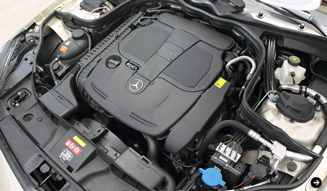
The CLS 350 is equipped with a 3.5-liter V6 engine.
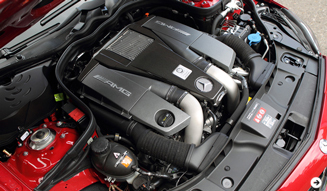
The CLS 63 AMG is powered by a 5.4-liter V8 engine.
However, this dissipates beyond the practical speed range of 30-40km/h, transitioning into a characteristic steering feel with a pleasant resistance. The effort and stroke of the brake and accelerator controls are exquisite, with no peculiar feel even for first-time drivers. Even when passengers are unfamiliar with the car, they won't be startled by overly sensitive accelerator response or abrupt braking; the car accelerates, turns, and stops smoothly and effortlessly. The fact that even the AMG, with its over 500ps, is so manageable reflects the profound philosophy behind their car manufacturing.
Speed Born from Security
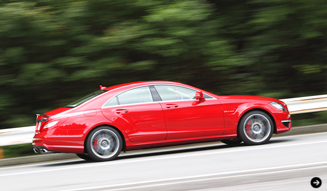
Mercedes-Benz CLS 63 AMG
What is conveyed when driving fast is a strong straight-line stability, an unwavering flat ride, and brakes that firmly plant the car to the ground even during cornering. Here too, the underlying principle is the sense of security for the occupants. While the 350, where this is evident, might be understandable, some might wonder if the AMG, with its power, could offer a more thrilling experience. However, they will not compromise their consistent policy of speed that comes from security. As a result, it is a car that can be used daily without being overwhelming, is comfortable on long journeys, and even at circuit speeds, never feels sluggish, allowing precise line-tracing with high controllability.
Even the AMG, which unleashes explosive power and a fierce V8 sound when pushed, is often chosen as a daily driver precisely because of its refined nature.
While it's true that for cars of this type, choosing the one you like based on design, quality, and utility is a path to happiness, it's also true that today, a clear dynamic philosophy of each brand can be glimpsed between these models. No matter how sophisticated one pretends to be, ultimately, it's about the driving experience. That is the true sentiment of German car manufacturers.

Audi A7 Sportback
Body Size: Length 4,990 x Width 1,910 x Height 1,430mm
Wheelbase: 2,915mm
Vehicle Weight: 1,900kg
Engine: 3.0-liter V6 DOHC + Supercharger
Maximum Output: 220kW (300ps) / 5,250-6,500rpm
Maximum Torque: 440Nm (44.9kgm) / 2,900-4,500rpm
Transmission: 7-speed S tronic
10-15 Mode Fuel Economy: 10.2 km/ℓ
CO2 Emissions: 228g/km
Price: 8.79 million yen
Mercedes-Benz CLS 350 BlueEFFICIENCY
Mercedes-Benz CLS 350 BlueEFFICIENCY
Body Size: Length 4,940 x Width 1,881 x Height 1,416mm
Wheelbase: 2,874mm
Vehicle Weight: 1,735kg
Engine: 3.5-liter V6
Maximum Output: 225kW (306ps) / 6,500rpm
Maximum Torque: 370Nm (37.7kgm) / 3,500-5,250rpm
Transmission: Electronically controlled 7-speed automatic
Fuel Economy: 6.8-7.0 ℓ/100km
CO2 Emissions: 159–164g/km
Price: 9.3 million yen
Mercedes-Benz CLS 63 AMG
Vehicle Weight: 1,870kg
Engine: 5.4-liter V8 + Twin-turbocharger
Maximum Output: 386kW (525ps) / 5,250-5,750rpm
Maximum Torque: 700Nm (71.4kgm) / 1,750-5,000rpm
Fuel Economy: 9.9 ℓ/100km
CO2 Emissions: 232g/km
Price: 16.25 million yen
*CO2 emissions not announced in Japan are based on home country data.