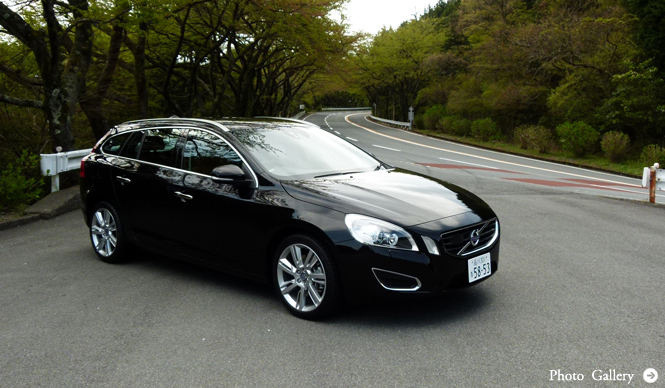
VOLVO V60 | Volvo V60: A New Generation of Station Wagon
VOLVO V60
A New Generation of Station Wagon: A Hybrid of Coupe and Wagon (1)
The Volvo V60, a hybrid of coupe and wagon, has arrived (from ¥3.95 million). It might be perfect for users who have a family but want to drive a stylish car.
By Fumio Ogawa
Distinctive Character Lines and a Face Shared with the S60
Volvo Car Japan launched the new Volvo V60 on May 9, 2011. Its selling points span multiple areas: design, driving performance, fuel efficiency, and safety. By emphasizing stylish design, it achieves a balance of youthful image and functionality, catering to a niche market. There are two engine variations: a model equipped with a 3-liter 6-cylinder turbo (from ¥5.39 million) and a model with a 1.6-liter 4-cylinder turbo based on the downsizing concept (¥3.95 million).
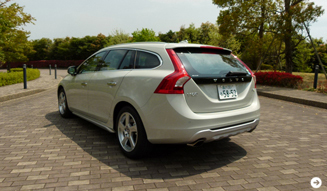
The Volvo V60 certainly has an eye-catching design. Despite being a wagon with a tailgate, the cabin is kept low. It's a hybrid concept, combining two styles, much like Honda excelled at in the past. The front grille shares a somewhat strong design with the previously announced S60, making it unmistakably Volvo. What's most striking is the view from the rear three-quarter angle, where the low-slung cabin and the dynamic character lines on the side, which Volvo calls "double wave," define the car's individuality.
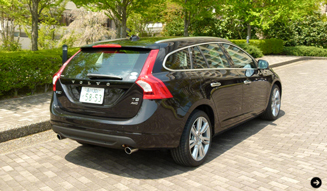
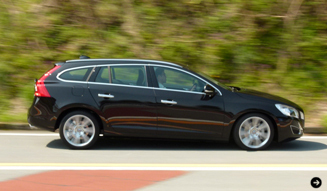
Volvo is not a manufacturer that struggles to release niche products. On the contrary, it can readily list several models with unique characteristics. For example—the V70 Cross Country, which added SUV elements to a station wagon by slightly raising the ride height, and the S60, which featured a compact cabin like a coupe.the S60, a pioneer of the 4-door sedan, andthe XC60, a large SUV with a cabin that appears compact and stylish due to its shortened roof length.... Volvo has been proactive in developing models that seem to fill a gap. These models share a common trait: Volvo seems to be aiming for a youthful image. While "V" reportedly stands for Versatility, it's a fitting designation for this model.
The V60 also features a youthful image. The impression it gives when stationary and when in motion is strikingly contrasting, with a strong sense of dynamism when driving. Viewed from the side, the roofline slopes downward towards the rear, while the beltline of the side windows rises. This successfully diminishes the perceived presence of the rear seats and cargo space, thereby weakening the impression of practicality and functionality that a wagon typically symbolizes.
The High-Performance "T6" Model for Enhanced Driving Pleasure
The model lineup is boldly divided into two distinct directions. The "T6 AWD" (from ¥5.39 million) combines a large 3-liter inline 6-cylinder turbo engine with a full-time 4WD system, and the fuel-efficient 1.6-liter 4-cylinder turbo "DRIVe" (¥3.95 million). The latter, DRIVe (pronounced Drive-E), was first introduced in the S60 and has recently been offered in the V70 and, in limited numbers, the S80. It's a key powertrain developed for the era of environmental consciousness.
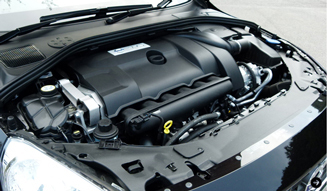
The driving experience is characterized by ample torque, ease of handling, and a comfortable ride. This applies to both the 6-cylinder and 4-cylinder engines. In the case of the T6, the torque delivery of 440 Nm from 2,100 rpm contributes to the driving pleasure. The steering, while powerful, has a moderately restrained sportiness, allowing for relaxed and comfortable driving.
Meanwhile, the DRIVe's 1.6-liter 4-cylinder turbo unit surprisingly demonstrates agile performance, effortlessly handling the car's dimensions of 4,630mm length, 1,845mm width, and 1,560kg weight.S60I had already experienced it in the S60, so I wasn't surprised, but I find this engine, with its maximum output of 180ps and peak torque of 240Nm from 1,600rpm, to be very well-executed.
Which one is preferable? If the price difference can be overlooked, my impression from driving in Hakone during the test drive event suggests the 6-cylinder T6 is smoother and more appealing. While some models clearly differentiate their character by pairing larger engines with sportier suspension (the V60 also has a T6 AWD R-Design model with a firmer suspension), the T6 SE AWD and the DRIVe seem to share a similar direction, offering a moderately sporty and relaxed ride. In that context, the T6 felt more preferable due to its smoother ride quality, attributed to the larger engine and heavier body.
VOLVO V60 | Volvo V60
A New Generation of Station Wagon: A Hybrid of Coupe and Wagon (2)
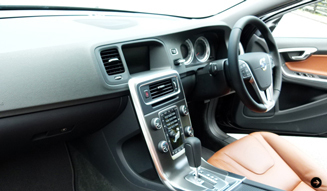
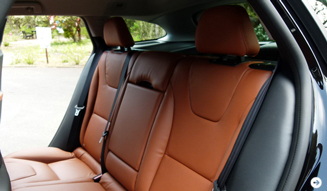
Simple Interior, Rich Interior Colors and Leather Combinations
The interior design is simple and neat. The wide array of interior colors and leather combinations available as options likely contributes to a rich impression and would be highly rated by users. The rear seat space actually offers ample headroom and legroom, so there's no need to compromise style for comfort. A minor detail, perhaps, but the rear seatbacks of the DRIVe are foldable in a 40/20/40 split. Volvo Car Japan proudly states, "This is typically seen in higher-end vehicles, but it's unusual for this class, where it's usually a 60/40 split."
When driving on winding roads, my body shifts. Perhaps because it was developed with the US market, one of Volvo's key markets, in mind—despite sales slowing due to price increases influenced by exchange rates—the seats might be too large for many Japanese individuals. If they provided better lateral support for the upper body, a slightly smaller size would be appreciated. Alternatively, this impression might be stronger with the leather seats. Fabric seats could offer better grip and a more comfortable feel.
The Latest Volvo Driver Assistance Systems Aiming for Zero Accidents
While not directly related to this test drive, it's worth noting that the V60 incorporates Volvo's current key focus on pedestrian protection. Volvo, which has set a goal of zero accidents, injuries, or fatalities involving new Volvo cars by 2020, actively uses electronic systems for accident avoidance. Although the definition of a "new Volvo car" isn't specified, the V60, capable of being equipped with "City Safety" and "Human Safety," likely falls within this category.
"City Safety" is a system designed to avoid or mitigate damage from collisions with the vehicle ahead. It uses infrared lasers to measure the distance to the preceding vehicle and applies brake control when necessary. It is claimed to avoid rear-end collisions at relative speeds up to 15 km/h and mitigate collisions at speeds up to 30 km/h. This system is standard on all models.
"Human Safety" is a "Collision Avoidance and Mitigation with Auto Braking and Pedestrian Detection." It uses radar and cameras to monitor the area ahead of the vehicle, employing brake control to help avoid collisions with pedestrians and other vehicles. It can avoid collisions up to 35 km/h and mitigate collision damage with pedestrians up to 80 km/h. This system is offered as part of the "Safety Package" (¥250,000), which also includes Adaptive Cruise Control with full-speed range, Lane Departure Warning, and Blind Spot Information System (BLIS). According to Volvo Car Japan, 70% of S60 buyers opt for this package.S60buyers opt for this package.
Volvo's Versatility Meets Diverse Needs
Strategic measures appear to have been taken with considerable consideration for the Japanese market, including pricing. According to Volvo Car Japan, the V60 DRIVe, with the optional navigation package added to its base price of ¥3.95 million, comes to ¥4.2 million. Competitors in the same price range include the Mercedes-Benz C200 Blue EFFICIENCY Station Wagon LITE (¥4.19 million). Above this are models like the Audi A4 Avant 2.0 TFSI (¥4.58 million) and the Mercedes C200 Blue EFFICIENCY Station Wagon (¥4.6 million), which includes features like a parking assist rearview camera, side airbags, and PRE-SAFE, a collision avoidance system. The navigation system is not included. Even with the leather package, the V70 is priced at ¥4.45 million, further emphasizing its price advantage.
Richness is not merely about abundant equipment. Just as lifestyles vary greatly among individuals, cars are expected to meet subtly different needs with precision. Volvo offers detailed customization options, from seat colors to dashboard materials. The significance of the V60, a new generation station wagon, lies precisely in its ability to cater to these diverse requirements.
VOLVO V60 DRIVe
Body Size | Length 4,830 x Width 1,845 x Height 1,480mm
Wheelbase | 2,775mm
Vehicle Weight | 1560kg
Engine | 1.6-liter DOHC Water-Cooled Inline 4-Cylinder
Maximum Output | 180ps (132kW) / 5,700rpm
Maximum Torque | 240Nm / 1,600-5,000rpm
Price | ¥3.95 million
VOLVO V60 T6 AWD SE
Vehicle Weight | 1,800kg
Engine | 3.0-liter DOHC Water-Cooled Inline 6-Cylinder
Maximum Output | 304ps (224kW) / 5,600rpm
Maximum Torque | 440Nm / 2,100-4,200rpm
Price | ¥5.59 million