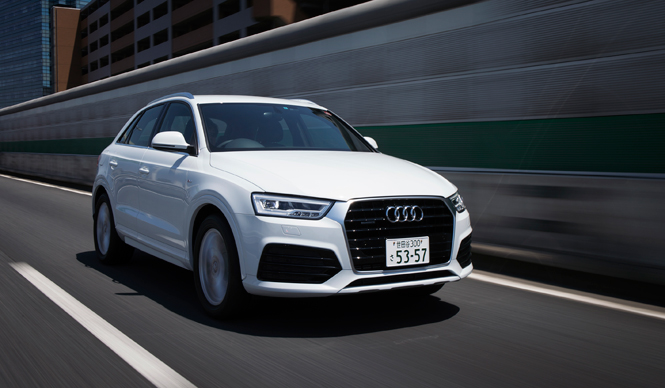
Test Drive the Minor-Changed New Audi Q3 | Audi
Audi Q3 | Audi Q3
Test Drive: The Refreshed Audi Q3
The Audi "Q3" has been refined inside and out, featuring a new singleframe grille design, sequential LED rear indicators, and an engine that's both more powerful and more fuel-efficient. Yasuhiko Kawamura reports on his test drive in Yokohama.
Text by KAWAMURA YasuhikoPhotographs by MOCHIZUKI Hirohiko
The Q3's Size: A Perfect Fit for Japan
First unveiled at theShanghai Motor Showin spring 2011, it was launched in Japan about a year later.—The Audi "Q3," which made its debut then, has now returned to Japan after amid-cycle refresh.
Audi's SUV lineup, which began with theQ7in 2005, was subsequently expanded "downward" with theQ5and now the Q3 featured here. For those who find even the Q5, with its nearly 1.9-meter width, too large, the Q3, measuring 4,400 x 1,830mm in length and width, falls into the "compact SUV" category. Its size is likely to appeal to many in Japan from the outset.
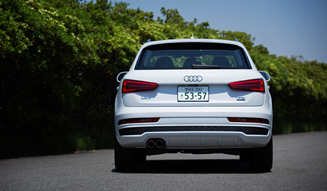
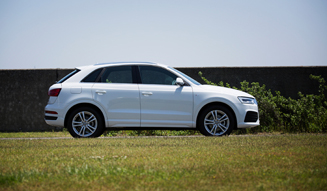
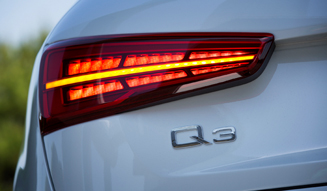
The refreshed Q3 series, including the "RS Q3" hot version powered by a unique five-cylinder engine, shares distinctive visual cues: a newly designed front grille where the hexagonal motif is more pronounced and its "outer corners" connect to the headlights, newly styled rear combination lamps with updated graphics, and redesigned front and rear bumpers.
The full LED headlights, with their distinctive luminescence that adds a modern touch even when off, are standard on the RS Q3 and optional on other grades. Notably, Audi's trend-setting "dynamic turn indicators," which flash sequentially, are applied only to the rear on the Q3 series. They are standard on the RS Q3 and optional on other models as part of the "LED Package," along with the aforementioned headlights.
The model tested here is the "2.0 TFSI quattro" grade. While the basic design of its turbocharged direct-injection 2.0-liter four-cylinder engine remains unchanged, it boasts increased power and torque compared to the previous model, while also achieving improved fuel economy in combination with the familiar 7-speed DCT.
Audi Q3 | Audi Q3
Test Drive: The Refreshed Audi Q3 (2)
A Premium Interior
Interestingly, the same "2.0 TFSI quattro" designation comes in two power outputs: one with a maximum output of 220 ps and another limited to 180 ps. The car featured in this review is the latter, priced at 4.69 million yen, with the navigation system and rearview camera offered as options.
Furthermore, this particular vehicle is equipped with options worth 1.24 million yen, including the "S line package" (comprising dedicated design bumpers, sports suspension, and 18-inch wheels), the aforementioned "LED package," a BOSE audio system, and a navigation system. The total price comes to 5.93 million yen.
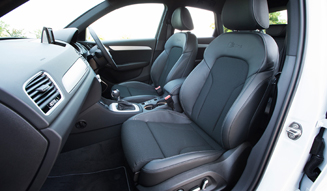
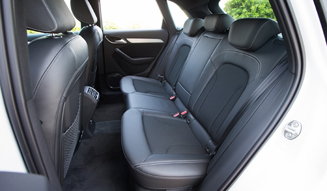
Whether the styling of this test car, finished in the optional "Glaicer White Metallic," justifies its near 6-million-yen price tag is, frankly, a matter of personal perspective. However, there would likely be unanimous agreement that its interior exudes a high-quality, premium feel.
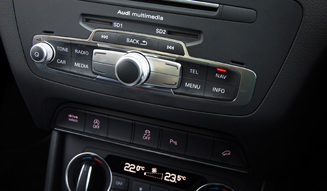
Indeed, the tactile sensation of the materials and the operation of the switches meet the expectations set by its refined appearance. Another point of appreciation is that, unlike some contemporary models that opt for touch-sensitive controls to emphasize modernity, Audi consistently employs physical switches for nearly all functions.
This is no exception in the new Q3 series. While physical switches are traditional, some might perceive them as "outdated," particularly the "smartphone generation."
However, for safe driving, where constant attention to the road ahead is paramount, physical switches, which can be operated with some degree of tactile feedback once familiar, are clearly more logical than touch controls that always require visual confirmation.
Audi Q3 | Audi Q3
Test Drive: The Refreshed Audi Q3 (3)
Strong Acceleration Even with 180 PS
Starting the engine, which boasts a 10 ps and 40 Nm increase over the previous model, the direct and responsive acceleration is immediately pleasing. This is a hallmark of the DCT, which offers virtually seamless gear changes and achieves transmission efficiency comparable to a manual, all with lightning-fast shifts.
On the other hand, even with gentle throttle inputs for smooth driving, the car can exhibit sharp acceleration and deceleration G-forces, particularly from a standstill. This behavior feels slightly more sensitive than a conventional torque converter automatic transmission. This aspect might be a matter of personal preference, though it's likely to be well-received by active drivers who opt for the S line package.
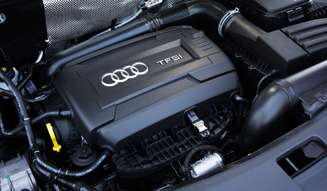
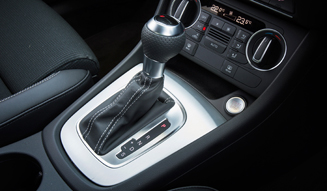
As mentioned earlier, even the "lower power" version of the "2.0 TFSI" in this test car offers no shortage of power when the accelerator is pressed deeply.—In fact, its ability to maintain strong acceleration and steadily increase speed gives a distinct impression of briskness.
As the data indicates, maximum torque is available from 1,400 rpm, providing ample low-end pull. Consequently, the DCT tends to select higher gears in the partial throttle range. This, combined with the lower engine speeds, contributes to excellent quietness, further underscoring the Q3's status as a "premium SUV" through its ride quality.
Our test drive was limited to the urban areas around Yokohama. Within this context, and with the caveat that it might be influenced by the car's setup, the suspension felt surprisingly firm.
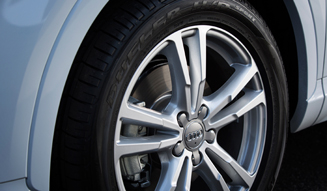
This is undoubtedly influenced by the fact that our test car was equipped with the "S line package," featuring 18-inch wheels (one inch larger than standard) combined with a sport-tuned suspension.
It's possible that the driving experience would be significantly enhanced on winding roads, such as those found in Hakone.
Audi Q3 | Audi Q3
Test Drive: The Refreshed Audi Q3 (4)
Practicality Plus: A Car to Be Proud Of
While practicality is important, when considering a purchase, one also desires a car that can be shown off with a sense of pride.—In that regard, the Q3 appears to be a highly suitable SUV.
The minimum turning radius of 5.7 meters, possibly due to the FWD-based chassis combined with large wheels, is slightly disappointing.
However, aside from that, the body size feels quite manageable in Japan, and naturally, four adults can comfortably travel for extended periods with a considerable amount of luggage.
The compact SUV segment, including models originating from Japan, is highly competitive. Nevertheless, the Q3 is undoubtedly a model that cannot be overlooked within this class.

Audi Q3 2.0 TFSI Quattro 180PS
Audi Q3 2.0 TFSI quattro 180PS
Body Dimensions | Length 4,400 x Width 1,830 x Height 1,575 (S line) / 1,595 (with navigation) mm
Wheelbase | 2,605 mm
Tread Front/Rear | 1,570 / 1,575 mm
Weight | 1,620 kg
Engine | 1,984 cc Inline 4-cylinder DOHC Intercooler Turbo
Bore x Stroke | 82.5 x 92.8 mm
Compression Ratio | 9.6 : 1
Max. Output | 132 kW (180 ps) / 4,000 - 6,200 rpm
Max. Torque | 320 Nm (32.6 kgm) / 1,400 - 3,900 rpm
Transmission | 7-speed S tronic
Drivetrain | 4WD
Suspension Front | MacPherson Strut
Suspension Rear | Double Wishbone
Brakes Front | Ventilated Discs
Brakes Rear | Discs
Tires Front/Rear | 235/55 R17
Fuel Economy (JC08 Mode) | 15.0 km/ℓ
CO2 Emissions | 155 g/km
Trunk Capacity | 460 ℓ
Price | 4.69 million yen
Audi Communication Center
0120-598-106(9:00 - 19:00 / Open Year-Round)