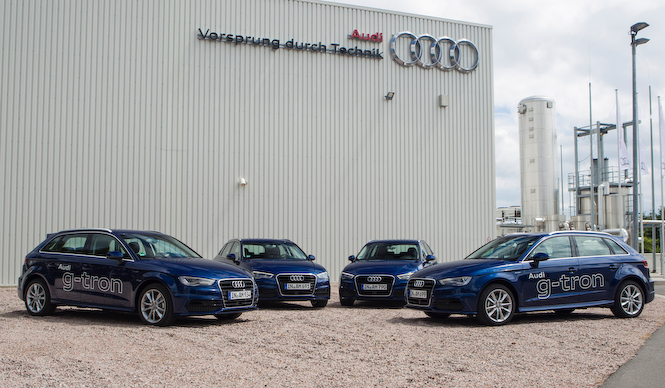
Audi A3 g-tron: Running on Gas Made from Wind (Part 1) | Audi
Audi A3 Sportback g-tron
Audi's Commitment to a Sustainable Society
The Audi A3 g-tron Runs on Gas Made from Wind: Part 1
Audi recently announcedThe New R8and its pursuit of speed and comfort,RS Modelsand its participation in WEC (World Endurance Championship), Audi has cultivated a strong image in motorsports. Simultaneously, it is a brand actively engaged in reducing CO2 emissions to foster a sustainable society. The "A3 Sportback g-tron," recently introduced by Audi, not only runs on CNG (Compressed Natural Gas) but also aims to achieve virtually zero CO2 emissions by generating this fuel from renewable energy. Tatsuya Otani reports on the reality through test drives and infrastructure tours. Part 1 delves into the background.
Text by Tatsuya Otani
Why We Must Reduce CO2 Emissions
"Unless we immediately reduce carbon dioxide (CO2) emissions, the phenomenon of global warming will reach an irreversible stage."—One reason why we struggle to grasp this issue realistically, despite hearing such statements repeatedly, is that CO2 is invisible, odorless, and thus, we cannot personally perceive its steady increase.
While we might concede it when hearing about extreme weather, we experience both hot and cold days, making it difficult to feel certain that temperatures are "steadily rising." Furthermore, the notion of "irreversible consequences within a few years" feels abstract, and in a world as uncertain as ours, where even our own futures are unclear, discussing the Earth's average temperature a few years from now doesn't quite resonate.
Nevertheless, global warming is undoubtedly a critical issue that could affect our lives and those of future generations, not just a distant problem.
For instance, if atmospheric CO2 continues to increase at the current pace, the Earth's average temperature will rise by 2 degrees Celsius by around 2040 compared to the early 20th century, and by 6 degrees Celsius by 2100 if it continues to climb.
So, what would happen if the Earth's average temperature rose by 6 degrees Celsius?
First, the ice in Iceland would begin to melt, causing sea levels to rise, and the glaciers in the Himalayas would start to diminish. It is said that between 10 million and 100 million people worldwide depend on glacial meltwater for their livelihoods; these individuals would suffer from water shortages. Moreover, recent reports have frequently highlighted the possibility of various disasters caused by water flowing from melting glaciers.
In a chain reaction, other environmental changes would occur, leading to a world predicted to be extremely difficult for humanity to inhabit.
Audi A3 Sportback g-tron
Audi's Commitment to a Sustainable Society
The Audi A3 g-tron Runs on Gas Made from Wind: Part 1 (2)
Audi's Serious Efforts to Reduce CO2 Emissions
To prevent this, it is essential to maintain the proportion of CO2 in the atmosphere at the level of around 2020 for the foreseeable future.
One might think, "Then why not implement strict CO2 emission regulations starting from 2020?" However, with the global population increasing and economic activity intensifying worldwide, reversing the trend of rising CO2 is not an easy task.
Ultimately, to allow for continued population growth and economic development at the current pace while keeping CO2 emissions at or below current levels, or even reversing the trend to a decrease, requires both a strong awareness of the need to improve our lifestyles immediately and technological innovation to fundamentally reduce CO2 emissions.
Otherwise, many experts point out, the only way to solve this problem would be to revert our lifestyles to those of the Stone Age or the Middle Ages.
In other words, it can be said that automotive manufacturers are researching day and night on how to reduce CO2 emissions while maintaining our affluent lifestyles.
Amidst this, Audi is pursuing its own initiatives, unconstrained by its role as an automobile manufacturer. Their efforts have been reported on multiple occasions through the coverage of "Audi Future Labo."Audi Future LaboWe at OPENERS have reported on Audi Future Labo more enthusiastically and in greater detail than any other media in Japan, and likely very few globally. And once again, I have witnessed Audi's serious engagement with CO2 reduction.
This time, however, it wasn't just a PowerPoint presentation or a model explaining "the need for facilities like this in the future."
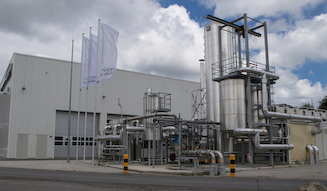
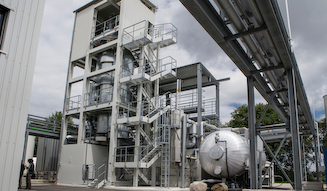
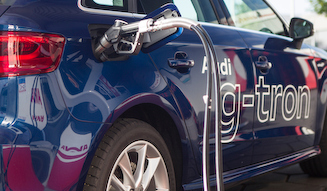
Audi has independently built and is operating a pilot plant that, though small in scale, genuinely contributes to CO2 reduction. This time, I was granted permission to visit the facility. Additionally, I test-drove the Audi "A3 g-tron," which runs on the groundbreaking fuel "e-gas" born from this plant, and will introduce that as well.A3 g-tron
Audi A3 Sportback g-tron
Audi's Commitment to a Sustainable Society
The Audi A3 g-tron Runs on Gas Made from Wind: Part 1 (3)
A Method to Store the Unstable Power of Wind Energy
AudiThe principle of e-gas has already been introduced on OPENERS.In Germany, wind power is widely utilized as a renewable energy source. However, wind power generation has the drawback of "not necessarily generating electricity when humans want it."
In other words, it doesn't generate enough power when we need it, and conversely, it generates a large amount when it's not needed. Furthermore, charging electricity is surprisingly difficult, making it hard to "charge in advance and utilize it when needed."
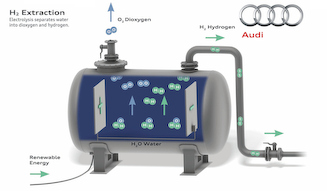
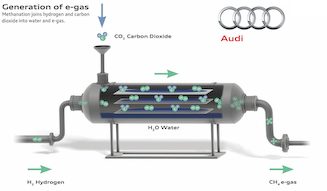
This is where e-gas comes in. It's a technology that aims to eliminate energy waste by converting surplus electricity from wind power into hydrogen or methane gas.
The principle involves using surplus electricity to electrolyze water (H2O) into hydrogen (H2) and oxygen (O2). The resulting hydrogen (H2) is then combined with carbon dioxide (CO2) to produce methane gas (CH4). Audi calls this generated methane gas "e-gas."
Since methane gas is the main component of natural gas, it can be supplied through Germany's extensive natural gas network, making e-gas virtually accessible anywhere within the country.
The gas you refuel at a gas station (yes, natural gas is available at quite a few gas stations in Germany) might be ordinary natural gas, not e-gas itself. However, similar to green electricity in Japan, the "low-carbon energy" you paid for is consumed somewhere and contributes to CO2 emission reduction. Therefore, it's as if you yourself have contributed to reducing CO2 emissions. Audi's e-gas is based on this concept.
In the second part, Tatsuya Otani test drives the A3 Sportback g-tron to consider its benefits.