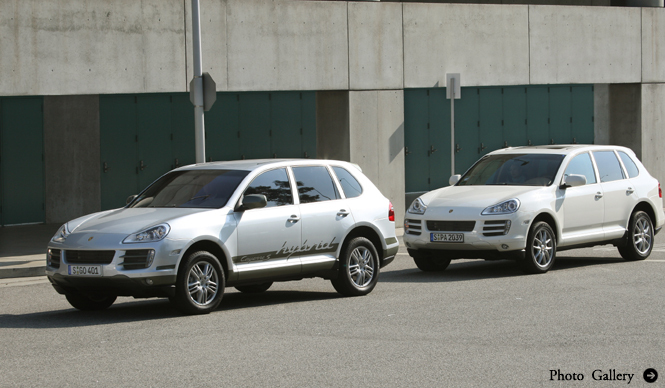
PORSCHE | Test Drive the Cayenne S Hybrid & Cayenne Diesel
PORSCHE Cayenne S Hybrid & Cayenne Diesel Test Drive
Two "Green Cars" Boasting the Distinctive Cayenne Driving Experience (1)
PorscheAmong the several green cars announced by Porsche, the Cayenne in particular makes the heart of anyone behind the wheel leap with joy. While the new model's Hybrid S has already been unveiled, I had the opportunity to test drive the current Cayenne S Hybrid and Cayenne Diesel beforehand. Motor journalist Yasuhisa Shimashita reports on the ride quality of each during the "Green Car Test Drive."
Text by Yasuhisa ShimashitaPhotos by Porsche Japan
Hybrid System Jointly Developed with Volkswagen and Audi
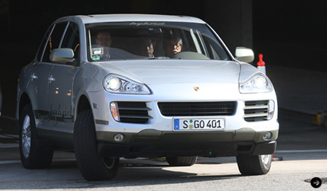
At the press event "Green Car Test Drive" held in December last year, there was an intriguing vehicle: the Porsche Cayenne S Hybrid.
Eight years after its debut as Porsche's first SUV, or rather, its first non-two-door sports car model, which achieved a stunning launch and quickly garnered strong support, the new Cayenne, set to arrive this year, will feature a hybrid model. The Cayenne S Hybrid I was able to drive this time is a test vehicle that incorporates the components intended for that model into the current generation's body.
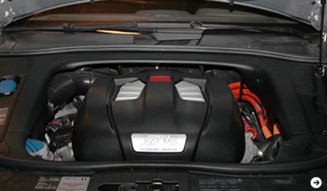
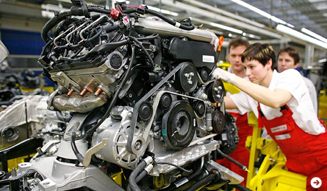
Initially rumored to be supplied by Toyota, Porsche's hybrid system ultimately led them to a different path: developing an entirely new system in collaboration with Volkswagen andAudi. The system features a V6 3.0-liter supercharged engine paired with an 8-speed automatic transmission, with an electric motor sandwiched between them. The battery, a proven nickel-metal hydride type, is housed beneath the luggage compartment floor.
In terms of utilizing an existing engine and transmission, and not requiring a dedicated chassis, the configuration is similar to that ofMercedes-Benz'sS-Class Hybrid. However, a significant difference is the presence of a clutch between the engine and electric motor. This allows them to be disengaged, meaning the engine can be shut off, enabling purely electric motor driving.
The interior around the driver's seat is virtually unchanged from the base Cayenne S. The only difference is the display of the hybrid system's operating status on the instrument panel and navigation monitor.
Gliding Silently at High Speeds
Turning the ignition key starts the engine, and the "READY" lamp illuminates, but the engine soon shuts off. When shifting to D and gently pressing the accelerator, the engine remains off, and the car begins to move silently. Under normal acceleration, the engine starts up around 15 km/h. The ability to use the electric motor for this initial low-speed range, where the engine is least efficient, is the first point where the hybrid contributes to fuel economy.
Incidentally, even when running on electric power, the cabin's air conditioning functions, and the power steering and brake booster remain operational. These are all electrified and work regardless of whether the engine is running. I noticed almost no change in feel associated with this. The system also excels in regenerative braking, which captures and stores energy during deceleration, a common challenge for hybrids. The braking control, often compromised by the combination of regenerative and hydraulic brakes, is virtually flawless.
There is no dissatisfaction with acceleration beyond that point. Although the vehicle's weight has increased by 140 kg, the supercharger delivers a maximum engine output of 333 ps, augmented by the electric motor's 52 ps, with the 8-speed automatic transmission efficiently utilizing all that power. This is as expected.
Easing off the accelerator at an appropriate point transitions to cruising. The Cayenne S Hybrid immediately shuts off the engine and switches back to electric-only driving. This is the second key point: the system actively shuts down the engine whenever it's not needed, conserving fuel. This engine shutdown occurs at speeds approaching 140 km/h. The sensation of gliding along at high speeds without the sound of the engine is a novel experience.
Will 11.2 km/L Be Achieved!?
From here, when I press the accelerator again to accelerate, the engine restarts instantly. The area that still feels like it needs refinement is the slight jolt when the clutch between the restarted engine and electric motor engages. This is the most challenging aspect of controlling this system.
However, this is the only real issue. Far from sacrificing the sporty driving performance characteristic of Porsche or the Cayenne, it actually enhances it. The fact that it's designated "S" despite having a V6 engine should give you a clue. While the test vehicle didn't feature a "boost mode" that utilizes the full power of both the engine and electric motor for maximum performance during full throttle, it's likely to be included in the production model. An EV mode, which allows for extended driving solely on electric power, is also highly probable.
Despite this, the crucial fuel economy, while not yet officially rated, was targeted at 8.9 L/100km, or approximately 11.2 km/L, when the first test vehicle was completed in 2007. If achieved, this would be an exceptionally good figure for this class of vehicle.
The launch is imminent. Furthermore, as the same system is already confirmed for the Panamera, I eagerly anticipate the day I can get behind the wheel of Porsche's hybrid production model.
PORSCHE Cayenne S Hybrid & Cayenne Diesel Test Drive
Two "Green Cars" Boasting the Distinctive Cayenne Driving Experience (2)
Maximum Torque Surpassing the Cayenne GTS
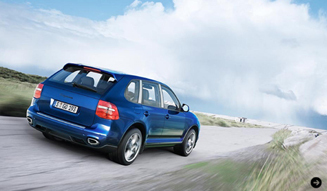
PorscheAt the "Green Car Test Drive" at the Los Angeles Auto Show, where I had the chance to test drive the Porsche Cayenne S Hybrid test car, another Cayenne was available. Although the emblem on the back simply reads "Cayenne," this model is, in fact, a "green car." It is the Cayenne Diesel, currently sold only in Europe.
Diesel in a Porsche. Hearing that, many people probably feel a sense of incongruity. In fact, Porsche itself felt that way until just a few years ago. Despite most SUVs sold in Europe being diesel-powered, even the CEO emphatically stated at the time of its debut that "Porsche is suited for high-revving gasoline engines, and we have no intention of installing a diesel."
But times have changed. The surge in gasoline prices a couple of years ago made even performance-oriented buyers consider fuel costs. Furthermore, the perception of diesel as a sporty engine has grown. With this in mind, Porsche has finally introduced a diesel option for the Cayenne.
However, it is currently sold only in Europe, not in North America. Looking closely at the test vehicle, it had German license plates, indicating it was a European specification model.
Its heart is a V6 3.0-liter direct-injection diesel turbo engine. While its maximum output of 240 ps at 4000–4400 rpm is slightly lower than the Cayenne V6, its maximum torque of 550 Nm at 2000–2250 rpm surpasses even the Cayenne GTS. It is paired with a 6-speed automatic transmission. The reported fuel consumption is 9.3 liters per 100 km, which is approximately 10.8 km per liter.
The Sportiest Cayenne in the City
When the engine starts, the characteristic diesel vibration and noise are noticeable, but not to an uncomfortable degree. Once you start driving, you'll likely forget about it. The torque is exceptionally abundant, and the over two-ton vehicle surges forward without needing to press the accelerator pedal deeply.
Acceleration thereafter is also powerful. Although the engine only revs up to just over 4,500 rpm, the momentum until then is explosive, rapidly increasing speed with quick gear shifts. It's understandable that its 0-100 km/h acceleration of 8.3 seconds surpasses that of the Cayenne V6.
While diesels are often associated with highway driving, particularly in Europe, their characteristics are actually advantageous in city driving. With torque readily available from low RPMs, the pickup is quicker than with gasoline engines, allowing for immediate acceleration. Personally, I don't think a diesel engine is ill-suited for the Cayenne at all. In fact, I believe this diesel variant might be the one that allows the Cayenne to be driven most sportily in the city.
Hybrid and diesel. The Cayenne is preparing to offer two eco-friendly powertrains. Both exhibit excellent synergy with the Cayenne, exceeding expectations. They undoubtedly deliver powerful performance while offering the advantage of fuel efficiency.
As for sportiness, there's no need to elaborate further. The Cayenne was already an exceptionally sporty model among SUVs. With the addition of these powerful powertrains, there's no question that the driving enjoyment remains intact.
It's likely that only the hybrid will be introduced to Japan. However, to be honest, I wish both were available... these are two remarkably well-executed vehicles.
Porsche Japan
http://www.porsche.com/japan/