Test Drive: The Audi A3 e-tron Plug-in Hybrid | Audi
Audi A3 Sportback e-tron
What Audi Aimed For With Its Plug-In Hybrid
Test Drive: Audi A3 Sportback e-tron Plug-In Hybrid
Audi, part of the Volkswagen Group, is promoting vehicle electrification for a sustainable mobility society. One result is the A3 Sportback e-tron, a plug-in hybrid version of the five-door hatchback A3 Sportback. Tatsuya Otani, who attended the test drive event in Germany, had assumed it was easily produced thanks to the "MQB" modular platform, which was developed incorporating EVs and hybrids. However, he discovered that meticulous engineering had been applied towards a clear objective.
Text by Tatsuya Otani
Engineers Gather for an Explanation
As I was admiring the cutaway model of theA3 e-tronon display at the presentation venue, several Audi engineers gradually gathered, and an impromptu discussion began.
My interest was primarily in the powertrain. While the A6 hybrid, Audi's first hybrid model released two years prior, had its engine mounted longitudinally, the A3 e-tron's engine is mounted transversely. However, the power flow from engine to motor to gearbox to drive wheels is the same for both the A6 hybrid and the A3 e-tron. The most noticeable differences appear to be the A3 e-tron's 8.8 kWh lithium-ion battery, enabling 50 km of electric-only driving (compared to 1.3 kWh for the A6 hybrid), and the onboard charging equipment required for external charging.A6 hybridThe A3 e-tron has a 8.8 kWh lithium-ion battery, enabling 50 km of electric-only driving (compared to 1.3 kWh for the A6 hybrid), and the onboard charging equipment required for external charging.
Another way to look at it might be: "The A3 e-tron is simply the currentA3 1.4 TFSIwith a battery and motor added. There's nothing technologically novel about it." Perhaps they sensed this thought lurking deep within me. It makes sense to consider that this was the reason the discussion became so heated.
For example, the 6-speed S tronic transmission. Audi was the first automaker to introduce a dual-clutch transmission in a mass-produced vehicle, and now offers S tronic in most of its models. Therefore, I assumed the one used in the A3 e-tron was a carry-over.
"No, no, this S tronic is newly developed," the powertrain engineer corrected me. "In the A3 e-tron, the engine, motor, and gearbox are arranged in a straight line. To fit these between the front wheels, the gearbox needed to be made more compact. That's why we decided to develop this 6-speed S tronic specifically for the hybrid model."
The engineer further explained that the decision to use a 6-speed S tronic, when 7-speeds are now mainstream, was due to the need for compactness. However, he added that a 6-speed provides sufficient performance for a hybrid model, which can be supplemented by the electric motor.
Audi A3 Sportback e-tron | Audi
What Audi Aimed For With Its Plug-In Hybrid
Test Drive: Audi A3 Sportback e-tron Plug-In Hybrid (2)
Hybridization Is Not So Simple
Additionally, a clutch called a decoupler is sandwiched between the engine and motor. While this clutch was dry-type in the A6 hybrid, it is wet-type in the A3 e-tron. In fact, the wet-type clutch, which is said to allow for finer control and smoother engagement/disengagement, significantly influences the A3 e-tron's driving feel, but we will discuss that later.
"But the 1.4-liter TFSI engine is a direct adaptation from the regular A3, isn't it?" When I asked this, the engine engineer corrected my misunderstanding. "The base is a standard TFSI engine, but we've used reinforced pistons and other components to enhance durability."
I couldn't believe my ears. I thought that since the engine's operating time would be reduced in a plug-in hybrid model, which often runs on electric power alone, it might be acceptable to reduce the engine's durability.
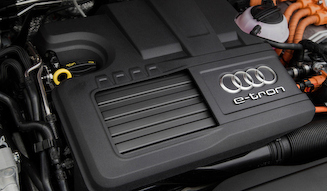
"That's incorrect," the aforementioned engineer replied. "In a hybrid model, the engine starts and stops abruptly, so the load on the engine is actually greater."
Hearing this, I jumped to the conclusion, "Ah, I see. They've increased durability because the engine might start up suddenly while it's still cold." Another engineer corrected me: "No, the engine coolant is kept at a constant temperature. To minimize cooling losses, the cooling systems for the battery, electrical components, and engine are interconnected, allowing the engine coolant to reach its optimal temperature after a certain period of driving."
However, the optimal temperatures for the engine, battery, and electrical system are all different. If all their cooling systems were unified, some components might become too cold while others overheat.
"Of course, that's correct," the engineer replied. "Therefore, in the A3 e-tron, we've made the cooling systems for the engine, battery, and electrical components independent, but connected them via a heat exchanger to ensure each operates at its optimal temperature."
After hearing all this, I realized my mistake. There are countless hybrids in the world, and I had carelessly assumed the A3 e-tron was also easily put together. I was completely wrong. While the exterior of the A3 e-tron is almost identical to a regular A3, its interior is packed with the latest, specially developed hybrid technology.
Audi A3 Sportback e-tron | Audi
What Audi Aimed For With Its Plug-In Hybrid
Test Drive: Audi A3 Sportback e-tron Plug-In Hybrid (3)
Usable Exactly Like Any Conventional Car
So, what was the purpose of all this technology? The answer is surprisingly simple: Audi aimed for the car to be "driven just like a regular A3."
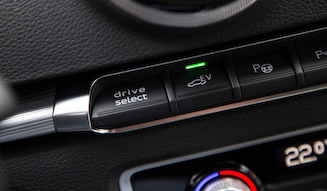
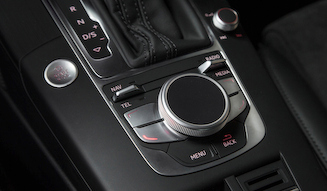
For instance, the only control on the A3 e-tron's dashboard that differs from a regular A3 (to avoid repetitive writing, I will refer to it as 'A3' hereafter) is the EV button.
This button allows selection of four modes: 1) EV mode for electric-only driving, 2) Hybrid-Auto for normal driving, 3) Hybrid-Hold to maintain the current charge level, and 4) Hybrid-Charge to actively recharge the battery. Other than this, everything, including the Driving Select system, is familiar to Audi drivers. There are no switches to adjust regenerative braking, which is common in EVs.
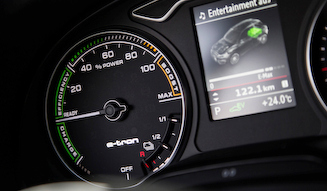
The instrument cluster is similar. A power meter (indicating 100% at maximum electric motor output; the engine power adds to the BOOST range) replaces the tachometer, and a battery charge level indicator is added below it. Overall, the design is largely unchanged from the A3.
The impression of "unchanged from the A3" persists even after starting to drive. Despite being about 200 kg heavier than the A3, the ride quality is supple yet feels somehow light, sharing the same characteristic as the A3. The handling, where the nose eagerly turns into the corner when the steering is turned, and the agility with which the car moves forward with just a light press of the throttle, are exactly the same as the familiar A3.
Indeed, when the engine turns on or off during Hybrid-Auto driving, there is no jarring shock, unlike the A6 hybrid; it's incredibly smooth. This is undoubtedly thanks to the aforementioned wet-type clutch, and this smoothness is another reason why the A3 e-tron feels so much like a regular A3.
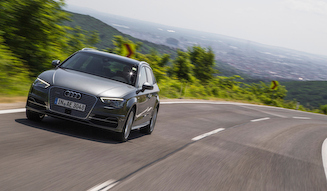
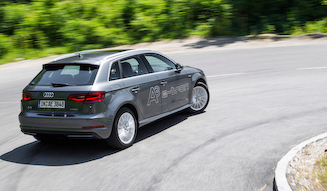
You might say, "Well, it's based on the A3, so that's natural," but that would be a big mistake. A 200 kg difference in weight would necessitate significant adjustments to the suspension settings. Furthermore, the weight distribution and center of gravity must have changed with the addition of the battery. The power characteristics would differ due to the electric motor, and the control system for engine on/off, as mentioned earlier, would likely not have been simple.
However, Audi aimed to create a car that hides all these differences. This is evident in their use of the same steel body (despite the extensive use of lightweight materials, the basic structure is steel) as the regular A3, and their prioritization of "making plug-in hybrids and EVs usable in exactly the same way as conventional cars."
Audi A3 Sportback e-tron | Audi
What Audi Aimed For With Its Plug-In Hybrid
Test Drive: Audi A3 Sportback e-tron Plug-In Hybrid (4)
The Difference Between the BMW i3 and the A3 e-tron
When the A3 e-tron is released in Japan, many people will likely compare it with theBMW "i3"and the A3 e-tron. Consequently, some will undoubtedly choose the i3 with its distinctly EV styling and carbon monocoque construction. However, I believe it's difficult to compare the e-tron and i3 on the same level.
Fundamentally, the A3 e-tron is a plug-in hybrid where the engine and motor "coexist," while the i3 is an EV that cannot be driven directly by its engine. However, the A3 e-tron can travel up to 50 km on electric power alone, and the i3's range-extender model can recharge its battery with a 650cc engine, so the gap between the two categories is surprisingly narrow.
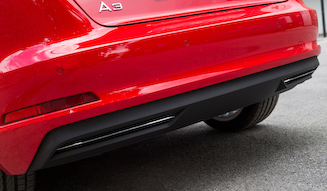
However, the biggest difference between the two cars lies, in extreme terms, in their very approach to car manufacturing. The i3 is a model that uncompromisingly embraces futuristic car design. Therefore, its usability requires a new way of thinking, a certain degree of compromise. Range is a prime example: it's just under 200 km in EV mode (according to Ministry of Land, Infrastructure, Transport and Tourism standards), and can travel an additional 100 km on a full 9-liter gasoline tank. While this is long for an EV, it's clearly shorter than a conventional gasoline car. As such, its usability is limited.
In contrast, the A3 e-tron has a 40-liter gasoline tank. Based on my test drive, where the average fuel economy was approximately 20 km/liter over 100 km, it could travel 800 km if this holds true, or at least 600 km even if estimated at 15 km/liter. In other words, it can be used with the same mindset as a conventional car.
The ride comfort is also contrasting. While the A3 e-tron is almost identical to the A3, the i3 transmits jolts due to its large-diameter tires.
However, given that BMW has perfected the use of run-flat tires, which previously transmitted considerable harshness, this ride comfort will likely improve in a few years. Currently, the A3 e-tron clearly has the advantage. The A3 e-tron also wins in terms of rear seat space and luggage capacity.
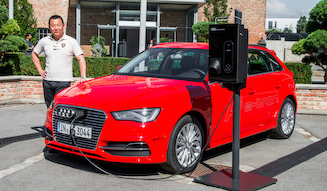
While I don't intend to conclude that the A3 e-tron is superior, it is an exceptionally well-executed car in the sense that it can be used with the same mindset as a conventional car. The i3, on the other hand, as a next-generation vehicle, demands a new approach from its driver. This distinction should be the deciding factor when choosing between the two.
The A3 e-tron is expected to be released in Japan in 2015, with a price around 5 million yen.

Audi A3 Sportback e-tron
Body Dimensions | Length 4,312 x Width 1,785 x Height 1,424 mm
Wheelbase | 2,630 mm
Tread Front/Rear | 1,542 / 1,516 mm
Weight | 1,540 kg
Engine | 1,395 cc Inline 4-cylinder DOHC Direct Injection Turbocharged
Bore x Stroke | 74.5 x 80.0 mm
Compression Ratio | 10.0
Maximum Output | 110 kW (150 ps) / 5,000-6,000 rpm
Maximum Torque | 250 Nm / 1,600-3,500 rpm
Motor Maximum Output | 75 kW (102 ps)
Motor Maximum Torque | 330 Nm
System Integrated Maximum Output | 150 kW (204 ps)
System Integrated Maximum Torque | 350 Nm
Transmission | 6-speed S tronic (Dual Clutch)
Drivetrain | FF
Drive Battery Type | Lithium-ion
Drive Battery Total Capacity | 8.8 kWh
Tires | 205/55R16
Maximum Speed | (Hybrid Mode) 222 km/h (EV Mode) 130 km/h
0-100 km/h Acceleration | (Hybrid Mode) 7.6 seconds
0-60 km/h Acceleration | (EV Mode) 4.9 seconds
Fuel Economy (ECE Value) | 1.5 ℓ/100km (approx. 66.7 km/ℓ)
CO2 Emissions | 35 g/km
Trunk Capacity | 280 liters, 1,120 liters with rear seats folded