Audi DESIGN | Designer Satoshi Wada Interview (Part 2)
Audi
Designer Satoshi Wada - Interview (Part 2)
A Designer Who Breaks Through Eras
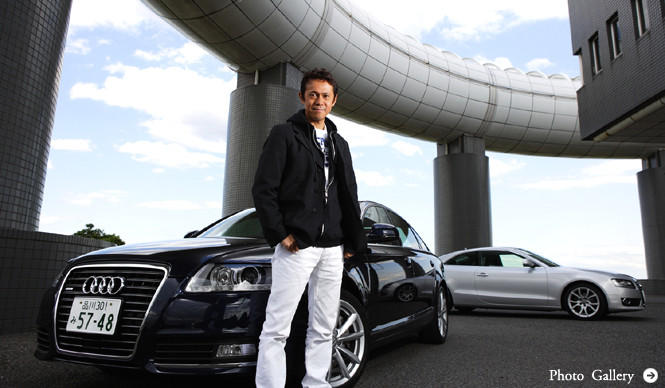
Since 1998,AudiSatoshi Wada, a Japanese designer with a brilliant career, joined the Audi design studio and, during his 12 years there, worked on three production cars and two show cars. We spoke with Mr. Wada, who is responsible for the future of Audi design as a Senior Designer/Creative Manager.
Text by OPENERSPhotos by Masayuki Arakawa
A Designer's Turning Point
“In the late 1990s, Audi design was generally described as postmodern, achieving high acclaim by perfecting inorganic and simple forms. Later, Walter de Silva, an Italian designer I admire, became the Director of Audi Design, and the shift began towards the more emotional design that Audi expresses today. During that time, I worked with Walter on three production vehicles, and through that creation, my potential as a designer was elevated.”
Mr. Wada, reflecting on his whirlwind decade at Audi Design, transferred in his eleventh year, 2008, for a one-year term to the Volkswagen Group's satellite studio in Santa Monica, Los Angeles, called 'Design Center California' (DCC). The purpose was to refresh. However, this year became a turning point for Mr. Wada as a car designer.
For example, the current Volkswagen Group has seven brands, including Audi,BentleyandLamborghini, and at DCC, he was able to work on designs for brands other than Audi. Of course, this was an experience he could not have had at the Audi headquarters Design Center in Ingolstadt.
“In fact, I was involved in a preliminary design project for a model from another brand that would debut a few years later. Through that creation, it was a valuable experience to be able to view our group from a different perspective than usual.”
“What’s more important,” Mr. Wada continues,
“When you are involved in new car development projects at the headquarters design studio, the work inevitably becomes product-focused. However, at DCC, I was able to work on building the future vision for Audi and the Volkswagen Group.”


What is Innovative, What is Truly Necessary
Nevertheless, in this era where the world faces severe challenges such as the once-in-a-century great recession and environmental issues, and cars are at an unprecedented crisis, what should car designers express and achieve for the coming era?
“Nowadays, I feel that the marketing aspect of design has become disproportionately large. In other words, design as a means to sell. Of course, as long as we are designing products, that is an important element. However, I believe that it is the job of us designers to consider and present what is innovative and what is truly necessary in the present and future.”
Mr. Wada speaks logically and passionately, captivating his audience, as befits a talented designer who moved to a foreign design studio alone and won numerous project competitions. At DCC, he also explored the software surrounding cars to investigate the future of cars and society as a designer. For example, what should cars become in the future? How should people interact with cars? He has been working on designing the very concept of cars in the new era, addressing fundamental issues concerning the future of automobiles.
“As a premium brand, Audi has always offered value different from other brands. However—and this is my personal opinion—perhaps there is no need to be premium in the future. For example, if the concept of premium can be bought with money, then what is important now are things that cannot be bought with money, such as people's feelings and emotions. I am now thinking, as an Audi designer, about what concept lies beyond the concept of money, beyond premium… It's a bit philosophical.”
Designers Should Transform Companies
Mr. Wada states that in today's environment surrounding automobiles, which is fraught with various problems, car manufacturers are being called upon to make a major shift from the traditional values of expansionism. Otherwise, he asserts, they may not be able to survive the next 50 years, or even the next 10 years.
“For in-house designers, the company's orders become the purpose of the design. In other words, design does not change unless the company's thinking changes. However, it is the designers who are at the creative core of a manufacturer. In that sense, I believe that in-house designers should and can transform companies. Fortunately, as our corporate slogan 'Vorsprung durch Technik' suggests, Audi has always been a manufacturer that creates new value. As an Audi designer, I want to create value through design that can break through the current era, together with the Audi brand, with courage.”
As someone who has owned two Audis and is acquainted with Mr. Wada, I, as an Audi fan and a car enthusiast, eagerly anticipate how he and Audi will break through the times and present us with new value in the future.
WADA Satoshi
Senior Designer / Audi Design Creative Manager, Audi AG. Born in Tokyo in 1961. After graduating from Musashino Art University, he joined Nissan Motor Co., Ltd. in 1983. From 1989 to 1991, he studied at the Royal College of Art in the UK. In 1998, he transferred to Audi AG / Audi Design as a Senior Designer. In 2001, he was responsible for the Audi "Avantissimo" show car at the IAA Frankfurt. In 2003, he was responsible for the Audi "Pikes Peak Quattro" show car in Detroit. In 2004, he became Senior Designer and Creative Manager. He was responsible for the new A6 in 2004, the Q7 in 2005, and the A5 in 2007. His lifelong hobby is surfing; he is also a surfer who deeply loves the sea and waves.