Audi DESIGN | Audi Designer Satoshi Wada Interview (Part 1)
Audi DESIGN
Designer Satoshi Wada: An Interview (Part 1)
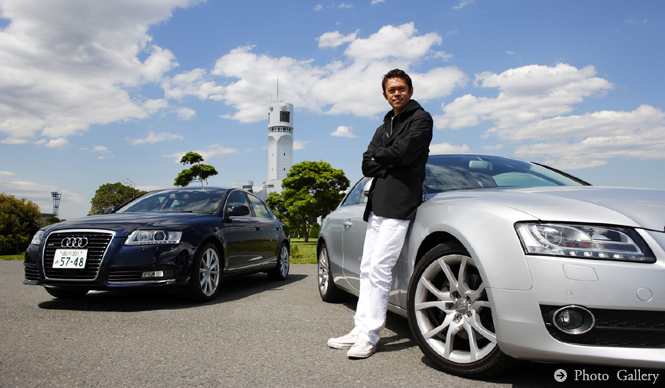
The Man Behind the A6, Q5, and A5
Since the 1990s, Audi has led automotive design with its overwhelming quality. Within the company's design studio works a Japanese designer. We spoke with Satoshi Wada, who has shaped three production cars in his 12 years with the company and is poised to lead Audi's design into the future.
Text by OPENERSPhotos by Masayuki Arakawa
Audi's Design Revolution, Beginning in the 1990s
1998—A car was born that sent shockwaves through the automotive design world. It was the Audi TT, named after the initial letters of the "Tourist Trophy" race held on the Isle of Man since the early 1900s. Its exceptionally simple and unique form, deviating from the context of past automotive design, evoked the philosophy of the German art and architecture school "Bauhaus," which gave rise to rationalist and functionalist modern design. Dubbed "the Bauhaus on wheels," it instantly captured the hearts of car enthusiasts worldwide.
And it was Audi's design center that created this remarkable form. It is no exaggeration to say that since the late 1990s, the company has led automotive design by introducing models with high design quality to the market, starting with the first-generation TT.
"I've been with Audi for 12 years, and fortunately, during that time, I've had the chance to design three production cars and two show models."
These are the words of Satoshi Wada, Senior Designer/Design Manager at the design center in Ingolstadt, southern Germany, where Audi is headquartered. After working as a designer for a certain domestic manufacturer, he transferred to Audi in 1998, the year the TT was released. Since then, as a senior designer, he has been responsible for the design of three flagship Audi production cars: the second-generation A6, the Q7, and the A5.
There's a reason he describes it as "fortunate." That's because for a design to be realized in a product, it must win internal competitions against fierce rivals.
"For each model, there were about 20 design proposals. And since there are competitions at each stage, becoming the winner is quite a miracle."
Wada says this with a smile, revealing a strong expression and evident confidence. This is backed by the market success of the models he has brought to the world. For example, the A6 surpassed 45,000 units sold in Germany in 2008, becoming the best-selling model in its segment. Incidentally, the A6 received a minor change in January of this year with slight design modifications, but the original form designed by Wada has been preserved.
"The A6 I designed was the first model to adopt the Singleframe grille, which has now become a symbol of Audi. Although it received a facelift from my colleagues this time, with all the original body panels I designed remaining, the front and rear designs have become more dynamic, further enhancing the 'sportiness' that is one of the spirit of the Audi brand."

The Car That Most Embodies Europe
Meanwhile, his latest work, the coupe model A5, has already achieved high popularity in Japan with its elegant styling.
"With the A5, I designed with the intention of inheriting the universal and classical beauty of Europe, going beyond the conventional concept of Audi design. In that sense, I am confident that the A5 is the most 'European' model among current European cars."
So, specifically, how did he express "Europe" in the A5?
"It's the atmosphere that car possesses. I wanted to preserve the beauty of European cars from the 1960s, a time when cars shone, with a modern interpretation. That's the sentiment I put into it. Specifically, it has a very low-profile, stable form, yet achieves a flowing silhouette. These are elements not found in previous Audi designs."
Wada explains that Audi has a philosophy of being an icon of Europe, a responsibility the brand must fulfill. "In that sense, Audi design needs to express Europe's heritage with a new interpretation, and I consider the A5 to be at the forefront of that effort."
The SUV Q7 and the coupe A5, created by Audi to offer unprecedented new value, and the A6, the main model that supports Audi's foundation. Wada has been instrumental in creating three epoch-making production models since joining Audi's design center. Last year, however, he was stationed at DDC (Design Center California), a satellite design studio of the Volkswagen Group, Audi's parent company. His design activities there had a significant impact on his stance as a designer moving forward. We will touch upon this in the second part.
SATOSHI WADA
Senior Designer / Audi Design Creative Manager, Audi AG. Born in Tokyo in 1961. After graduating from Musashino Art University, he joined Nissan Motor Co., Ltd. in 1983. From 1989 to 1991, he studied at the Royal College of Art in the UK. In 1998, he transferred to Audi AG / Audi Design as a Senior Designer. In 2001, he was responsible for the Audi "Avantissimo" show car at the IAA Frankfurt. In 2003, he was responsible for the Audi "Pikes Peak Quattro" show car at the Detroit Auto Show. In 2004, he became Senior Designer and Creative Manager. He was responsible for the new A6 in 2004, the Q7 in 2005, and the A5 in 2007. His lifelong hobby is surfing, and he is a passionate surfer who loves the sea and waves.