Human Instinct and the 'i3' – An Architect's Perspective, Kimihiko Okada | BMW
BMW i3 | BMW i3
Human Instinct and the "i3"
An Architect's Perspective: Kimihiko Okada
What Remains Unchanged, What Should Be Changed──Kimihiko Okada is one of Japan's leading architects, known for creating buildings and designs that endure and are loved over time, while still responding to the changes of the era. In today's world, environmental concerns are paramount. This is also true for the automotive industry. The "i3," newly launched by BMW this year, is not only its first electric vehicle in its 100-year history but also a bold new challenge. What constitutes a comfortable living space, and what provides the joy of driving? Perhaps the answers to both lie within human instinct.
Text by OGAWA Fumio
Ecology in the Narrow and Broad Sense
Architect Kimihiko Okada is a master at creating homes that feel wonderfully livable. In all his works, including the Toda Residence in Hiroshima, he consistently considers how each building interacts with its larger environment—the sun's movement, topography, wind direction, and more. Recently, Okada has been focusing on BMW i.
──What aspects of BMW i have captured your interest?
"I feel that cars are entering a new era. Environmental considerations are increasingly important, and fuel efficiency regulations in various countries are becoming stricter. In this context, BMW's serious commitment to environmental initiatives is almost inevitable. We often talk about 'ecology,' but I believe the crucial point is how broadly we define 'environment.'"
"For example, when arranging solar panels on the ocean for power generation, shouldn't we also consider the marine life whose sunlight would be blocked? Going forward, we need to think about sharing natural energy among all living things. I feel that the BMW i can be integrated into such a cycle."
──So, it's important to have a broad perspective when choosing a car?
"In our work, we are always conscious of sustainability. However, human activities are complex, and societal conditions and policies are determined by the interplay of numerous factors, making it difficult to foresee the future clearly. Yet, once a building is constructed, it's hard to change, so we design with as many considerations as possible. I believe the same applies to cars."
BMW i Customer Interaction Center (Open daily, 9:00 - 20:00)
 0120-201-438
bmw-i.jp
BMW i3 | BMW i3
Human Instinct and the i3
An Architect's Perspective: Kimihiko Okada (Part 2)
Satisfying Human Instinct
Kimihiko Okada states that what he considers in his work is, surprisingly, human instinct. He offers an intriguing perspective: the enduring nature of human instinct influences the homes we live in and the cars we drive.
──The buildings you design, Mr. Okada, feel very livable and appealing. They evoke an intuitive sense of "I'd love a room like this!" rather than relying on intellectual reasoning.
"I believe there are certain 'comfortable places,' 'gathering spots,' and 'uplifting designs' that resonate with people universally, regardless of nationality, age, or whether they are children or adults. Whether this is an innate human sense or something hardwired into our genes, I value these inherent sensibilities. Perhaps what most people unconsciously seek in a home is its role as a shelter, protecting them from danger. Society changes rapidly, but as biological beings, humans cannot evolve instantly. While it may seem obvious, many things are forgotten. Considering these fundamental aspects is crucial when creating a truly comfortable living space."
"I believe what most people unconsciously seek in a home is its role as a shelter, protecting them from danger. Society changes rapidly, but as biological beings, humans cannot evolve instantly. While it may seem obvious, many things are forgotten. Considering these fundamental aspects is crucial when creating a truly comfortable living space."
──The theme of "instinct" also seems to come up frequently when discussing cars.
"All young boys love cars, don't they? Many children are drawn to certain things without being taught, suggesting that instinctual desires are involved. Humans only began settling in one place about 10,000 years ago, which is a very short period for biological evolution. Before that, we lived by hunting and moving. Perhaps humans still retain an 'instinct for movement.' From this, the desire to move faster, to possess superhuman abilities... It's based on these further desires that automotive technology has evolved. Shifting course significantly from this would be quite challenging, I imagine."
──And yet, circumstances are emerging that necessitate such a shift...
"Indeed. The i3, which naturally allows for enjoyable driving while fulfilling these instinctual human demands, possesses the potential to be accepted by many as a new generation of car. Following this, the plug-in hybrid sports car, the 'i8,' will also be released, won't it? It's good that even eco-cars don't force you to compromise."
BMW i Customer Interaction Center (Open daily, 9:00 - 20:00)
0120-201-438bmw-i.jp
BMW i3 | BMW i3
Human Instinct and the i3
An Architect's Perspective: Kimihiko Okada (Part 3)
A Sense of a New Kind of Vehicle
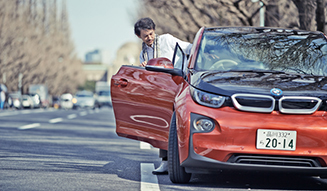
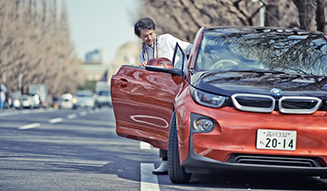
Okada first experienced the i3 in Tokyo's Aoyama district. His immediate impression was, "It's a car with character." He operated the key, opened the door, and settled into the driver's seat.
──What were your initial impressions?
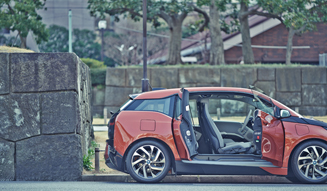
"It's much cuter than I expected from the photos. One aspect is the design of the front, including the headlights. Another is the overall compact proportion. Meanwhile, the styling around the rear quarter windows, called 'Streamflow,' creates a sense of dynamism. In a word, it's 'coolly cute' (laughs). The 'cute' aspect reminds me of a hunting animal. As an architect, I find the design where the carbon fiber reinforced plastic used for the cabin is exposed at the lower part of the door particularly interesting. It's a fresh approach to reflect the internal structure on the exterior."
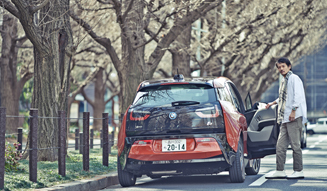
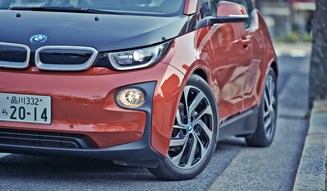
──This i3 is based on the "LifeDrive" concept. The chassis housing the electric motor and battery is called the Drive Module and is made of aluminum. The cabin where passengers sit is the Life Module, made of carbon. It's manufactured in a factory powered entirely by hydroelectricity. So, what are your impressions of the interior?
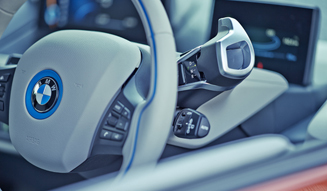
"I understand it uses natural materials like kenaf and recycled plastics. The design that leverages the texture of these materials is very intriguing. For a long time in architecture, surfaces were heavily coated for ease of maintenance, even with wood, but that's started to change recently. I believe people find comfort in the natural variations and imperfections of materials, even if they get a little worn over time. I felt a similar assertion from the i3. It has a visual character and a tactile quality."
──And how was it to drive?
"It's incredibly quiet when you start it up, almost like a computer. And when you press the accelerator, it moves off so smoothly. This flowing sensation is completely different from a gasoline car. Furthermore, I was impressed by its agility, more so than the hybrid cars I've experienced. It's smooth, quiet, the interior is innovative... the feeling of it being a new kind of vehicle is very refreshing."
"Also, the setting where the regenerative braking engages strongly when you ease off the accelerator pedal, providing significant deceleration, felt akin to human walking, which I found appealing."
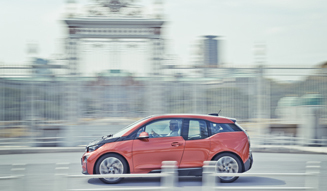
"Earlier, I mentioned that the challenge for future automotive evolution will be how to engage with human instinct. I believe the i3 naturally responds to these demands while skillfully managing human senses, avoiding any sense of dissonance. It feels like the future of cars has begun."

OKADA Kimihiko | Kimihiko Okada
Architect. Representative of Kimihiko Okada Architects. Born in Yokohama, Kanagawa Prefecture, in 1971. Graduated from the School of Science and Engineering at Meiji University with a degree in architecture. Began his career in 1997 at Ryue Nishizawa Architects. In 2005, he established Kimihiko Okada Architects in Meguro, Tokyo. He currently serves as a part-time lecturer at various universities, including Tokyo University of Technology.
BMW i Customer Interaction Center (Open daily, 9:00 - 20:00)
0120-201-438bmw-i.jp

BMW i3 | BMW i3 (with Range Extender)
Body Dimensions | Length 4,010 x Width 1,775 x Height 1,550 mm
Wheelbase | 2,570 mm
Tread (Front/Rear) | 1,575 mm / 1,560 mm
Minimum Ground Clearance | 110 mm
Weight | 1,260 kg
Drive Battery | 1 Lithium-ion battery (96 cells)
Maximum Output | 125 kW (170 ps) / 5,200 rpm
Maximum Torque | 250 Nm (25.5 kg) / 100-4,800 rpm
Drivetrain | RR
Suspension (Front/Rear) | Strut / Multi-link
Brakes (Front/Rear) | Ventilated discs
Tires (Front/Rear) | 155/70R19
0-100 km/h Acceleration | 7.2 seconds
Minimum Turning Radius | 4.6 meters
Trunk Capacity | 260-1,100 liters
Maximum Speed | 150 km/h
Driving Range per Charge (JC08) | 229 km
Price | 4.99 million yen
BMW i3 | BMW i3 (with Range Extender)
Body Dimensions | Length 4,010 x Width 1,775 x Height 1,550 mm
Wheelbase | 2,570 mm
Tread (Front/Rear) | 1,575 mm / 1,540 mm
Minimum Ground Clearance | 110 mm
Weight | 1,390 kg
Drive Battery | 1 Lithium-ion battery (96 cells)
Maximum Output (Electric Motor) | 125 kW (170 ps) / 5,200 rpm
Maximum Torque (Electric Motor) | 250 Nm (25.5 kg) / 100-4,800 rpm
Generator Engine | 2-cylinder inline DOHC 4-valve
Maximum Output (Generator Engine) | 28 kW (38 ps) / 5,000 rpm
Maximum Torque (Generator Engine) | 56 Nm (5.7 kg) / 4,500 rpm
Drivetrain | RR
Suspension (Front/Rear) | Strut / Multi-link
Brakes (Front/Rear) | Ventilated discs
Tires (Front/Rear) | 155/70R19 / 175/60R19
0-100 km/h Acceleration | 7.9 seconds
Minimum Turning Radius | 4.6 meters
Trunk Capacity | 260-1,100 liters
Maximum Speed | 150 km/h
Hybrid Fuel Economy (JC08) | 27.4 km/ℓ
Driving Range using Charging Power | 196.1 km
Price | 5.46 million yen